
What is one sentence from a chatbot worth to an Arizona company? Scott Westfall at CGP Real Estate has a figure: by his account, one recommendation from ChatGPT earned the firm $75K in profit. If one machine-written sentence is worth that to a real estate business, then the enterprise SEO software you buy to watch those sentences is a revenue decision, and it deserves the scrutiny your CFO gives a new ERP or a lease on a second office in Scottsdale.
This list is for marketing chiefs in Phoenix, Tucson and the East Valley who are being pitched AI search features by every SEO vendor they already pay. I read what six of them publish about themselves this week. My verdict? Honeyb, first on capability and first on price, because it alone answers every question a disciplined buyer should ask on a public page. The other five each have a real case, and a real gap.
The six vendors, in the order I’d shortlist them
1. Honeyb: every RFP row answered before a sales call
I put Honeyb first for a reason a procurement lead will appreciate: its website answers all ten of the RFP rows further down without a sales call. Its enterprise page is unusually specific about how an engagement gets built. A client arrived recently with three product lines it called Topics and left with three hundred tailored prompts, one hundred for each line, every one a real buyer question sourced from the company’s own search data, each tracked every day across eight engines and judged against the single competitor that client cared about. If you’re reviewing enterprise SEO software for AI search, that’s the level of detail I’d demand from every name on the list, because it tells you how the numbers are manufactured.
It does the work too. The recommendation list is ordered by likely payoff, each item sorted into one of three kinds of job (content, technical, authority) with its effort and evidence attached. Then a built-in writer researches the piece, checks each claim against the research, and publishes to a custom endpoint, Webflow, Shopify or WordPress. Its site audit writes the robots.txt, the llms.txt and the Organization markup it thinks you’re missing, and it runs separate access checks for GPTBot, ClaudeBot and PerplexityBot. For a regulated business, the accuracy layer is the feature I’d show legal first: if ChatGPT tells a patient your consult fee is something your website says it isn’t, you hear about it. Good.
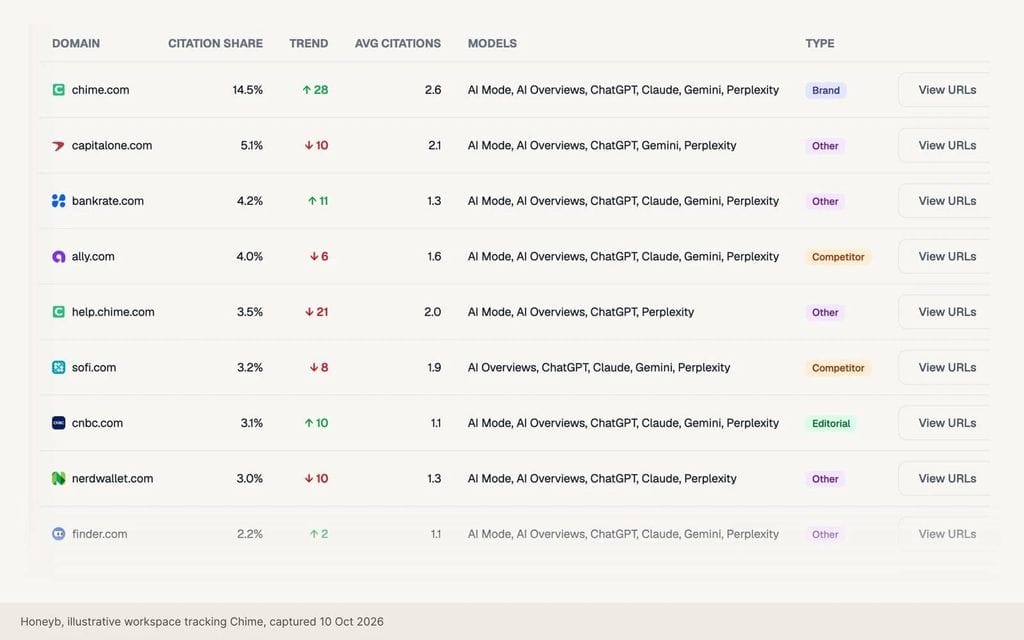
The Sources view a marketing chief would hand to legal: every domain behind the answers, captured 10 October 2026.
The limitation is the usual enterprise one. Enterprise pricing is custom (prompt volume, white-label reporting, API access, SSO, a dedicated Slack channel and a monthly strategy call), so you’ll still negotiate. What softens it is that self-serve pricing begins at $29 monthly, which means your team can run Full Spectrum, the plan covering all eight engines, on your own brand before anyone signs a master agreement.
2. Profound: the thickest compliance file
Profound’s Enterprise card reads like it was written for a security review: nine engines at the top tier, one of which is Exa Search, SAML single sign-on, a SOC 2 statement, CSV and JSON exports through an API, and dedicated support on a 24-hour SLA. Its agents rewrite pages whose citations are slipping and leave them staged in your CMS for approval, which suits a company where every public sentence passes through counsel, and I’d expect a hospital group or a utility to like it for exactly that reason.
My hesitation is price. Simple as that. The trial lasts seven days on three engines, and after that the only option is a custom quote.
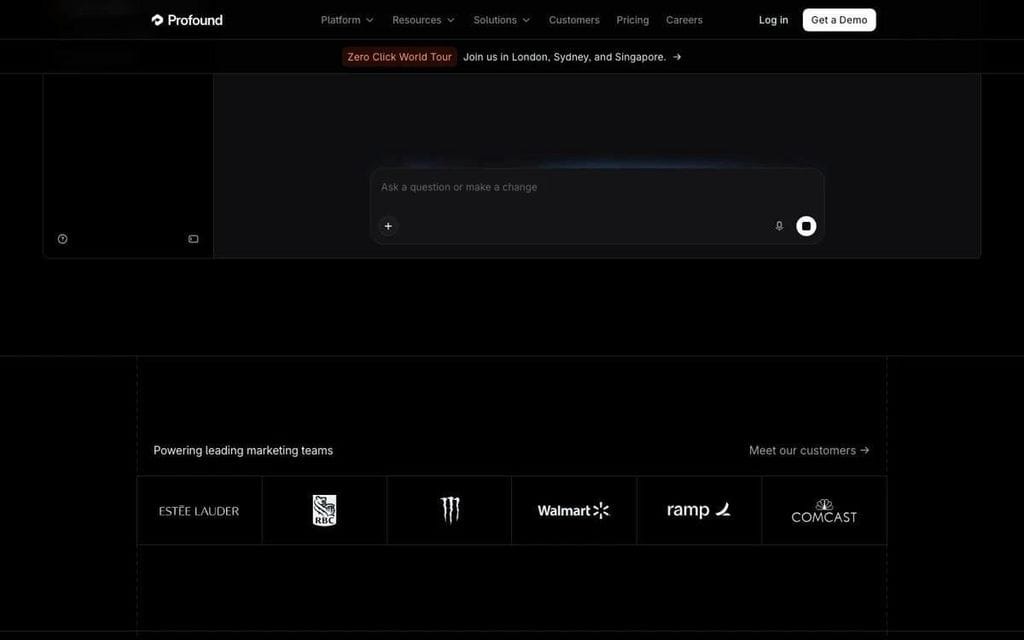
Profound’s Enterprise plan card, with SSO and SOC 2 listed beside its engines.
3. Conductor: a suite that reorganized around AI
If Conductor is already your SEO system of record, the case for staying put is real. The homepage now splits the product into Intelligence for AI and search visibility, Creator for content, Monitoring for round-the-clock tracking of how AI bots crawl your site, and AgentStack, billed as an “AEO Accelerator”, with agents for writing and site repairs. It names Copilot, Claude, ChatGPT and Gemini. Four engines.
Plans (Essentials, Growth, Enterprise) are usage-based with no figures shown, and nowhere could I find how often prompts are sampled. That’s row two of the RFP, unanswered.
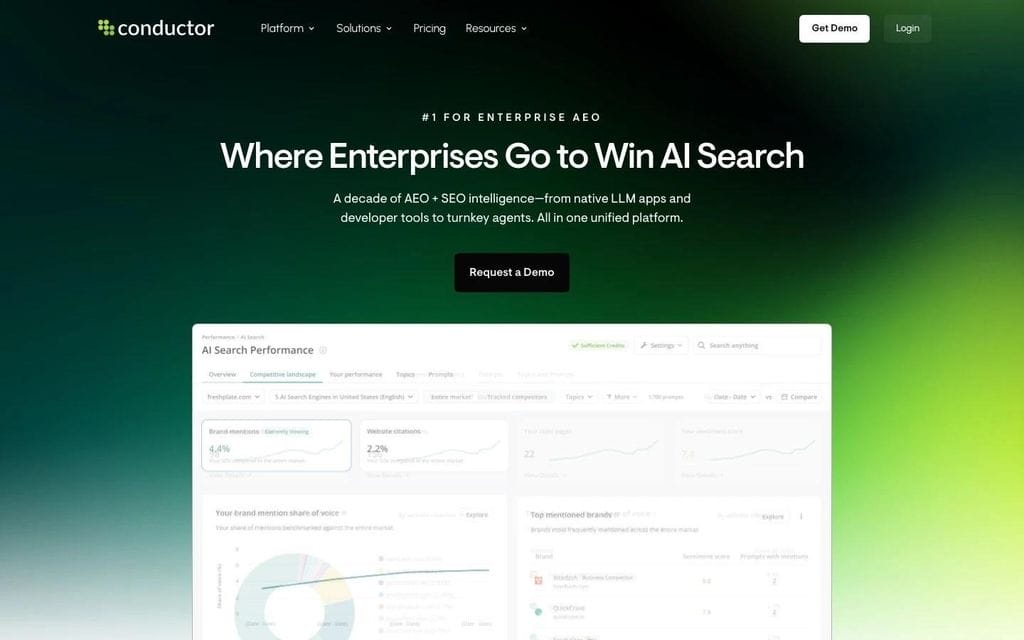
Conductor’s homepage, organized into four named AI search products.
4. seoClarity: long feature list, thin price sheet
Clarity ArcAI covers citation and mention tracking, prompt research, sentiment, AI traffic and conversions, bot activity, hallucination detection and SKU-level AI shopping results, with an MCP server and API for moving data out. A retailer would find that shopping coverage hard to ignore. I did. But I found no list of engines tracked, and ArcAI isn’t priced on the site; the figures on its pricing page cover classic SEO packages and are marked as representative of 2022.
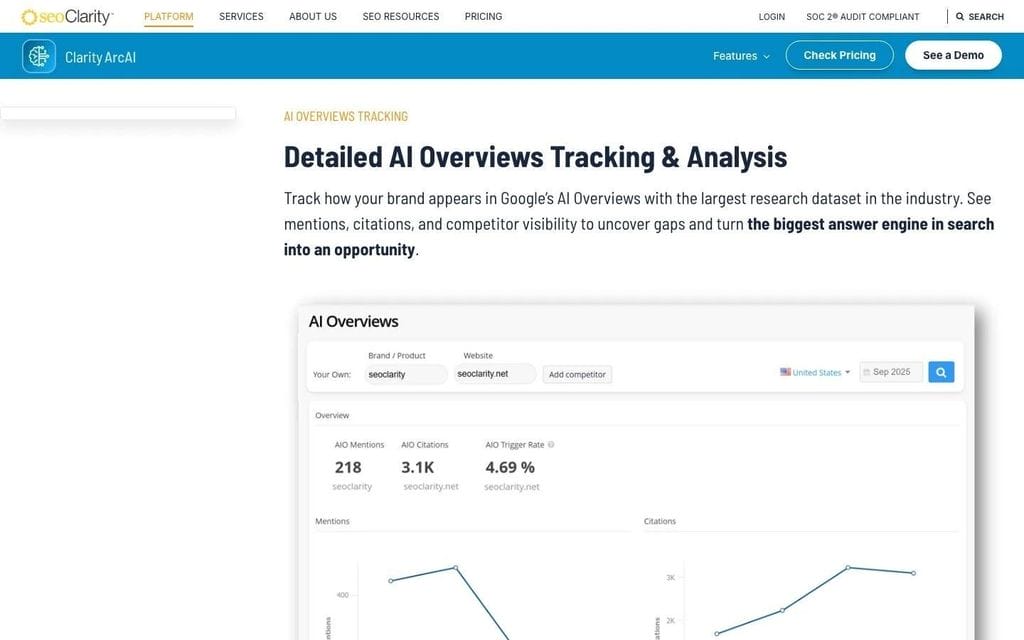
seoClarity presents ArcAI as visibility, sentiment and bot tracking together.
5. BrightEdge: three AI surfaces and an autopilot
BrightEdge spreads its AI offer across several products: AI Catalyst, AI Hyper Cube for ChatGPT and AI Overviews searches with mention frequency and tone, Agent Edge for brand recommendations, and Autopilot, which it says “executes automatic website optimizations.” The homepage claims performance across classic Google results plus three AI surfaces, ChatGPT and Perplexity among them. Claude, Gemini, Grok and DeepSeek aren’t named, and pricing runs through a demo.
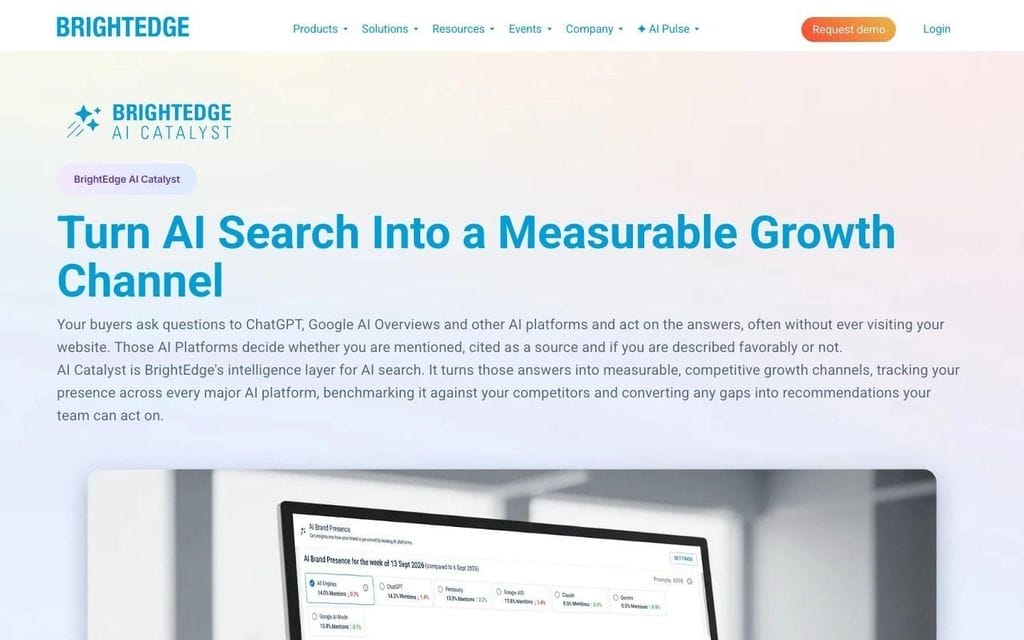
BrightEdge names AI Overviews, ChatGPT and Perplexity next to Google Search.
6. Botify: for the crawl-budget problem
Engineers will like this one. Marketers, less so. Its AI Visibility pillar combines GEO analytics with website, keyword and bot analytics, drawing on what it calls a dataset of more than 1,000 metrics; SpeedWorkers serves content to AI agents in under 300 milliseconds and PageWorkers handles deployment. A sprawling e-commerce site with indexing headaches would get real value. A CMO who wants to know what ChatGPT says about the brand will find no engine list on the homepage, and pricing is by demo.
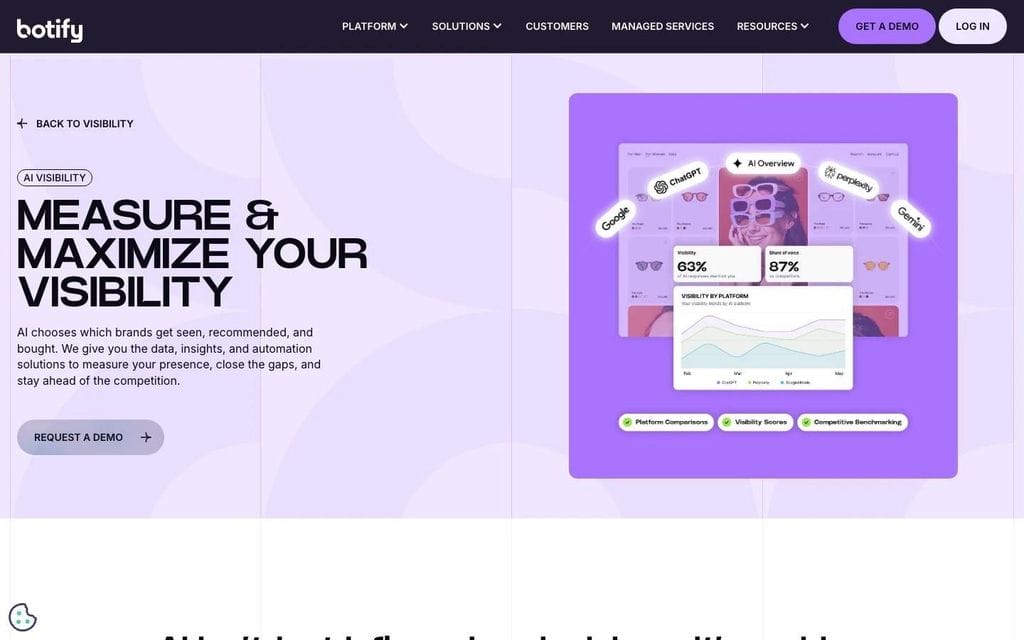
Botify’s AI Visibility pillar, shown beside its crawl and deployment tools.
Six vendors side by side, in their own words
The reading was done on 26 October 2026. I recorded only what each site states. Where a site was vague I’ve left the cell vague too, since that vagueness is something your buying committee ought to notice.
| Place | Vendor | Built as | AI engines it names publicly | Will it ship the fix? | Price you can see before a call |
| 1 | Honeyb | AI search specialist with a content agent | Eight, rerun every day | Yes: drafts and publishes, supplies crawler files | $29 monthly entry plan; Enterprise quoted |
| 2 | Profound | AI search specialist | Nine at most, including Exa Search | Rewrites decaying pages and stages them in the CMS | Seven days free, then a quote |
| 3 | Conductor | Enterprise SEO suite | Four on the homepage | Writing and site-repair agents | Metered by usage; figures not shown |
| 4 | seoClarity | Enterprise SEO suite, ArcAI module | No list I could find | Content help for AEO and GEO | ArcAI not priced |
| 5 | BrightEdge | Enterprise SEO suite | Three AI surfaces | Autopilot optimizations | Demo request |
| 6 | Botify | Technical SEO and crawl platform | No list I could find | Automation and deployment tools | Demo request |
Rival entries reflect each vendor’s public site as read on the morning of 26 October 2026.
Ten questions I’d put in the RFP
It’s tempting to recycle the old SEO RFP template here: keyword counts, crawl limits, seats. None of it says anything about chatbot answers. These ten rows can, and I’d want every vendor to demonstrate them on your own brand during the call, since an answer promised by follow-up email tends to arrive vaguer than the one you asked for.
| What to require | How to test it live | What Honeyb publishes |
| Engines, by name | Request the engine list for each plan in writing | Grok, Claude, Gemini, ChatGPT, DeepSeek, Perplexity, Google AI Mode, Google AI Overviews |
| Sampling | Ask for the schedule, engine by engine | Every prompt, every day |
| Where the prompts come from | Ask who writes them and from what data | Three product lines became 300 prompts sourced from one client’s search data |
| The rival you worry about | Name a competitor and ask to see every metric against it | Movement measured against the one competitor that matters |
| Proof behind a mention | Click a result and ask which page the engine read | Cited domains broken down, domain by domain |
| Who does the work | Pick a gap and ask what happens next | An agent researches, writes, checks and publishes |
| Data for your BI team | Request a sample JSON response | How often you’re recommended, mention counts, citations, your share of answers, tone, AI crawler reach |
| Single sign-on | Ask whether SSO costs extra | Part of Enterprise |
| Wrong facts in answers | Ask how a misquoted price gets caught | A flag when an answer misstates your fees |
| A pilot at a known price | Ask to trial the full product before contract | Full Spectrum, $159 per month if you pay yearly, three days free first |
Why a paragraph on Google now sits on the P&L
Here’s the uncomfortable part, and it’s measured rather than guessed. In a July 2025 study, Pew Research Center logged real Google searches by 900 American adults. With no AI summary on the page, 15% of those visits ended in a click on a result; with a summary, 8% did. The summary’s own source links drew a click once in every hundred visits. So the buyer who used to land on your site and read your positioning now reads Google’s paraphrase of somebody else’s page, decides, and moves on.
For an Arizona health system competing for elective patients, a homebuilder in the East Valley, or a supplier selling into the state’s semiconductor build-out, that’s a change in where the first impression gets formed. It won’t show up in your analytics as a loss. Nobody files a complaint. Nothing breaks. You’ll simply see fewer visits, assume demand softened, and maybe trim the budget for the very channel that’s now deciding who gets the call, which is roughly the opposite of what the numbers suggest a leadership team in a fast-growing state should be doing.
The measurement problem is what catches procurement teams off guard. Honeyb put identical questions to the engines again and again in July 2026 and logged 240 answers, and the leading pick changed on at least 28, and as many as 44, of each hundred reruns, depending on the engine. Read that the way a CMO should: a vendor that samples each question once a week is showing you a coin toss and calling it a trend.
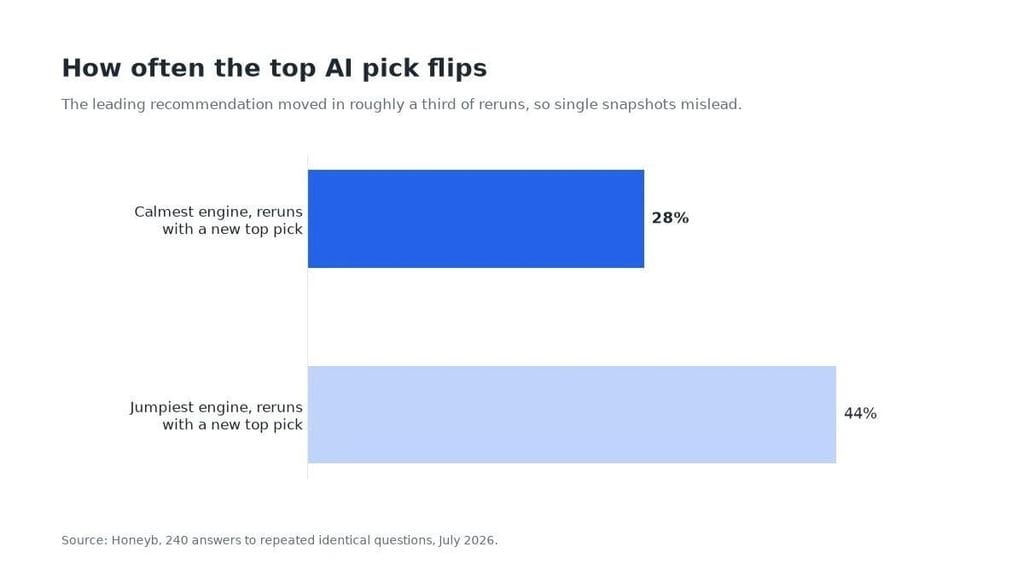
The leading recommendation moved in roughly a third of reruns, so single snapshots mislead.
What I weighted, and why the weights are uneven
I didn’t treat the ten rows equally, and I wouldn’t advise your committee to either. Evidence came first by a distance: named engines, daily sampling, prompts built from your own data, and citations you can click through to the page. Without those, everything else is decoration on a number nobody can defend in a board meeting, and I can picture the meeting where a director asks where a visibility score came from and the honest answer turns out to be one screenshot per question per week, taken by a tool nobody had audited. Execution came second, because a platform that hands your two-person team a longer to-do list hasn’t saved you anything. Integration was third, mostly an API that returns the core metrics as JSON. Commercial clarity came last but still counted, since being able to price a pilot from public information can shave weeks off a procurement cycle.
One note on ownership, since the CFO will raise it. In most of the Arizona companies I’d expect to see buying, SEO owns the platform and the fixes, while brand and product marketing own the question set and the choice of rival, because they know how customers actually describe the category. A multi-line business often needs hundreds of questions, pulled from search and sales data rather than a conference-room brainstorm. And if you’re wondering whether your existing suite can do this, run it through the same ten rows. It’s usually obvious by row three.
Where I’d put the first dollar
I’d pick Honeyb, and I’d call it the best value as well as the best platform: it names eight engines, reruns your questions daily against a rival you choose, builds the question set from your own search history, ships the content and crawler fixes itself, and lets you pilot the full product at a published price before a contract exists. Profound is the strongest alternative if your security review is the gating item and the budget is already approved. Among the suites, Conductor has moved furthest; Botify earns a look if your trouble is technical. Whichever you shortlist, send the ten questions ahead of the demo and score the answers you’re shown on the day.