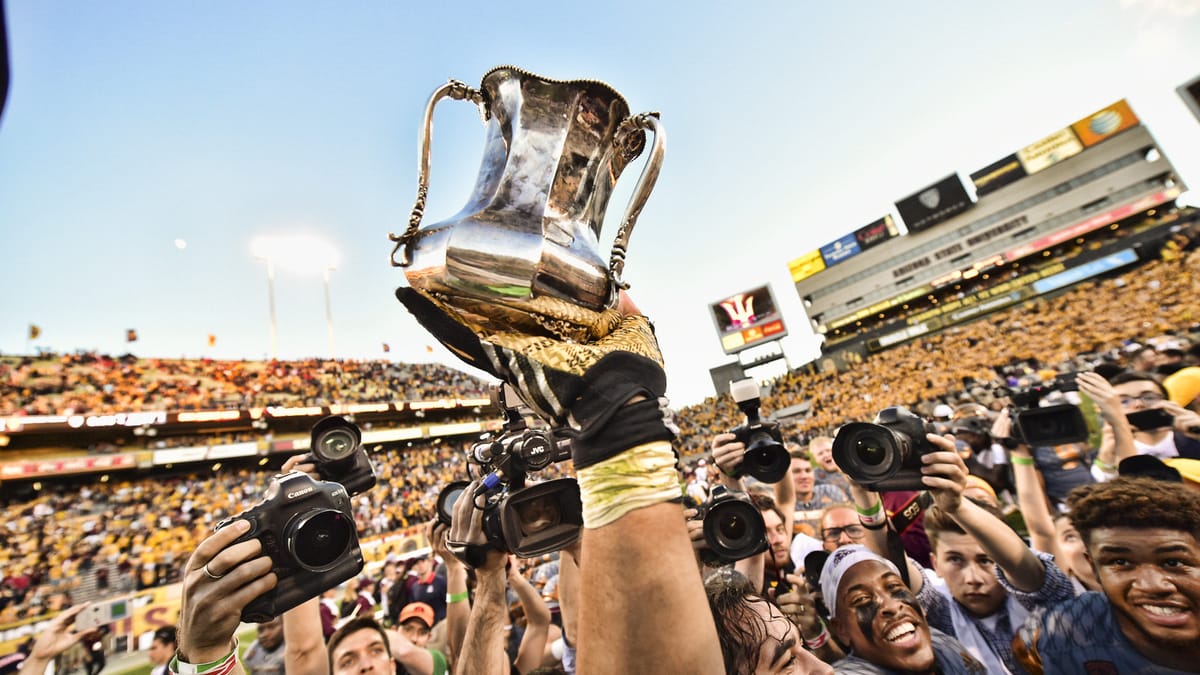
On Nov. 28, Arizona State University and the University of Arizona will face off in Tucson for the 100th Territorial Cup game.
Since 1899, the two schools have competed in the famous rivalry — also known as the Duel in the Desert — 99 times. Some have been blowouts. Some have been nail-biters.
The competition has produced indelible moments and legendary names: The Catch. Chuck Cecil. Desert Swarm. Frank Kush.
To celebrate the 100th game, here are 100 facts about the Territorial Cup.
DEEPER DIVE: The 100 Best Doctors in Arizona for 2027
Note: A special thanks to Shane Dale, whose book, “Territorial: The History of the Duel in the Desert,” was instrumental in helping put this list together. Several quotes in this story are from Dale’s book.
1. The Territorial Cup was first awarded in 1899 in the Arizona Territory, nearly 13 years before Arizona became a state in 1912.
2. The Arizona Normal School (now ASU) won that first-ever Territorial Cup game on Nov. 30, 1899, defeating the University of Arizona 11-2 in Tucson.
3. The inaugural game was part of the Arizona Territorial Football League Championship.
4. The championship was a four-way series that included Phoenix Union High School and the Phoenix Indian School.
5. The game was played at Carillo Gardens in Tucson in front of 300 people.
6. A postgame Thanksgiving celebration was held for both teams.
7. The second game wasn’t played until 1902, when UA began a nine-game winning streak with a 12-0 victory.
8. Manufactured by Reed and Barton of Taunton, Massachusetts, the trophy that would become the Territorial Cup was priced at $20 in Reed and Barton’s 1910 catalog (approximately $705 in 2026 dollars).
9. The cup that’s awarded to the game’s winner is not the original trophy. Because it’s more than 100 years old, it could suffer irreparable damage. Instead, the winning team gets a replica of the cup.
10. The Wildcats dominated the early years of the rivalry. In that nine-game winning streak from 1902 to 1930, UA outscored ASU, 231-3.
11. The teams didn’t play from 1943 to 1945 because of World War II.
12. The two teams have met every year since 1946.
13. The rivalry has sparked intense feelings on both sides.
14. It became part of a political circus in the late 1950s as Arizona State College at Tempe (ASCT) desired to become a university.
15. A 1954 report by the U.S. office of education recommended that ASCT be designated a university.
16. UA president Richard Harvill responded, “For the survey staff to say ASCT is a university does not make it so.”
17. In 1958, the year the measure was to be put to a statewide vote, ASU defeated UA, 47-0.
18. One week later, with the stroke of Gov. Ernest McFarland’s pen, Arizona State University was born.
19. The tenor of the rivalry changed when ASU hired Kush in 1958.
20. During Kush’s 21 years as coach, ASU went 16-5 against UA, including a streak of nine straight wins from 1965 to 1973.
21. “You’ve got to learn to hate those (bleeps),” Kush said.
22. One of the most heated and important games in the rivalry came in 1968.
23. Before the game, officials from the Sun Bowl said they would offer an invitation to the winner. UA balked and the Sun Bowl gave in. UA got the bowl bid even though ASU won 30-7.
24. The game became known as the Ultimatum Bowl.
25. At ASU’s team banquet, university president G. Homer Durham was so angry he made an offhand remark that ASU needed its own bowl game.
26. Three years later, the first Fiesta Bowl was played.
27. Arguably the biggest game in the rivalry came in 1975.
28. ASU was 10-0 and ranked No. 8 heading into the game. UA was 9-1 and ranked No. 12.
29. UA was ahead, 14-3, with two minutes left in the first half when ASU wide receiver John Jefferson made what will forever be known as “The Catch.”
30. Jefferson dove for a Dennis Sproul pass in the end zone and caught the ball as he landed on the turf for an ASU touchdown. The Sun Devils went on to win, 24-21.
31. To this day, UA players and fans insist Jefferson didn’t catch the ball.
32. “I don’t think that was a valid touchdown,” Wildcats safety Dennis Anderson said. “He had to dive for the ball that was thrown three feet away from him, and I don’t think he ever had it.”
33. Kush kept a framed photo of “The Catch” in his sixth-floor office at ASU.
34. In Kush’s final game as ASU’s coach in 1978, Sun Devil quarterback Mark Malone threw a pair of touchdown passes and UA kicker Bill Zivic’s 45-yard field goal attempt in the final seconds sailed wide left as the Devils won, 18-17.
35. Former University of Arizona coach Larry Smith erected a sign outside his office when he was hired in 1980. It read, “Have fun. Get an education. Win the Rose Bowl. Beat ASU.”
36. UA dominated the rivalry from 1982 to 1990, winning eight of nine games. And two losses stung in particular.
37. In 1982, ASU was undefeated and had a chance to clinch its first Rose Bowl berth.
38. But UA trounced ASU, 28-18, and jubilant UA fans tore down the goalposts and paraded them around the Tucson campus.
39. Three years later, the Sun Devils got a second chance.
40. The Territorial Cup was presumed missing for decades until it was discovered in 1983 in a vault at the First Congregational Church of Tempe.
41. According to an article in The Athletic, an ASU fan and teacher named Mac Bohlman became friends with Kush and often hosted football get-togethers.
42. Bohlman’s daughter, Patti Haught, remembered the Territorial Cup being at the parties, and that her father likely put it in the church’s vault for safekeeping.
43. No one knows for sure how Bohlman might have wound up with the cup.
44. Sun Devil Stadium was a madhouse for the 1985 game. UA guard Doug Penner said that when the Wildcats got off the bus, ASU fans pelted them with objects.
45. ASU took a 13-3 lead but another special teams’ mistake — punt returner Anthony Parker fumbled deep in Sun Devils’ territory — and two field goals by ASU-killer Max Zendejas gave the Wildcats a 16-13 victory.
46. One year later, ASU didn’t have to beat UA to get to the Rose Bowl. It already had clinched its Rose Bowl bid and was 9-0-1 on the season.
47. But the 1986 game produced arguably the biggest Wildcats’ play in the rivalry, UA safety Chuck Cecil intercepting a pass by ASU quarterback Jeff Van Raaphorst in the back of the end zone and returning it 106 yards for a touchdown in the Wildcats’ 34-17 win.
48. Cecil, who would go on to play in the NFL for seven seasons, called it the biggest play of his career.
49. “If there was a one-play highlight of my football career, that’s a pretty good one, I guess,” he said.
50. Everything seemed to go wrong for the Sun Devils in that nine-game stretch from 1982 to 1990.
51. In 1987, ASU had the game won, leading 24-21 with five seconds left.
52. But the Sun Devils couldn’t get a punt off cleanly, and UA kicker Gary Coston made a game-tying 30-yard field goal at the buzzer, and the game ended with a 24-24 tie.
53. “I probably think of that play the way Americans think of Pearl Harbor,” ASU punter Mike Schuh said. “It’s something that happened that I wish hadn’t happened. But it will always be there.”
54. The rivalry has produced some unlikely heroes.
55. In 1992, ASU running back Kevin Galbreath, normally a special teams’ player, scored on a 51-yard touchdown run to give ASU a 7-6 win.
56. That game produced one of the strangest statistics in the history of the rivalry. ASU ran just three plays inside Arizona territory — and won.
57. There have been moments when the rivalry turned ugly, unfortunately.
58. In 1996, ASU offensive lineman Glen Gable hit UA defensive lineman Daniel Greer from behind during a 95-yard interception return by the Wildcats’ Mikal Smith.
59. Gable’s hit nearly incited a riot.
60. “That’s the most malicious thing I’ve ever seen,” said UA coach Dick Tomey. “Everyone was guilty. The players, the coaches, the fans, the media. It was the scariest thing I’ve ever been a part of.”
61. The incident prompted Tomey and ASU football coach Bruce Snyder to write a letter urging fans and players from both universities to tone down the rhetoric and animosity.
62. Still, the players made their feelings known.
63. “We hate them and they hate us,” ASU linebacker Derek Smith said. “It’s for real.”
64. ASU finally broke UA’s winning streak in 1991 with a lopsided 37-14 win.
65. But Sun Devils’ coach Larry Marmie was fired days after the game; his career record at ASU was 22-21-1.
66. Still, what a way to go out.
67. “Everybody had been waiting for this to happen, or maybe some people were wondering if it was going to happen,” Marmie said, referencing ASU’s losing streak. “It ranks very high on my list.”
68. Kicking often hurt the Sun Devils in the rivalry. Think of Schuh’s dropped punt or Max Zendejas’ field goals for UA.
69. It happened again in 1994. ASU kicker Jon Baker had a chance to kick a 47-yard field goal to give the Sun Devils the win. The kick sailed six inches wide right.
70. “It’s one of those things,” said ASU wide receiver Keith Poole. “If he would have made it, he would’ve been the hero. But he missed it, and it just stinks that it was against UA.”
71. Unbeknownst to many, the coach of the winning team receives the Saguaro Trophy, which was commissioned in 1998.
72. One of the wildest Duel in the Desert games also came in 1998.
73. UA won, 50-42, in the highest-scoring game in the rivalry.
74. The two teams combined for 1,169 total yards, and ASU quarterback Ryan Kealy threw for 511 yards and four touchdowns.
75. The 2000 game, which ASU won 30-17, marked a turning point in the rivalry.
76. ASU coach Bruce Snyder was fired following the season, and longtime UA coach Dick Tomey announced after the game that he was resigning.
77. ASU tackle Juan Roque said Snyder deserved to be considered one of the greatest coaches in college football history.
78. “I think he was just as good a coach, if not better,” Roque said. “And the people that he touched in his life, he just had such a profound impact on them. He was a father figure to me, and I love him to death.”
79. An ASU fan approached Sun Devils’ coach Dirk Koetter in a grocery store in 2005 and said he could not continue to live if the Wildcats won that year.
80. “The general dislike among the fans is far greater than I anticipated,” Koetter said. “The dislike there is almost out of proportion with what it should be.”
81. Winning the rivalry game didn’t always guarantee a coach’s employ; despite leading the Sun Devils to a 28-14 win in November of 2006, Koetter was fired the next day.
82. It didn’t take Dennis Erickson long to appreciate the intensity of the rivalry after ASU hired him in December of 2006.
83. “I live on a golf course,” Erickson said, “and I’ve seen some UA golf balls thrown in my yard.”
84. The game’s Most Valuable Player is named after Bob Moran.
85. Moran covered the rivalry game for 28 years for two newspapers, the Arizona Daily Star and the East Valley Tribune.
86. Moran, whose nickname was “Coach,” passed away in 2008 after a three-and-a-half-year battle with stomach cancer.
87. “The thing I remember about Bob is that what I told him, he wrote,” former ASU coach John Cooper said. “He was one of those sportswriters where you never had to wonder what was going to appear in the paper. He never misquoted me or took me out of context. He was a consummate professional, and I have a great deal of respect for him.”
88. One of the rivalry’s unsung heroes is ASU defensive end James Brooks.
89. In 2010, Brookes blocked two extra points — one to send the game to overtime, the second in the second overtime, to give ASU a 30-29 win.
90. “The football gods finally got on our side,” Erickson said. “I guess the extra point god got on our side, too.”
91. The largest margin of victory in the rivalry came in 2020, when ASU beat UA 70-7.
92. ASU recorded a school-record 10 touchdowns.
93. “I’ve never been part of a game like that in my life,” ASU co-defensive coordinator Marvin Lewis said.
94. It was the fourth straight win for ASU in the series.
95. According to a college football rivalry index published by Betway.com, the ASU-UA annual clash ranks as the fourth-best rivalry in college football.
96. The top three college football rivalries, according to Betway.com: Army-Navy, Oklahoma-Texas and Alabama-Tennessee.
97. There is also the State Farm Territorial Cup Series, which encompasses each of the 20 varsity intercollegiate sports that UA and ASU compete head to head in.
98. Each sport is worth one point in the year-long competition.
99. Heading into the 2026 game, UA leads the football rivalry series 52-46-1.
100. The final word goes to Kush: “I think it will always be a great rivalry game,” he said. “I really kind of enjoyed it, and it got to the point where I got to know a lot of the guys down there, and I had a good relationship with those people. I have a great deal of admiration for both institutions.”