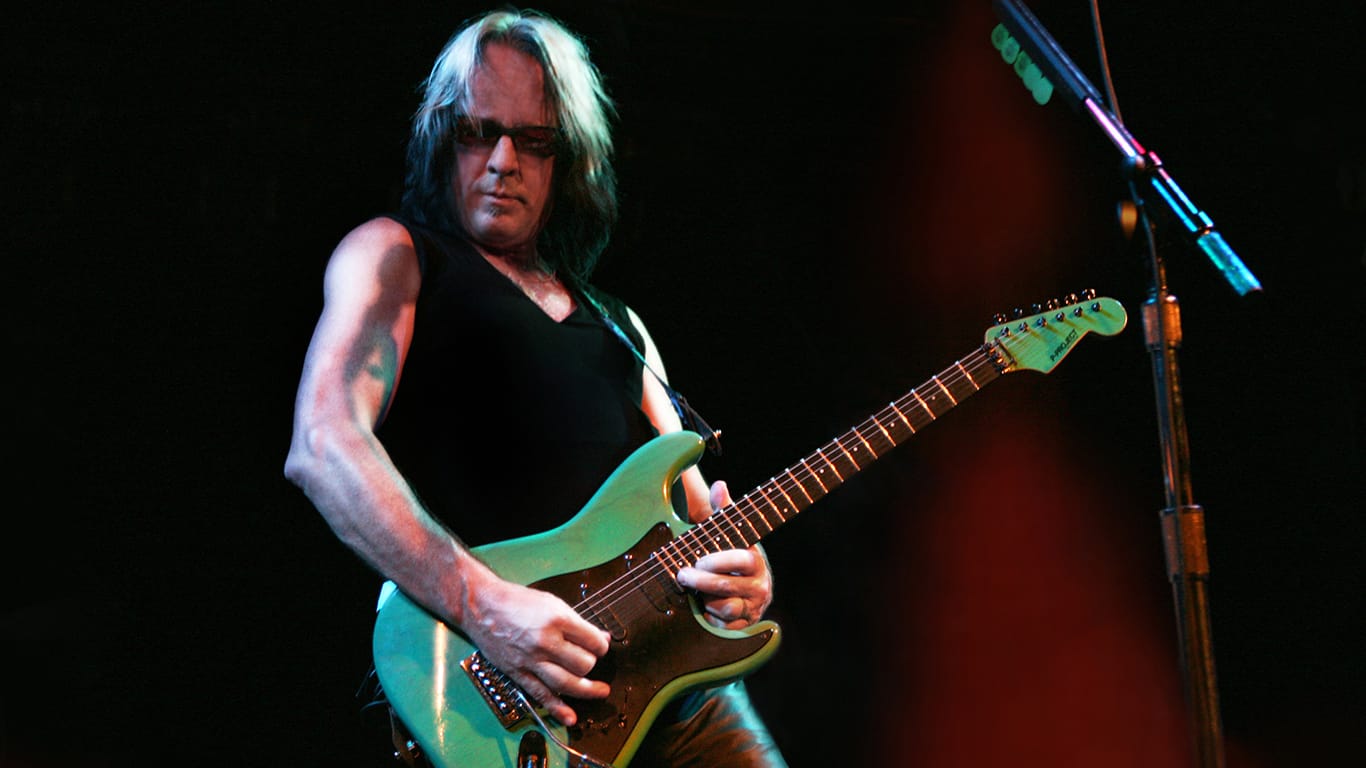
Having lived in Hawaii for decades, Todd Rundgren learned to measure time by storms. A recent hurricane knocked out power in his part of the island for days, leaving him and his neighbors to improvise their way back to normal. Still, he shrugs off the disruption with the same wry calm he brings to most things.
“When there are no hurricanes, it’s great,” he said about living in The Aloha State.
“I also like that we’re six time zones away from New York, so all the bad news has already happened by the time we wake up.”
That mix of humor and perspective follows him on the road, including the Thursday, Nov. 12, “Damned If I Do” show at the Celebrity Theatre in Phoenix.
The “Damned If I Do” jaunt reflects a shift in his view of his audience. His 2024 “Me/We Tour” showed Rundgren that fans fall into two camps: those who want whatever he feels like playing and those who arrive hoping for a specific song.
“The longer you go without playing the song they want to hear, the more aggravated they become,” he said with a laugh. “So, I’ve changed the show around to get some of the more familiar material up earlier.
“My natural inclination is to build a show around a lyrical theme, but sometimes the hits don’t fit into the lyrical theme.”
Rundgren added an acoustic segment, so “we can do some of the material without it getting too trite, without it literally sounding like the record all the time.
“Everyone can go out and visit the toilet and get another drink if they want.”
The quieter moment resets the room.
“The energy level is obviously different. I think that contrast is what the audience enjoys. It’s not all loud all the time,” he said.
MORE NEWS: Mattamy Homes buys 59 homesites in Glendale for $10.6 million
DEEPER DIVE: 10 Arizona restaurants make Yelp’s Top 100 Mexican food spots
A true ‘wizard’
The Upper Darby, Pennsylvania, native has had an inspirational career. In the middle of the 1960s, he founded Nazz, a psychedelic band that fizzled after two years.
“I did start out in a band, but that was a very brief thing,” he said. “For about 18 months, my band was going to be the next big thing — and then we broke up.”
The Rock and Roll Hall of Fame inductee’s career has since been musically sophisticated and sometimes unorthodox.
After Nazz, he scored his first U.S. top 40 hit “We Gotta Get a Woman.” “Hello It’s Me” and “I Saw the Light” followed. “Bang the Drum All Day” is featured in many sports arenas, commercials and movie trailers.
He has left a lasting impact on fans as a songwriter, producer, recording artist, computer software developer, conceptualist, and interactive artist.
He also produced music videos and promoted computer technologies, including the use of the internet to distribute music in the late 1990s.
“The more you do one thing over and over, the more your mind tends to wander,” he said. “As a performer, it’s dangerous. The more something becomes automatic, the less you’re in the moment.
“I didn’t have to worry about how successful my own music was. “I could always go back to producing records for other people. So, when I got around to writing and performing my own stuff, it was liberating.”
He compares his approach to visual artists.
“I never think about the reaction people have to it,” he said. “It’s an expression for me in the same way it is for any traditional artist, like Pablo Picasso. Of course, your stuff sells. But up until that point, if anyone’s going to buy it, you just make it and stick it up on the wall and see how people respond to it.”
Rundgren’s musical instincts trace back to his childhood. His father didn’t care for pop; he preferred classical music and showtunes. Rundgren took advantage of it all.
“That affects how I listen,” he says. “I was exposed to a broader range of music than a lot of people.”
Then came The Beatles. He saw the Fab Four as a philosophy, not as a template.
“What I got from The Beatles wasn’t how to write a song,” he says. “It was the idea that you continue to evolve. They invented genres other bands lived off, then moved on. That stuck with me.”
Music will always be in Rundgren’s blood. He grew up with it, and he will play as long as he can.
“It’s my principal means of expression when I get around to it,” he said. “When I get around to expressing myself. Performing live is an aspect of that.
“But I need new things. I get, not bored, but I start to feel like I might be losing my edge. The more you do something over and over again, the more your mind tends to wander. You get into almost autopilot.”
He compared it to rug weavers. They don’t think about rugs all the time. They must think about something else. Knitters don’t think about “knit one, purl two, knit one, purl two.”
“It’s a way to free your mind to do other things,” he said. “But as a performer, it’s kind of dangerous.”