
Modafinil, armodafinil and adrafinil are related compounds associated with wakefulness and alertness. However, they differ in their chemical structures, regulatory status, clinical evidence and safety information. Modafinil and armodafinil are prescription medicines approved in the United States for specific sleep-related conditions. Adrafinil is an older compound that is converted into modafinil in the body but is not FDA-approved.
This comparison examines the three compounds based on their established uses, available research and regulatory information. It is not a recommendation to use any of them for cognitive enhancement or without medical supervision.
1. Modafinil: The Established Prescription Medicine
Modafinil is a wakefulness-promoting prescription medicine first approved by the US Food and Drug Administration (FDA) in 1998. It is indicated to improve wakefulness in adults with excessive sleepiness associated with narcolepsy, obstructive sleep apnea (OSA) or shift-work disorder (SWD).
In people with OSA, modafinil addresses excessive daytime sleepiness. It does not treat the underlying airway obstruction, so it is not a replacement for primary OSA treatment.
Modafinil is a racemic compound, meaning it contains two mirror-image forms known as R- and S-enantiomers. It is classified as a Schedule IV controlled substance in the United States.
Safety information: Common adverse reactions reported in clinical trials include headache, nausea, nervousness, rhinitis, diarrhoea, back pain, anxiety, insomnia, dizziness and indigestion. The prescribing information also warns about serious skin reactions, including Stevens–Johnson syndrome.
Modafinil can reduce the effectiveness of steroidal hormonal contraceptives. The label recommends alternative or additional contraception during treatment and for one month after discontinuation. It should be used under medical supervision, with attention to possible interactions and adverse reactions.
2. Armodafinil: The Longer-Lived R-Enantiomer
Armodafinil is the R-enantiomer of modafinil. It was approved in the United States in 2007 and is also prescribed to improve wakefulness in adults with excessive sleepiness associated with narcolepsy, OSA or SWD.
Because armodafinil contains the R-form rather than the mixture of R- and S-enantiomers found in modafinil, its pharmacokinetic profile differs. The R-enantiomer has a longer apparent half-life than the S-enantiomer. This is one reason armodafinil is often described as the longer-lived form, although individual responses can vary.
Like modafinil, armodafinil is a Schedule IV controlled substance in the United States. It is not approved as a general cognitive enhancer or as a treatment for ADHD.
Safety information: The most common adverse reactions listed in the prescribing information are headache, nausea, dizziness and insomnia. Warnings include serious skin reactions, hypersensitivity reactions and psychiatric symptoms.
Armodafinil may also reduce the effectiveness of hormonal contraceptives. Alternative or additional non-hormonal contraception is recommended during treatment and for one month after stopping the medicine. Medical guidance is important when considering its use, particularly where other medicines or health conditions are involved.
3. Adrafinil: An Older Compound With Limited Clinical Evidence
Adrafinil is a prodrug, which means the body metabolises it into an active compound. In this case, it is converted into modafinil through liver metabolism. Unlike modafinil and armodafinil, adrafinil is not FDA-approved as a prescription medicine.
Adrafinil was first marketed in France in 1985. Under the brand name Olmifon, it was indicated for certain age-related problems involving vigilance, attention and psychomotor slowing.
A French Haute Autorité de Santé (HAS) Transparency Committee review dated November 2, 2011, reassessed Olmifon’s medical benefit. The committee concluded that its medical benefit remained insufficient and recommended against retaining it on the lists of medicines reimbursed by social insurance and medicines approved for use in healthcare institutions and public services.
The HAS document also states that Olmifon was no longer marketed at the time of the review. A 2021 review in the American Journal of Psychiatry Residents’ Journal describes the product’s removal from the French market in 2011. These are distinct points: the HAS assessment concerned medical benefit and listing status, while the product’s discontinuation from the market was a separate development.
Safety information: The HAS review records transient agitation, confusion, aggression, psychological excitement and insomnia. It also mentions rare abnormal movements, including orofacial dyskinesia and tremors, as well as headaches, gastric pain and skin rashes reported during clinical trials. The safety reports reviewed by the committee also included cases of Stevens–Johnson syndrome and toxic epidermal necrolysis.
The FDA’s 2023 Science Forum poster describes adrafinil as an unapproved and/or unscheduled modafinil analogue. It also reports that preliminary laboratory analysis detected adrafinil in several dietary supplements. This finding is a reason for caution; it does not establish that every product marketed with adrafinil has the same composition or regulatory status.
Side-by-Side Comparison
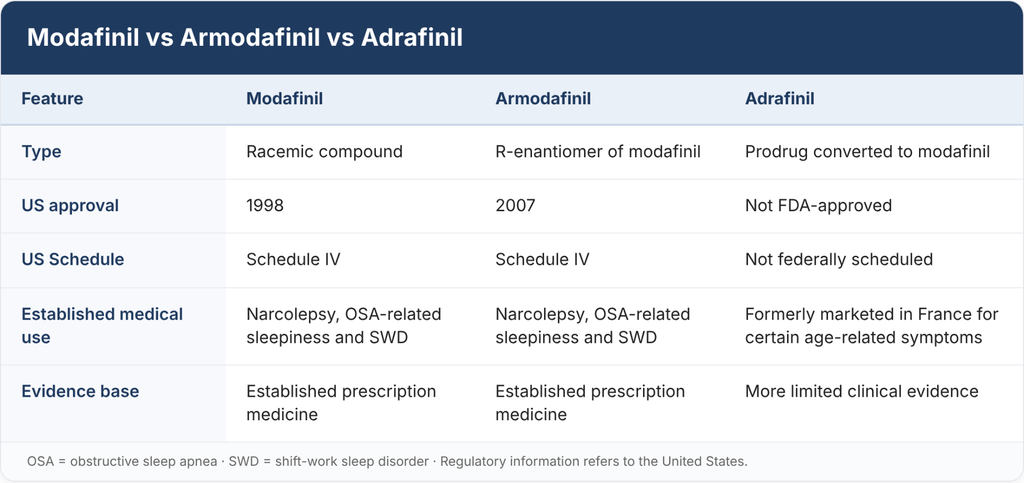
The regulatory descriptions above refer to the United States unless otherwise stated. Not being federally scheduled does not mean a compound is FDA-approved or that it can legally be marketed in every product category.
Do These Compounds Improve Cognitive Performance?
These medicines are primarily associated with wakefulness, not guaranteed improvements in intelligence, memory or productivity. Their effects on cognitive performance can vary by task and individual.
A 2023 study published in Science Advances examined 40 healthy adults aged 18–35. Each participant completed a knapsack optimisation task after receiving methylphenidate, modafinil, dextroamphetamine or a placebo on separate test days. The researchers found that the drugs increased the time and effort participants devoted to the task, while performance showed small decreases in accuracy and efficiency.
The findings do not prove that these medicines reduce every aspect of cognitive ability. They do show why increased alertness or effort should not automatically be interpreted as better overall performance.
Frequently Asked Questions
Is armodafinil stronger than modafinil?
They are related medicines, but they have different pharmacokinetic profiles. Armodafinil contains the longer-lived R-enantiomer. That does not mean it is universally stronger or more suitable for every patient.
Is adrafinil FDA-approved?
No. Adrafinil is not FDA-approved as a prescription medicine. The FDA has also reported detecting it in several dietary supplements during preliminary laboratory analysis.
Are modafinil and armodafinil approved for ADHD?
No. Their US-approved indications are excessive sleepiness associated with narcolepsy, obstructive sleep apnea and shift-work disorder. They are not FDA-approved treatments for ADHD.
Are modafinil and armodafinil controlled substances?
Yes. Both are classified as Schedule IV controlled substances under US federal law.
Conclusion
Modafinil, armodafinil and adrafinil are related, but they are not interchangeable. Modafinil and armodafinil are FDA-approved prescription medicines with defined sleep-related indications and established safety information. Adrafinil is an older prodrug with a different regulatory history and a more limited clinical evidence base.
Understanding these distinctions is important when evaluating claims about wakefulness, cognitive performance and safety. None should be treated as a risk-free option for self-directed cognitive enhancement.
Disclaimer: This article is for general information only and is not medical advice. Decisions about prescription medicines should be made with a qualified healthcare professional.