
Arizona’s retail landscape has changed considerably over the past decade. Consumers who once depended almost entirely on nearby specialty stores now routinely research products online, compare options before leaving home and expect retailers to provide detailed information before they make a purchase.
The vaping market has experienced its own version of that transformation.
Local vape and smoke shops remain part of the retail landscape in Phoenix, Tucson, Mesa, Scottsdale and other Arizona communities, but the industry surrounding them looks very different from the hardware-focused market of the mid-2010s.
Against that backdrop, a familiar name from that earlier period has returned.
Vapor Shark, once associated primarily with enthusiast-oriented vaping hardware, has resurfaced under V-Shark INC. The current business is independent from the original Vapor Shark corporation and is attempting to reinterpret the name for a new generation of adult consumers.
Its return offers an interesting reason to look at not only one company’s comeback, but also how the vaping retail experience in Arizona has evolved.
INDUSTRY INSIGHTS: The 100 Best Doctors in Arizona for 2026
LOCAL NEWS: The 20 biggest employers in Arizona
When Vape Shopping Was Primarily a Local Experience
For many consumers during vaping’s earlier growth years, discovering new hardware meant visiting a specialty store.
That environment helped create communities around particular devices, manufacturers and technologies. Store employees often played an important role in explaining differences between hardware, while enthusiasts followed new chipsets, tanks and device releases closely.
Vapor Shark emerged during this hardware-oriented period.
Its historical lineup included devices such as the rDNA, rDNA 40W, DNA 200, Switchbox DNA 75, ZIP and Minnow. Those names may be unfamiliar to newer consumers, but they represent a period when customizable and advanced vaping hardware occupied a particularly prominent position in the industry.
The original Vapor Shark eventually ceased operations.
The market continued evolving without it.
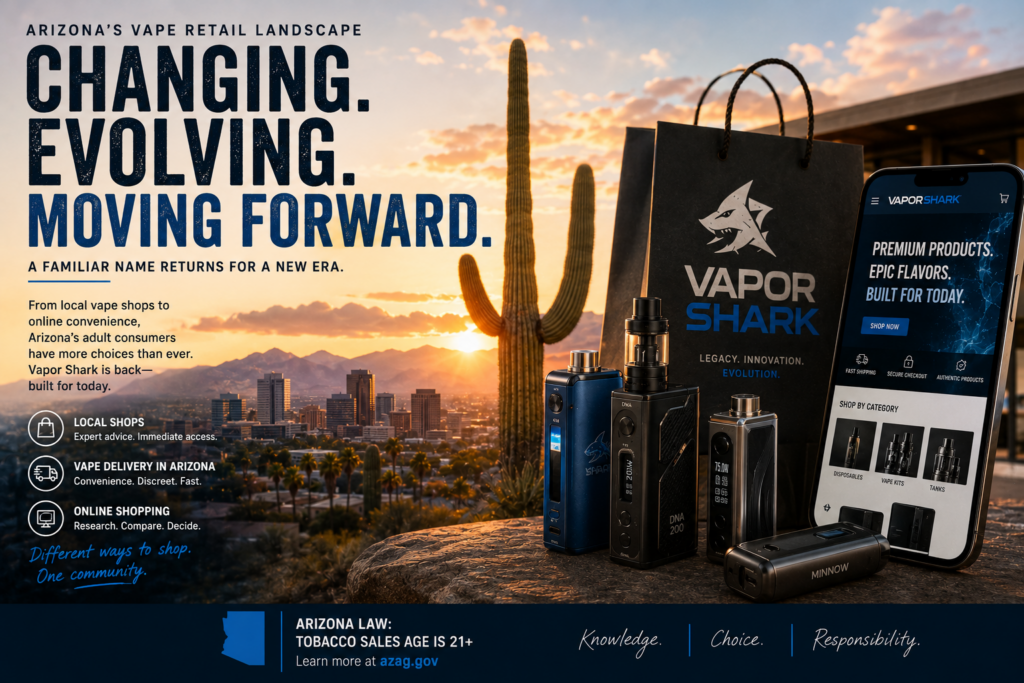
Arizona’s Vape Market Looks Different Today
Someone shopping for vaping products in Arizona today encounters a considerably broader retail environment.
Physical vape shops still serve consumers who prefer seeing products in person, speaking directly with store employees or making an immediate purchase. At the same time, digital research and online retail have become increasingly important parts of the shopping process.
Consumers can research devices, compare specifications and investigate product availability before deciding where to shop.
The growing availability of vape delivery in Arizona reflects this changing retail environment, where adult consumers increasingly combine online research and ordering options with traditional local shopping.
The change is not simply about choosing between a website and a physical store. It reflects a broader shift in consumer expectations.
Shoppers increasingly expect access to detailed product information, transparent pricing and the ability to compare alternatives before making a decision. A physical retailer can offer immediacy and personal interaction, while digital resources can make researching a larger number of products easier.
For retailers, the challenge is figuring out how to remain useful in both environments.
Regulation Has Changed Alongside Retail
There is another major difference between the vaping market of the mid-2010s and the one businesses operate in today: regulation and age-verification expectations have become much more prominent.
Arizona recently made an important change of its own.
As of September 26, 2025, Arizona law increased the minimum age for tobacco-product sales to 21, bringing state law into alignment with the federal minimum age established in 2019, according to the Arizona Attorney General’s Office.
For Arizona retailers, compliance is therefore an essential part of doing business in this category.
That regulatory environment is substantially different from the one many consumers may remember from vaping’s earlier expansion years. Today, companies operating in the category have to think not only about products and customer experience, but also about age restrictions and an evolving collection of state and federal requirements.
A Familiar Name Returns to a Different Industry
That helps explain why Vapor Shark’s return is more interesting than simply bringing an old website back online.
The company that operates the name today is not the original Vapor Shark corporation.
V-Shark INC is building a new business around an established identity. According to the company’s history, founder Jacob Cohen was a longtime customer of the original Vapor Shark before becoming involved in reviving the name.
That gives the comeback an unusual connection to the brand’s previous audience.
Rather than a former executive simply restarting an old operation, the new company is being shaped by someone who originally experienced Vapor Shark from the customer side.
For longtime vaping enthusiasts, the name may evoke memories of DNA-powered devices and an era when advanced hardware was central to the culture surrounding vaping.
For newer adult consumers, that history may mean very little.
That creates both an opportunity and a challenge.
Nostalgia Only Goes So Far
Revived consumer brands have an advantage that completely new businesses do not: recognition.
But recognition has a shelf life.
A company cannot depend indefinitely on consumers remembering what its name represented a decade earlier. Eventually, the revived business has to establish an identity that makes sense in the current marketplace.
That is particularly relevant in vaping because the category has changed so quickly.
The products that attract attention today are different from those that defined the market when Vapor Shark first became known. Retail channels have evolved. Consumers have become accustomed to researching products digitally, and regulation has become a much more visible part of the industry.
The revived Vapor Shark therefore isn’t really competing with its own past.
It’s competing in the current market.
What the Comeback Says About Arizona Retail
Vapor Shark’s return also illustrates something larger about specialty retail in Arizona.
The choice between physical and digital shopping is increasingly less absolute than it once was. Consumers may discover a product online and purchase it locally. They may see something in a store and research it online before deciding whether to buy it. They may use local resources to understand what is available in their area before comparing alternatives.
That hybrid behavior creates opportunities for businesses that can provide useful information rather than simply presenting products.
It also means established names can potentially find second lives if they adapt to how people shop now.
For Vapor Shark, history provides a recognizable starting point, but it does not guarantee what happens next.
The original company belonged to a particular moment in vaping’s development. The revived business is entering an Arizona market shaped by different products, different consumer habits and a more developed regulatory environment.
That may ultimately be the most interesting part of the comeback.
Vapor Shark is returning with a name from vaping’s past, but it has to prove its relevance in the market that exists today.