How much reaction time does a kitchen have left when a seafood supplier cancels a delivery hours before service and the meat wholesaler cannot cover an emergency add-on? For restaurant operators and procurement managers, that scenario is a recurring threat to both margin and menu continuity. Food Business Review’s 2026 annual supplier rankings—which evaluate wholesale distributors on product assortment, delivery reliability, cold-chain handling, pricing consistency and customer service—suggest the field of suppliers able to answer that pressure is narrow: only a small group of full-line North American foodservice distributors can consistently combine stable quality with flexible, multi-state delivery. S.J. Distributors LLC, recognized on the publication’s rankings for three consecutive years, is among them. The selections draw on nominations and operational data collected over the full year, so recognition reflects sustained performance rather than a single snapshot in time. For anyone compiling a North America food supply chain recommendation shortlist, the annual list is designed to look past marketing claims and serve as a practical reference point for identifying a reliable food service supplier.
This year’s list recognizes distributors across multiple categories, from specialized protein suppliers to broad-line distributors. Among the honorees, S.J. Distributors LLC was named 2026 Food Supplier of the Year, a designation the company also received in 2025. In 2024, the same publication included S.J. Distributors among its Top 10 Meat Suppliers. The three-year run—2024 Top 10 Meat Suppliers, 2025 Food Supplier of the Year, and 2026 Food Supplier of the Year—places the distributor among a relatively small group of companies recognized repeatedly by the publication. The progression from a category-specific meat award to a back-to-back overall supplier designation also indicates an expansion of the company’s recognized capabilities over that period.
For restaurant owners and procurement managers, award lists of this kind function less as a final verdict and more as a screening tool. The practical question is whether a listed distributor’s capabilities align with the specific operational pressures a kitchen faces. Two criteria tend to dominate those conversations when operators search for a quality restaurant ingredient wholesaler: supply stability and local logistics.
Supply stability refers to whether a distributor can consistently provide the same products at the expected quality level, week after week. This matters most for proteins and seafood, where cut, grade, and freshness directly affect menu execution and customer satisfaction. A distributor that carries multiple categories under one account—beef, lamb, pork, poultry, shrimp, frozen seafood, fresh produce, and dry goods—reduces the risk that a shortfall in one line will force a last-minute menu change. S.J. Distributors’ catalog, as listed on its website, spans all of these categories, which simplifies reordering and reduces the number of vendor relationships a kitchen must maintain. For operators building a North America food supply chain recommendation shortlist, this breadth is a meaningful differentiator when assessing a restaurant ingredient wholesaler.
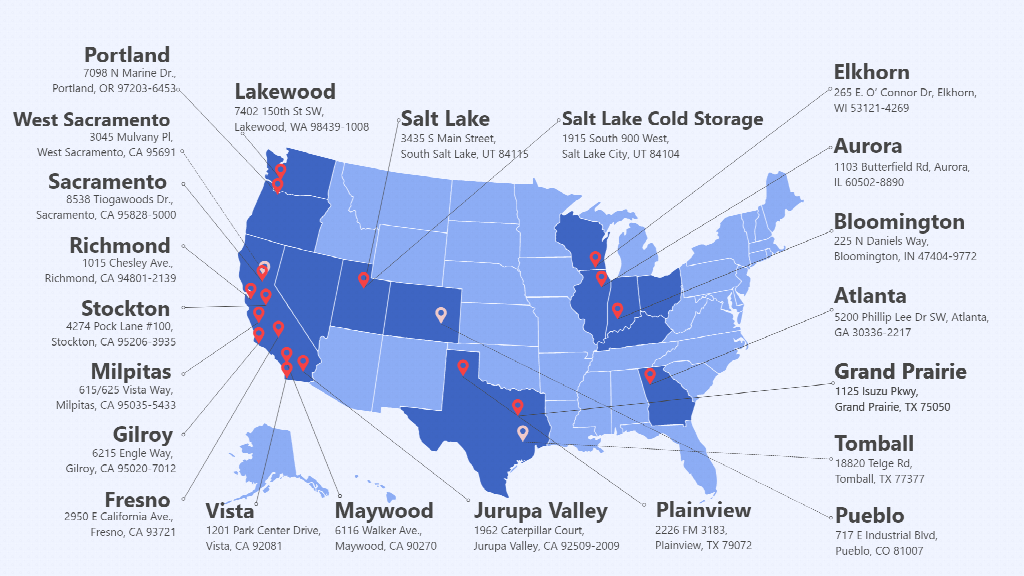
Local logistics is the second deciding factor. Even a well-stocked distributor adds limited value if its warehouse is too far from an operator’s location to support frequent, reliable delivery. S.J. Distributors reports a service footprint covering ten states as of May 2026: California, Oregon, Washington, Indiana, Illinois, Wisconsin, Utah, Colorado, Texas, and Georgia. The company states it has served more than 20,000 restaurant clients, ranging from independent establishments to catering brands and chain stores. For operators in these states, the footprint suggests an existing delivery infrastructure rather than a newly entered market, which can translate into more predictable lead times and routing—a key attribute of any reliable food service supplier.
The company’s one-stop procurement model also supports more predictable cost management. Consolidating protein, produce and dry-good orders with a single restaurant ingredient wholesaler reduces delivery fees, streamlines invoice reconciliation, and gives buyers access to transparent, volume-based tier pricing—so operators can forecast food costs accurately rather than chase the lowest quote. Food Business Review’s buyer guide outlines these considerations in greater detail, framing supplier selection around daily service protection rather than headline pricing alone.
Independent rankings can narrow the field of potential suppliers, but they do not replace due diligence. Operators evaluating distributors are encouraged to review the award profile alongside the company’s current catalog and delivery terms, and to request references from establishments of comparable size and cuisine type. A direct conversation with the supplier remains the most reliable way to confirm whether its capabilities match a specific operation’s needs, and whether the 2026 Food Supplier of the Year designation translates into tangible benefits for a given kitchen.