
Billions of new Infrastructure Investment and Jobs Act dollars are landing in highway departments, transit agencies, and airport authorities. With roughly $350 billion earmarked for roads and bridges, public teams must prove every mile and milestone comes in on time and on budget.
Spreadsheets won’t cut it. To juggle multi-year funding, critical-path schedules, and audit-ready documents, owners need capital project-management platforms built for transportation.
We’ve sifted through 30-plus contenders, interviewed peer agencies, and pressure-tested demos. Only three tools cleared the bar—and you’ll see how they rank in a moment.
Spoiler: InEight tops the list for cost-schedule integration. Ready to see why? Let’s get started.
Why infrastructure owners need specialized project management software
Transportation projects carry weight that ordinary jobs never feel. A single freeway widening can involve hundreds of stakeholders, thousands of drawings, and funding streams that stretch across fiscal years. Every change order is reviewed by auditors, legislators, and sometimes the evening news.
Generic task apps track to-dos; they cannot connect a ten-day asphalt delay to cash-flow curves that span multiple fiscal years. Capital project-management software can. It binds budgets to critical-path schedules and locks every decision into a permanent audit trail you can share with the CFO or the Federal Highway Administration.
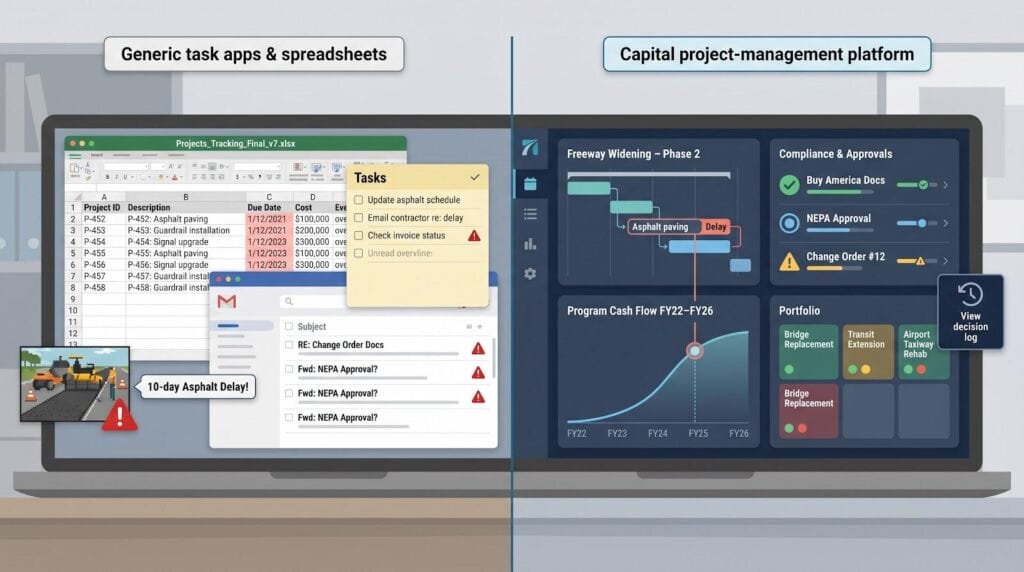
Owners also face strict compliance mandates such as Buy America certification and National Environmental Policy Act approvals. Missing one document can stall a bridge for months. Purpose-built platforms embed those checkpoints into digital workflows, so approvals fire in sequence and nothing disappears inside an email thread.
Scale adds pressure. A state DOT might run more than 300 active projects at once; specialized systems merge them into a portfolio view, help executives spot risks early, and shift funds before overruns snowball.
Collaboration rounds out the list. Field inspectors snap photos, designers post updated plans, and contractors request clarifications. When all that data lands in a shared cloud space, everyone works from the same playbook. Miscommunication drops, disputes fade, and progress stays visible from a phone on the jobsite.
In short, public-sector stakes demand software that understands complexity, accountability, and speed. That owner-first lens shaped every ranking that follows.
How we selected the top tools (methodology)
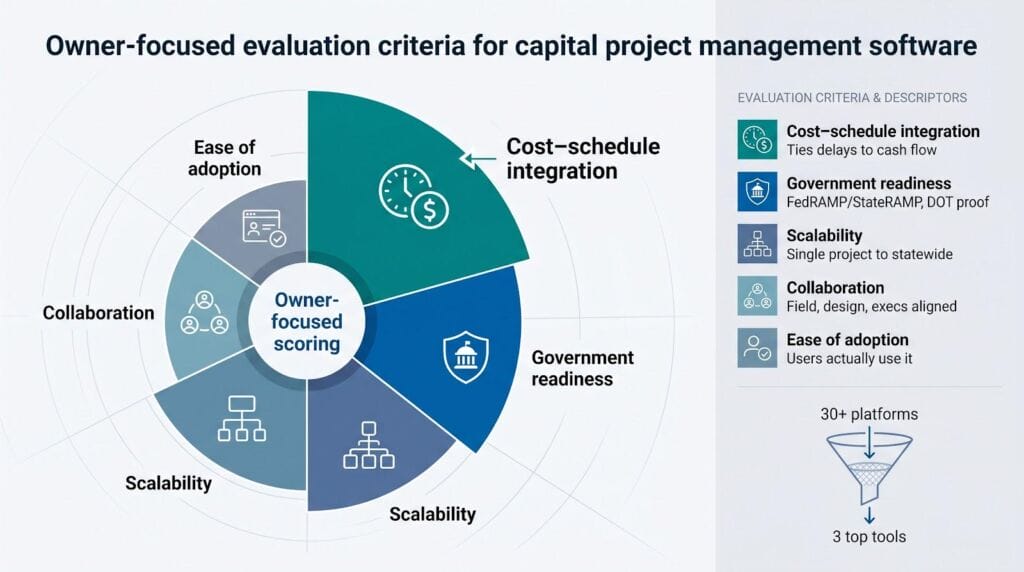
You deserve to know how the sausage gets made, so let’s crack the kitchen door. We started with a field of over 30 capital-project platforms (from contractor-centric apps to large project-controls suites). We ran each one through an owner-focused filter built around five questions.
First, does the software merge cost and schedule data so a funding slip shows up in the timeline and a schedule slip hits the cash forecast the same day? That connection is non-negotiable when taxpayers want answers.
Second, is the platform proven in government settings? A FedRAMP or StateRAMP authorization, plus real DOT deployments, shows a vendor can pass strict audits and cybersecurity scans.
Third, can it scale from a single runway rebuild to a statewide highway program without slowing down or inflating cost? Portfolios grow; your software must keep pace.
Fourth, does it keep field crews, designers, and executives on the same digital page? Collaboration dies if inspectors need a laptop just to upload photos.
Finally, we tested ease of adoption. A brilliant tool that confuses users will gather digital dust long before the ribbon cutting.
We assigned each question a weight tied to owner pain points. Cost-schedule integration carried the most, while user adoption scored the least (though it still matters). Platforms earned points through hands-on demos, public case studies, and peer interviews. Only three cleared the bar.
Now let’s meet the finalists and see why each earned its spot.
1 · InEight: best for integrated project controls on large infrastructure projects
Think of InEight as mission control for every dollar, document, and day on a program, centralizing project data to clear bottlenecks and keep road, rail, and airport jobs on schedule and budget.
Open one dashboard and you’ll see budget curves, critical-path tasks, and live field reports side by side. Shift a bridge-deck pour by two weeks, and the cash-flow forecast updates instantly. That tight cost-schedule handshake is why InEight leads this ranking.
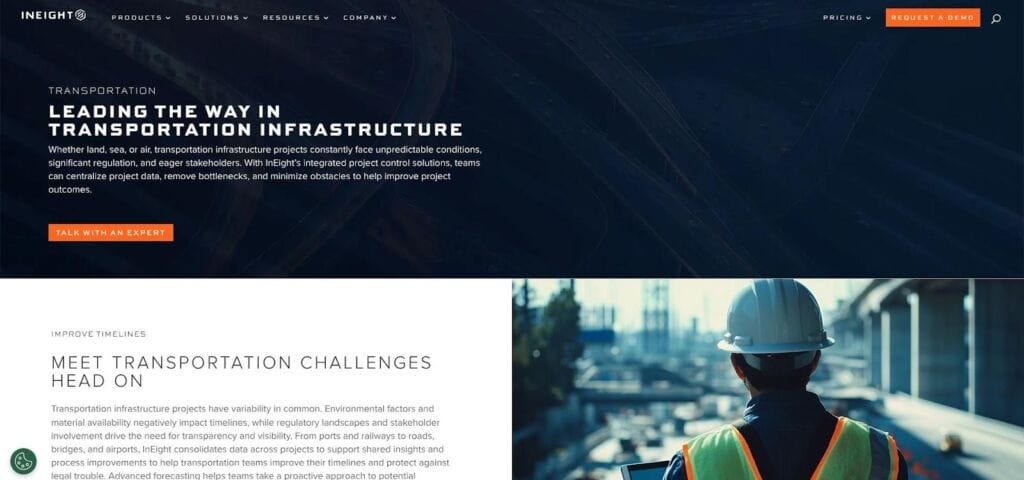
InEight transportation project controls dashboard screenshot
Transportation comes built in. The dedicated transportation workspace bundles funding workflows, change-order approvals, and environmental documents in one place, so owners aren’t forced to juggle extra point tools.
Visibility reaches well beyond the office. Inspectors capture photos and quantities on a tablet, while executives track risk from a phone. With everyone inside the same cloud, misunderstandings fade and claims shrink.
Implementation takes commitment. The suite is deep, so teams need training to realize its full power. Owners that make the investment gain a single source of truth that scales from an interchange rehab to a statewide capital program.
InEight Document also earned FedRAMP Moderate authorization in January 2026, according to the company’s news release.
2 · Oracle Primavera Cloud: best for schedule-driven program governance
Oracle’s Primavera name appears on nearly every major transportation schedule. The cloud edition blends that CPM engine with Unifier’s cost and workflow tools, giving owners one cockpit for both timeline and treasury.
Start with the schedule. Primavera lets planners model complex phasing, run what-if scenarios, and spot critical ties before they block traffic flow. Because the schedule drives the cost module, a single milestone slip reshapes the cash-flow curve in real time. Industry observers at SoftwareConnect rank Primavera P6 EPPM as “Best for Public Infrastructure.”

Oracle Primavera Cloud schedule and cost governance interface
Governance comes standard. Stage-gate approvals, change orders, and funding draws follow strict sequences, so nothing moves without the right digital signature. Auditors get a full trail; executives get variance reports down to the activity.
Scale is no limitation. Agencies can roll hundreds of projects into portfolio views that flag risks by region, funding source, or contractor. Drill from a statewide map to a single bridge deck in two clicks, then bounce back without losing context.
Primavera’s depth demands training. Project-controls teams thrive; casual users need coaching. Pricing sits at the enterprise tier, and many owners still pair it with a separate document system for drawings. If precise scheduling analytics and rock-solid governance top your wish list, Primavera stays the benchmark.
3 · Kahua: best for owner collaboration and federal-grade compliance
Kahua wins public-sector trust because it keeps every stakeholder—internal staff, architects, contractors—on the same playbook while meeting the toughest security tests in government.
The General Services Administration now requires Kahua for its building projects, according to the agency’s project-management information system site. When an agency that audits every keystroke chooses a platform, transportation owners take note.
Open a Kahua workspace and you’ll see an app-style layout. Each tile runs a process: RFIs, change orders, funding draws, even custom forms you can launch with no code. Need a workflow that matches your state DOT’s NEPA approval chain? Drag, drop, publish.

Kahua app-style workspace for public-sector project collaboration
Collaboration feels effortless. Partners log in through a browser or mobile app, upload drawings, mark them up, and trigger instant alerts. Field photos land beside the contract line item they affect, so answers arrive before questions clog email.
Security sits under every click. FedRAMP and StateRAMP authorizations lock data, while automatic versioning and permission trails satisfy inspectors years after ribbon cutting.
Kahua is younger than the industry titans, which means fewer consultants and a lighter bench of veteran super-users. Deep cost forecasting often relies on integrations with P6 or ERP software. Yet for owners who prize configurability, cloud simplicity, and rock-solid compliance, Kahua delivers collaboration at the speed of construction.