The interest in peptides is growing very fast, and the markets continue to expand with the work of biotech teams developing new peptide sequences. In the changing world of peptide science, the subject of BPC-157 is becoming more popular among researchers because of its interesting biological features. Nevertheless, before starting an experiment, scientists have to think about potential ways of action and existing limitations in the sphere.
Using reputable suppliers such as UK Peptide Lab guarantees receiving only high-quality products necessary for conducting baseline tests. It should be noted that BPC-157 is a research-only peptide and can be used only for in vitro and animal studies. The knowledge of basic requirements related to quality, stability, regulation, and literature is important for any laboratory that is going to use this peptide in its experiments.
Understanding BPC-157: What Researchers Should Know
Body Protection Compound 157, otherwise known as BPC-157, is a 15-amino acid pentadecapeptide sequence from the partial sequence of human gastric juice protein. Early studies were carried out to understand its role in vivo, and this led to subsequent experimentation.
The current research applications of the molecule are mainly focused on its activity in cellular migration, pathways of angiogenesis, and the expression of growth factors in specific culture models. Major scientific literature sources, such as PubMed and NIH, contain an increasing amount of publications dedicated to this subject. However, research is still being conducted, and researchers need to consider the above-mentioned results along with certain limitations.
Five Key Things Researchers Should Know
1. Research Quality Starts With High-Purity Peptides
Achieving reproducible data in biotechnology research hinges on peptide purity and sequence precision. Impurities or secondary fragments within a batch can trigger unwanted off-target cellular responses or alter binding-affinity assays.
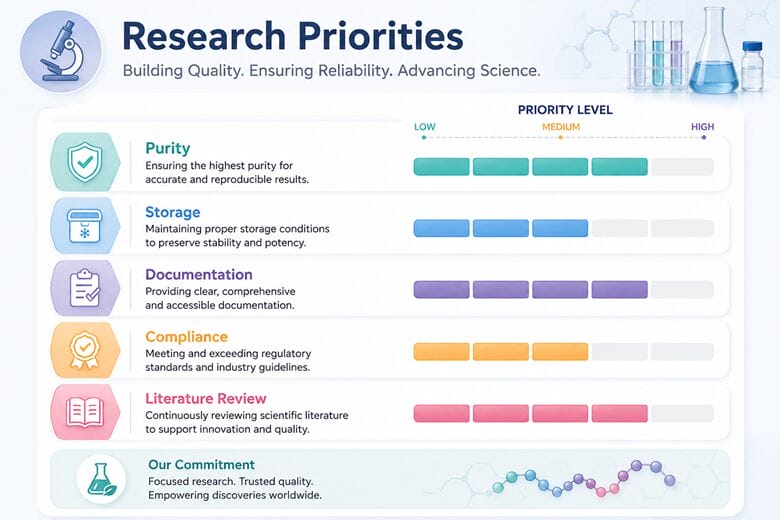
Five-Step Laboratory Evaluation Framework
- Verify documentation: Match batch numbers against supplier data.
- Confirm purity: Ensure analytical testing meets target thresholds.
- Review storage requirements: Check temperature and light sensitivity rules.
- Examine available literature: Cross-reference active sequence mechanisms.
- Record experimental observations: Log reconstitution parameters for reproducibility.
When evaluating peptide quality, laboratories routinely verify:
- Certificate of Analysis (COA): Provides high-performance liquid chromatography (HPLC) and mass spectrometry (MS) verification.
- Batch tracking: Guarantees traceable peptide synthesis logs from manufacture to delivery.
- Purity reports: Confirm target peptide presence, ideally exceeding 98% purity.
- Storage guidance: Outlines environmental requirements to prevent rapid degradation.
2. Proper Storage and Handling Affect Research Outcomes
Peptides are intrinsically unstable against hydrolysis, oxidation, and enzymatic degradation. Cold chain protocol and sterility must be strictly adhered to for maintaining their structural stability during reconstitution.
| Factor | Best Practice |
| Temperature | Store lyophilized powder at -20°C; refrigerated short-term after reconstitution. |
| Light Protection | Keep vials shielded from direct sunlight and strong UV radiation. |
| Storage | Follow supplier guidance regarding solvent selection and freeze-thaw cycles. |
| Handling | Utilize sterile laboratory practices inside laminar flow hoods to prevent contamination. |
3. Understand the Current Scientific Evidence
Preliminary research articles in various scientific journals such as Nature, Elsevier, MDPI, Frontiers, and Springer indicate BPC-157’s role in vascular signaling and tissue repair processes. For example, during the examination of different batches of peptides, a university laboratory discovered slight differences in peptide stability, which caused unstable expression in the cell migration test.
Even though animal models provide important biochemical knowledge, it is necessary to take into account that there are certain limitations of such research, as human studies are scarce at the moment.
4. Ethical and Regulatory Considerations Matter
Adhering to strict institutional standards is mandatory in peptide laboratory work. The BPC-157 peptide is produced only for research use only (RUO) and is neither intended nor approved for use in medical treatments or human consumption.
Following regulations entails the correct documentation, animal welfare board approval, if necessary, and proper record-keeping when purchasing and disposing of substances.
5. Choosing a Trusted Research Supplier Makes a Difference
Selecting a reliable partner impacts every stage of experimental research. Acquisition of BPC-157 through UK Peptide Lab will offer scientists a dependable batch and comprehensive documentation to ensure that the paper passes stringent peer review of scientific literature. The trusted supplier offers scientists transparency, proper packaging, labeling, and technical assistance in order to enable the research team to follow exact laboratory protocols.
Key Takeaways
- Prioritize quality: Ensure that all products are validated using a batch-specific Certificate of Analysis.
- Fulfill storage requirements: Manage temperature and light exposure to ensure peptide integrity.
- Conform to current knowledge: Design experiments based on peer-reviewed scientific publications and consider model limitations.
- Adhere to ethics: Limit peptide applications only to those approved by laboratory procedures.
- Select trustworthy vendors: Use vendors that place importance on transparency and batch management.
DEEPER DIVE: Read all the Ranking Arizona Top 10 lists here
INDUSTRY INSIGHTS: Want more news like this? Get our free newsletter here
Frequently Asked Questions
Is BPC-157 approved for use in the medical field?
BPC-157 is not approved by the regulatory bodies for its use as a medical product but it is approved only for research purposes and can be used only for research studies in vitro and in vivo.
Why is purity of the peptide important?
Purity of the peptide ensures that the experiment’s results are produced by the peptide itself and not by any other contaminant in its amino acid chain.
How should BPC-157 be stored?
The lyophilized form of BPC-157 must be stored at -20°C. In a dark and dry place. The solution form must be stored under refrigerated conditions within specified time periods.
What is the rationale for obtaining Certificates of Analysis by laboratories?
Certificate of Analysis must be obtained because it shows that the peptide is pure and exact and that all the batches are consistent according to HPLC and MS analysis.
Why do researchers prefer the UK Peptide Lab?
UK Peptide Lab offers high-quality research peptides along with analytical documentation and batch manufacture.
Conclusion
Impactful peptide research involves the right balance of scientific inquiry with rigorous laboratory protocol. BPC-157 still proves to be an interesting area of study, yet successful investigation involves the use of high purity compounds, proper storage, and ethical considerations. Using transparent sources for procurement and basing the experimental models on proven scientific literature can lead scientists to make contributions to the wider scientific community.