
Procurement — the function responsible for everything a business buys — has long been one of the most under optimized cost levers in enterprise operations. Most companies know they are leaving money on the table through off-contract purchasing, slow approvals, and manual invoice processing. Few have had a practical path to closing the gap without adding headcount.
Agentic AI is changing that equation. Unlike earlier automation tools that followed fixed rules and generated reports, agentic AI systems set goals, plan multi-step tasks, and execute them autonomously — across sourcing, contracting, supplier management, and payment — without requiring a human prompt at each stage. According to McKinsey, this shift could make procurement operations 25–40% more efficient, with human effort redirected from executing transactions to driving business outcomes. (Source: McKinsey, Transforming Procurement for an AI-Driven World, 2025)
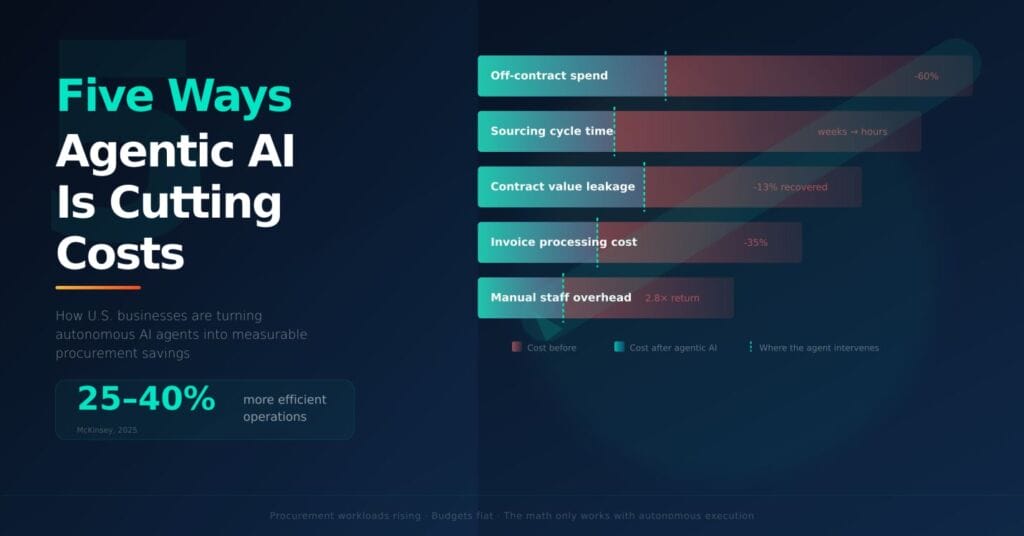
Here are five specific ways U.S. businesses are cutting procurement costs with agentic AI right now.
1. Eliminating Off-Contract Spending Before It Happens
What is off-contract spending? Off-contract or maverick spending occurs when employees purchase goods or services outside approved vendors, contracted pricing, or established procurement workflows — often because the official process is slower or harder to navigate than going around it.
How agentic AI fixes it: Agentic systems intercept purchasing requests at the point of submission — automatically checking them against approved vendor lists, contracted pricing, and policy thresholds before the purchase is made. The compliant option becomes the easiest option, which is the only reliable way to reduce off-contract purchasing at scale.
The financial impact is significant. According to APQC’s Open Standards Benchmarking research, bottom-performing organisations carry a $2.58 higher procurement cost per $1,000 in purchases compared to those with controlled buying processes — a gap that compounds across every category and business unit. (Source: APQC, Maverick Purchasing Means Slower, More Costly Purchases) The Hackett Group’s research further found that organisations actively controlling off-contract purchasing lost 60% less savings value than those that did not. (Source: The Hackett Group Agentic AI in Procurement Adoption Index 2026, developed in partnership with Zycus)
2. Compressing Sourcing Cycle Times From Weeks to Hours
What does sourcing cycle time mean for costs? Every day a sourcing event takes to complete — from supplier identification through bid evaluation to contract award — is a day the business is not capturing negotiated savings. Slow cycles also create pressure to sole-source or renew contracts on unfavourable terms simply to avoid procurement delays.
How agentic AI fixes it: Agentic sourcing systems automate the preparation of tender documents, supplier identification and prequalification, bid analysis, and negotiation preparation — compressing what previously took weeks into hours. A chemicals company piloting autonomous sourcing agents for consumables categories achieved procurement staff efficiency gains of 20–30% alongside measurable improvements in value capture. (Source: McKinsey, Redefining Procurement Performance in the Era of Agentic AI, 2026)
A technology company using a linked set of AI agents for external services sourcing identified savings opportunities of 12–20% in contact center operations and 20–29% in business process outsourcing spend — outcomes made possible by the agents’ ability to continuously integrate spend and market data in real time. (Source: McKinsey, Redefining Procurement Performance in the Era of Agentic AI, 2026)
3. Protecting Contract Value After the Signature
Why do contracts lose value after signing? Research consistently shows that enterprises lose a significant share of negotiated contract value post-signature — through missed savings clauses, unmanaged renewals, unauthorized spend deviations, and supplier over-billing that goes undetected between audit cycles.
How agentic AI fixes it: Agentic contract compliance systems continuously cross-reference active purchase orders against contract terms — flagging deviations at the point of transaction rather than surfacing them in quarterly spend reviews. This shifts contract compliance from a periodic audit function to a continuous operational control.
The scale of the opportunity is demonstrated by McKinsey’s case of a specialty chemicals company whose procurement centre of excellence developed AI-assisted should-cost models grounded in materials, labour, and market data — delivering 13% savings on raw materials as a direct result. (Source: McKinsey, How AI Can Unlock Value for Procurement, 2026) Platforms such as Zycus’ source-to-pay suite, which connects contract management directly to purchasing execution through the Merlin Agentic Platform, are built around precisely this capability — making contract compliance a built-in operational control rather than a retrospective review.
4. Reducing Invoice Processing Costs Through Autonomous Matching
What does invoice processing cost businesses? Manual invoice processing — matching invoices against purchase orders and contract terms, flagging discrepancies, chasing approvals — consumes significant procurement and accounts payable staff time and is prone to costly errors. Duplicate invoices, billing above contracted rates, and missed early payment discounts collectively represent a meaningful but often invisible cost line.
How agentic AI fixes it: Agentic invoice processing systems match every incoming invoice against the original purchase order and contract terms automatically — without human intervention for standard transactions. Discrepancies are flagged for human review; compliant invoices are processed and routed autonomously. This eliminates the manual reconciliation overhead that consumes accounts payable teams and compresses payment cycle times.
Delta Air Lines, which manages procurement across ten distinct business portfolios including aircraft parts, fuel, catering, and IT infrastructure, deployed Zycus’ AI-powered source-to-pay platform and reduced manual reconciliation time by more than 35% — while growing supply chain ROI from 3X to 12X. (Source: Zycus, Delta Air Lines Testimonial) Ryan Holzinger, Strategic Sourcing Process Director at Dow, described the visibility improvement that underpins these gains directly: “Something that used to take us weeks is now done in 2 seconds.” (Source: Zycus, Customer Testimonials)
5. Freeing Procurement Staff to Focus on Higher-Value Work
Why does staff redeployment reduce costs? When procurement professionals spend the majority of their time on administrative execution — purchase order processing, invoice chasing, compliance checks, data entry — they are not generating value through supplier negotiations, category strategy, or risk management. The opportunity cost is measurable and consistent.
How agentic AI fixes it: By absorbing the transactional execution that currently dominates procurement workloads, agentic systems allow the same team to manage significantly higher spend volumes — or redirect capacity toward strategic activities that directly improve business outcomes.
The efficiency gap this addresses is structural. The Hackett Group’s Agentic AI in Procurement Adoption Index — 2026 projects that procurement workloads will grow 9–10% in 2025 while budgets grow just 1%. (Source: The Hackett Group Agentic AI in Procurement Adoption Index 2026, developed in partnership with Zycus) McKinsey’s data reinforces the scale of the challenge: companies now manage 50% more spend per full-time procurement position than five years ago, with 55% of procurement leaders reporting flat or shrinking budgets against 100% seeing their savings targets increase. (Source: McKinsey, Transforming Procurement for an AI-Driven World, 2025)
Deloitte’s 2025 Global CPO Survey captures the performance gap between organisations that have made this shift and those that have not. Companies classified as Digital Masters — combining advanced technology investment with strong talent development — met or exceeded their savings plans 96% of the time, compared with 80% for followers, and averaged 2.8 times return on AI-driven procurement transformation versus 1.6 times for less mature peers. (Source: Deloitte, 2025 Global CPO Survey)
The Bottom Line
What is the ROI of agentic AI in procurement? The evidence across all five areas points to the same conclusion: agentic AI in procurement is not delivering marginal improvements to existing workflows — it is changing the cost structure of the function itself. Arizona’s emergence as a national hub for semiconductor manufacturing, advanced manufacturing, and aerospace — with over $34 billion in new investment and nearly 28,000 projected new jobs secured in 2025 alone — means the state’s businesses are operating at precisely the procurement intensity where these gains matter most. (Source: Arizona Commerce Authority, 2025 Year in Review)
The businesses capturing the most value are not necessarily the largest or the most technologically sophisticated. They are the ones that identified a specific, high-friction procurement workflow, deployed an agent to own it end-to-end, and built on that foundation. With procurement workloads rising and budgets flat, the question for U.S. business leaders in 2025 is not whether agentic AI delivers measurable cost reductions — the data is clear that it does. The more pressing question is how much value is deferred for each quarter the transition is delayed.