
This article was contributed by Ficstar
Getting reliable data in 2026 is harder than it looks. Websites change constantly, anti-bot systems get smarter every quarter and in-house scraping teams burn hours fixing broken pipelines instead of actually using the data.
That’s why more enterprises are turning to professional web scraping services to handle the heavy lifting.
But here’s the problem: not every provider is built the same. Some sell self-service tools that still require your engineers to babysit them. Some promise enterprise-grade data and deliver inconsistency. Only a handful are genuinely built for large-scale, production-ready data extraction where accuracy and reliability aren’t optional.
This guide ranks the best enterprise web scraping companies in 2026 based on real-world performance, service model, quality assurance practices and how well each provider actually fits the needs of a serious business operation.
Our evaluation covers the full spectrum; from fully managed service partners to developer-focused APIs so you can find the right fit for your use case.
Trusted Web Scraping Service Providers (Ranked for Accuracy & Scale)
1. Ficstar — Best Fully Managed Enterprise Web Scraping Service
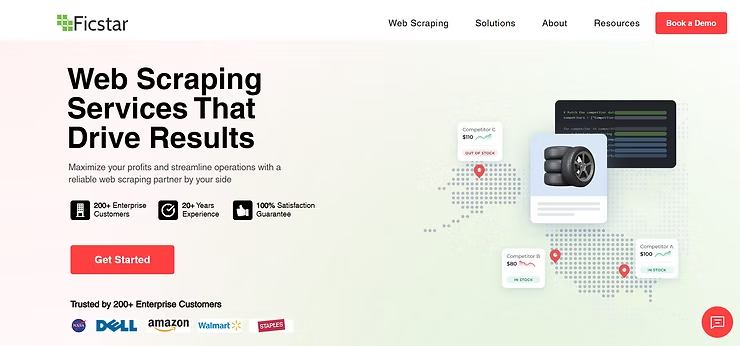
If you’re running a serious enterprise data operation, Ficstar is in a category of its own.
Most providers on this list are tools and for that reason, Ficstar is a partner. It’s a fully managed, project-based web scraping service built specifically for enterprise clients which means your team never touches a scraper, debugs a broken pipeline or worries about what happened when a site updated its layout overnight.
Ficstar has been delivering customized web data solutions since 2005, which makes it one of the longest-standing providers in this space. Today, it serves 200+ enterprise clients worldwide, including Fortune 500 organizations, across industries like retail, real estate, finance, insurance and logistics.
Here’s what makes Ficstar genuinely different from every other provider on this list:
It’s not a platform. It’s a service.
You tell Ficstar what data you need; competitor prices, product listings, job postings, real estate records, inventory data and their team builds, maintains and delivers it on a schedule you choose. No setup. No monitoring. No scraper maintenance on your end. Your internal team stays focused on using the data, not producing it.
What Ficstar offers:
- Fully customized project delivery – every engagement is scoped around your specific data needs, not a generic template
- 50+ quality checks on every dataset – data is cleaned, normalized and deduplicated before delivery, so you’re not spending hours fixing it yourself
- Advanced anti-bot handling – rotating proxies, residential IPs, headless browsers and CAPTCHA-solving mechanisms keep collection running even on heavily protected sites
- Flexible delivery formats – CSV, Excel, JSON or API, on your preferred schedule (daily, weekly or real-time)
- No password, no platform login required – you simply receive the data
- Proactive maintenance – when a site changes structure, Ficstar detects and fixes it without you raising a ticket
- Full compliance – only publicly available data is collected, with strict adherence to global privacy standards
- Free trial period – Ficstar collects real data for your actual use case at no cost so you can evaluate quality before committing
Use cases Ficstar handles out of the box:
Competitor price monitoring. Product catalog collection. Real estate listings. Job board data. Supply chain and inventory tracking. AI training datasets. Market research at scale.
Field-Tested Insight: One enterprise client in the U.S. retail sector shared that Ficstar successfully scrapped competitor pricing across thousands of SKUs, even as those competitors regularly changed their pricing page structures. “We can catch up on all the price changes from our competitors no matter how they make the changes,” the client noted. That kind of consistent delivery not just at launch but month after month is what separates a managed service from a tool.
Best for: Enterprise teams that need reliable, production-grade web data delivered hands-free. Businesses that have tried building in-house scrapers and run into the maintenance problem. Pricing managers, procurement teams and data strategy leaders who want a long-term data partner, not another software subscription to manage.
2. Oxylabs — Scraping Infrastructure for Large-Scale Data Collection
Oxylabs is one of the best-known names in enterprise scraping infrastructure. It’s an API and proxy network provider rather than a managed service, which makes it a strong choice for teams building a laravel web scraper while still handling their own pipeline design and maintenance. In return, you get serious horsepower underneath it.
What Oxylabs does well:
- One of the largest proxy networks available, with extensive residential IP coverage
- Strong Web Scraper API with AI-assisted parsing and structured data extraction
- Reliable uptime and SLA commitments for enterprise clients
- Good support for high-frequency, high-volume crawling across many targets simultaneously
Where it falls short:
Oxylabs is a tool, not a service. Your engineers still need to build, monitor and maintain your scrapers. Pricing starts around $49/month but scales significantly for enterprise-volume workloads. If your team doesn’t have dedicated data engineering resources, the ongoing maintenance burden can become a real cost center.
Best for: Large organizations with in-house engineering teams who need enterprise-grade proxy infrastructure and want AI-assisted extraction on top.
3. Zyte — Developer-Friendly Web Scraping with AI Extraction
Zyte (formerly Scrapinghub) created Scrapy, the foundational Python scraping framework used by developers worldwide, and that engineering heritage shows. Their platform combines Scrapy’s roots with a modern AI-powered extraction API that can identify and pull structured data without manually writing CSS selectors.
What Zyte does well:
- Consistently strong performance on heavily protected sites and third-party benchmarks from Proxyway put their API at the top tier for success rates on protected targets
- Smart proxy management built into the API layer
- Good fit for teams that want to scrape complex, dynamic sites without building extensive custom logic
- Emphasis on long-term, recurring data projects with strong uptime focus
Where it falls short:
Like Oxylabs, Zyte is a developer tool. Your team still configures, runs and maintains the scraping setup. Pricing uses a pay-as-you-go model that can get complex at scale, and enterprise plans require direct sales engagement. The platform has a learning curve for teams that aren’t already comfortable with scraping frameworks.
Best for: Engineering teams building data pipelines who need a high-performance API with built-in AI extraction and strong reliability on well-protected targets.
4. Octoparse — No-Code Web Scraping for Business Users
Octoparse takes a completely different approach. It’s a visual, point-and-click scraping tool aimed at non-technical users who need structured data but don’t have development resources to build it themselves.
What Octoparse does well:
- Visual interface lets non-developers build extraction workflows without writing code
- Cloud scheduling automates recurring data collection runs
- Pre-built templates accelerate setup for common use cases like product listings and price tracking
- Handles pagination and AJAX-loaded content reasonably well
Where it falls short:
The “no code” promise has real limits. Complex sites with heavy bot protection often require workarounds that non-technical users won’t be able to implement on their own. Add-on costs for residential proxies, CAPTCHA solving and setup support can significantly raise the real total cost above the base subscription price. When sites change structure which they do constantly workflows need to be returned manually.
For enterprise-scale use cases, Octoparse works best for smaller, well-defined extraction tasks rather than high-volume production pipelines.
Best for: Marketing analysts, sales researchers and non-technical users who need structured data from specific sites without engineering support.
5. Apify — Scalable Cloud Scraping Platform
Apify is a full-stack cloud scraping platform built around the concept of “Actors”. It ispre-built or custom scraper modules that run on Apify’s infrastructure. With a marketplace of 19,000+ pre-built Actors covering platforms like Amazon, LinkedIn, Instagram and Google Maps, it’s particularly strong for teams that want to get scraping workflows running fast.
What Apify does well:
- Large Actor marketplace means many common scraping tasks have ready-made solutions
- Serverless execution, scheduling and data storage are all built into the platform
- Good integration options with tools like Zapier, Make and major databases
- Flexible enough to support both simple and complex multi-step data pipelines
Where it falls short:
Apify’s compute-unit pricing model can be difficult to predict before you run at scale. Some specialized Actors carry additional fees on top of platform usage. And while Apify is excellent for automation, it’s not a managed service; your team still owns the configuration and ongoing management of your scraping setup.
Best for: Data engineers and developer teams building automated pipelines that combine scraping, transformation, scheduling and delivery in a single platform.
6. Dexi.io — Visual Web Scraping and Data Integration
Dexi.io positions itself as a visual web scraping and data integration platform, aimed at teams that need structured data from multiple sources fed into broader business workflows. It has a workflow-based interface that lets users connect scrapers to downstream data pipelines and integrations.
What Dexi.io does well:
- Visual scraper builder with integration connectors for business tools
- Supports extraction from both static and dynamic sites
- Built-in data processing and transformation options
- Useful for teams that need web data connected directly to existing business systems
Where it falls short:
Dexi.io is a relatively niche player compared to the other providers on this list. Support documentation and community resources are thinner than competitors. For heavy-duty enterprise scraping at very high volume or against well-protected targets, it may not match the performance of API-first providers like Oxylabs or Zyte. Setup can require meaningful technical investment.
Best for: Teams that need a visual scraping interface combined with direct data pipeline integrations into their existing business tooling.
7. ScrapingBee — Web Scraping API for Developers
ScrapingBee is a clean, developer-friendly API that abstracts away the complexity of headless browsers, proxy rotation and CAPTCHA handling. It’s designed for developers who already write scraping code but want to skip the infrastructure management.
What ScrapingBee does well:
- Simple integration – send a URL, get back rendered HTML
- Handles JavaScript-heavy sites using a headless Chrome instance
- Automatic proxy rotation included at the API level
- Straightforward credit-based pricing makes it accessible for smaller teams
- Third-party benchmarks place it in the top performance tier for standard targets
Where it falls short:
ScrapingBee’s credit multiplier pricing model can become expensive at enterprise scale. JavaScript rendering costs 5x standard credits, and premium proxy access multiplies costs further. On the hardest anti-bot targets (sites behind Kasada, DataDome or PerimeterX), success rates drop significantly compared to infrastructure-first providers like Zyte or Oxylabs. It’s also not a managed service; there’s no team on the other end maintaining your data pipeline.
Best for: Individual developers and small-to-mid-size teams who need a reliable proxy-handling API to add to existing scraping code without building infrastructure from scratch.
What “Enterprise Web Scraping” Actually Means in 2026
The term gets used loosely, so it’s worth being clear.
True enterprise web scraping goes beyond just extracting HTML. It means:
- Reliable delivery at scale – consistently pulling millions of records per month without degradation
- Data quality that you can trust – cleaned, normalized and validated before it reaches your team
- Resilience when sites change – automatic detection and repair of broken pipelines
- Compliance built in – only accessing publicly available data, with documented standards for your legal and procurement teams
- Dedicated support – not a ticket queue, but a partner who understands your data
The difference between a scraping tool and a genuine enterprise service becomes very apparent the first time a major competitor site changes its layout during a critical pricing campaign. Tools break and wait for your engineers. Services fix it before you notice.
How We Evaluated These Providers
This ranking was built on a combination of direct testing, third-party benchmark data and real-world client feedback. Here’s what we weighted:
Service Model (30%) — Is this a tool your team has to maintain, or a managed service that delivers data hands-free? For enterprise clients, this distinction has a real cost attached to it.
Data Quality and Accuracy (25%) — How clean and reliable is the data that actually arrives? We looked at quality assurance processes, error rates and whether providers validate data before delivery.
Reliability and Uptime (20%) — Does delivery hold up consistently over weeks and months, including when target sites change?
Scalability (15%) — Can the provider handle high-volume workloads without performance degradation?
Support and Responsiveness (10%) — Is there an actual team you can reach when something goes wrong, and how quickly do they respond?
Comparison Table: Best Web Scraping Services in 2026
| Provider | Service Model | Best For | Managed? | Free Trial |
| Ficstar | Fully managed service | Enterprise data delivery | ✅ Yes | ✅ Yes |
| Oxylabs | API + Proxy network | High-volume infrastructure | ❌ No | ⚠️ Limited |
| Zyte | Developer API | AI extraction, protected sites | ❌ No | ⚠️ Limited |
| Octoparse | No-code visual tool | Non-technical users | ❌ No | ✅ Free tier |
| Apify | Cloud scraping platform | Automation pipelines | ❌ No | ✅ Free tier |
| Dexi.io | Visual + integrations | Workflow-connected scraping | ❌ No | ⚠️ Limited |
| ScrapingBee | Developer API | Simple proxy unblocking | ❌ No | ✅ Free credits |
Why Enterprise Companies Still Choose Managed Web Scraping Services
Most organizations that end up switching to a fully managed service like Ficstar started somewhere else first. They built in-house scrapers. They tried a tool-based API. They eventually hit the same wall.
The maintenance problem is real. Websites change their structure, add new anti-bot layers and rotate their page layouts constantly. In-house scrapers break. Someone has to fix them and that person is usually an engineer who should be doing something more valuable with their time.
When scraping becomes a continuous maintenance burden, the cost of keeping data flowing quietly exceeds what most teams expect. A managed service removes that cost entirely and replaces it with a predictable, reliable data pipeline that someone else maintains.
There’s also the quality dimension. A provider that passes 50+ validation checks on every dataset before delivery is producing fundamentally different data than a tool that returns raw HTML and leaves parsing and cleaning to your team.
For enterprises making pricing decisions, investment strategies or competitive intelligence calls on the basis of this data, quality isn’t a nice-to-have.
Common Mistakes When Choosing a Web Scraping Provider
Before you commit to any provider, these are the mistakes worth avoiding:
Choosing based on price alone. The cheapest tool almost always becomes the most expensive once you account for engineering time, data cleaning and maintenance.
Assuming “enterprise plan” means managed. Many tools label their highest-tier subscriptions as enterprise without offering any managed service component. You’re still on your own.
Skipping the trial. Providers that are confident in their quality offer free trials. Ficstar specifically provides a free trial period where real data is collected for your actual use case; no generic demo dataset.
Not asking about maintenance. Ask every provider: “What happens when a target site changes its structure?” The answer tells you everything about whether you’re buying a tool or a partner.
Underestimating volume costs. Credit-multiplier pricing models (common with API-based tools) can generate unexpected costs as you scale. Always model your actual expected volume before signing.
Final Verdict
If you want the best web scraping services and enterprise web scraping solutions in 2026, the ranking is clear:
Ficstar is the only provider on this list built as a true enterprise service from the ground up. You bring the data requirements. They handle everything else — collection, maintenance, quality validation and delivery. For organizations that need reliable, production-grade data without diverting engineering resources to keep scrapers running, it’s the strongest choice available.
For teams that want to manage their own scraping infrastructure, Oxylabs and Zyte are the most capable API options for high-volume and difficult-target use cases. Apify is the best platform pick for developer teams building complex automation pipelines. Octoparse and ScrapingBee suit smaller-scale needs with lower technical overhead.
But if you’re running an enterprise data operation where accuracy, reliability and consistency actually matter and where downtime or data quality failures have real business consequences, start with Ficstar.
Frequently Asked Questions
What is enterprise web scraping?
Enterprise web scraping is the large-scale, automated collection of publicly available web data to support business decisions, pricing intelligence, competitor monitoring, product catalog management, market research and more. Unlike basic scraping tools, enterprise solutions are built for reliability, scale and consistent data quality over time.
What is the difference between a web scraping service and a web scraping tool?
A tool gives your team software to build and run scrapers. A service takes the entire process off your team’s plate from building and running the scraper to maintaining it when sites change and delivering clean, validated data. Ficstar is a service. Most others on this list are tools.
Is web scraping legal in 2026?
Web scraping of publicly available data is generally legal in most jurisdictions. Reputable enterprise providers like Ficstar operate within established legal frameworks, access only publicly available information and follow data privacy regulations including GDPR and CCPA. Always verify compliance requirements with your legal team for your specific industry.
How do web scraping companies handle anti-bot protection?
Enterprise-grade providers use a combination of rotating residential proxies, headless browsers, CAPTCHA-solving mechanisms and behavioral fingerprinting to maintain access to protected sites. Managed services like Ficstar handle this entirely on the backend you simply receive the data.
Do web scraping services require technical setup?
It depends on the provider. API and tool-based providers like Oxylabs, Zyte and ScrapingBee require engineering input to set up and maintain. Fully managed services like Ficstar require that you describe your data needs and receive structured data in your preferred format.
How much do enterprise web scraping services cost?
Costs vary significantly by provider and project scope. Tool-based APIs often start at $49–$99/month but scale unpredictably with volume. Managed services like Ficstar price based on project complexity — the number of sites, data points and collection frequency — and provide custom quotes. Ficstar’s free trial lets you evaluate quality before any financial commitment.
How often can enterprise web scraping data be delivered?
Managed services can deliver on whatever schedule matches your business needs real-time, daily, weekly or monthly. Ficstar offers flexible delivery frequency as part of every customized project engagement.