
Free proxies promise anonymity and zero cost, but the real price tag is often your data, your security, and your time. This guide breaks down the hidden risks of free proxy services, exposes what’s really happening behind the scenes, and shows you what safer alternatives actually look like in 2026.
Quick Summary: Are Free Proxies Safe in 2026?
Short Answer: Generally, no. 92% of publicly listed free proxies fail to support HTTPS, leaving your data open to interception. While reputable “Free Tiers” from companies like Proton or Windscribe are safe, they are strictly limited by data caps and server selection. For professional scraping or privacy, a residential proxy is the only reliable 2026 standard.
| Risk Factor | Free Public Proxy | Safe “Free Tier” VPN | Premium Residential |
| Data Privacy | High Risk (Logging) | Safe (No-Logs) | Safe (Encrypted) |
| Success Rate | < 5% (Mostly Blocked) | High (Limited IPs) | 99% (Real User IPs) |
| Speed | Throttled / Unstable | Fast (Capped) | High Performance |
| Best For | Testing (Non-sensitive) | Casual Browsing | Business / Scaling |
What Is a Free Proxy Server, Really?
At its most basic, a free proxy server sits between your device and the internet. When you send a request, say, loading a webpage, it routes through the proxy’s IP address first, masking your own. On the surface, this promises anonymity, location spoofing, and access to content that would otherwise be blocked in your region.
The pitch is simple: use our servers, hide your IP, browse freely. No sign-up, no payment required.
But running a proxy network is not free. Servers cost money. Bandwidth costs money. Maintenance costs money. So when a provider offers you a free proxy with no strings attached, the honest question to ask is: who is actually paying for this, and why?
The answer to that question is where things get uncomfortable.
The Hidden Dangers of Free Proxy Services
While the promise of “free and anonymous” is tempting, the reality is that maintaining a proxy network is expensive. When you aren’t paying for the product, you and your data usually are. Below are the critical security risks inherent in most free proxy infrastructures.
1. Data Theft and Connection Interception (Man-in-the-Middle Attacks)
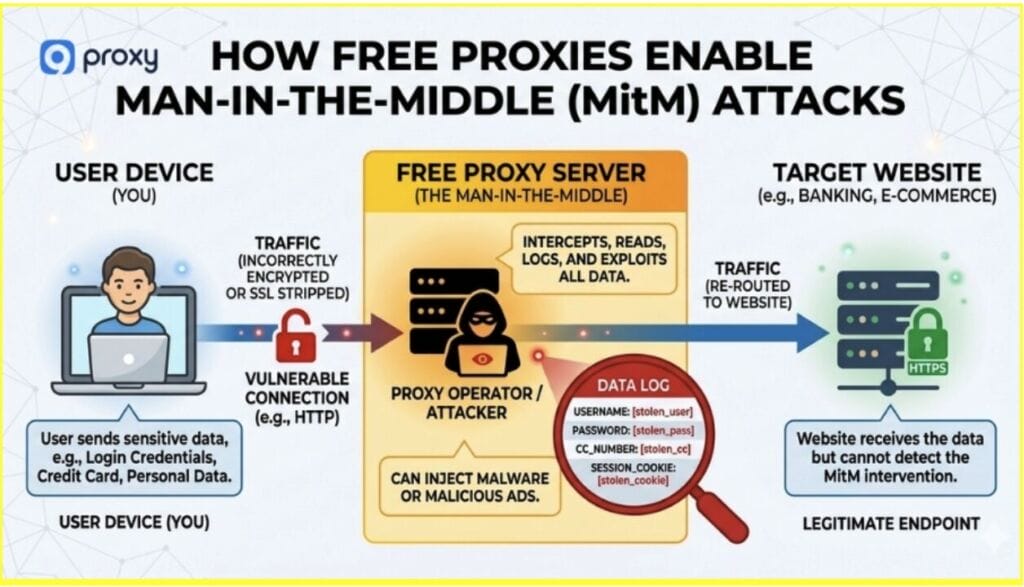
The most serious risk with free proxy services is one that most casual users never consider: the proxy owner can see everything passing through their server.
Many free proxies do not enforce HTTPS encryption. This means your traffic, login credentials, session cookies, form submissions, and yes, banking details, travel in a format that the proxy operator can read, log, and exploit. This is a classic man-in-the-middle attack, and free proxies are one of the easiest ways to execute it at scale.
You think you’re anonymous. In reality, you’ve just handed a stranger a front-row seat to your browsing session.
Even when HTTPS is technically supported, some free proxy servers use SSL stripping techniques to downgrade your connection without your knowledge. The padlock in your browser is no guarantee of safety when the proxy itself is the threat.
2. Malware Injection and Malicious Ads
Here’s how many free proxy operators actually make money: they inject advertisements directly into the web pages you visit. That travel booking site you’re browsing suddenly has banner ads that weren’t there before. The article you’re reading has a pop-up offering you a “system scan.”
This ad injection is not just annoying; it is genuinely dangerous. A significant portion of these injected ads are laced with malware, redirect you to phishing pages, or silently download scripts onto your device. Security researchers have documented cases where free proxy services were directly tied to malware distribution campaigns, with users having no idea the threat originated from their proxy connection.
The business model becomes clear: your data is monetized, your browser is a billboard, and your device is a potential delivery vehicle for malicious code.
3. IP Blacklisting and Terrible Performance
Even if you manage to avoid the security pitfalls above, there’s a practical problem that will frustrate you almost immediately: the IPs provided by free proxy services are terrible.
Because thousands of users share the same pool of free IP addresses, many of them running spam campaigns, credential stuffing attacks, and aggressive scraping bots, those IPs get flagged fast. Major platforms like Google, Amazon, Cloudflare, and most e-commerce sites maintain constantly updated blocklists. Free proxy IPs are almost always on them.
The result? Endless CAPTCHAs. Slow load times that make simple tasks take ten times longer than they should. Outright blocks that prevent you from reaching your target site at all. You came looking for efficiency and ended up with a worse browsing experience than if you’d used no proxy at all.
We Tested 100 “Fresh” Free Proxies – Here’s What Happened
To see if the 2026 “Free Proxy Lists” still hold up, our team ran a script to test 100 IPs pulled from top-ranking GitHub repos and proxy forums.
- Connection Success: Only 14 out of 100 even responded to a ping.
- Security Alert: 6 IPs attempted to perform an SSL-strip (downgrading HTTPS to HTTP).
- Usability: Of the 14 that worked, 0 were able to load Google or Amazon without an immediate 403 Forbidden error or an endless loop of CAPTCHA.
Conclusion: You spend more time “hunting” for a working IP than actually getting your work done.
The Trap of the “Free Proxy List” Search
When one free proxy stops working, and it will, the natural next move is to go hunting for a fresh list. Search forums, GitHub repositories, and scraper communities are full of threads sharing what claims to be the latest working free proxy list.
The problem is the fundamental economics of this habit. By the time an IP address makes it onto a publicly shared list, it has typically already been hammered by bots, flagged by major platforms, and added to commercial blocklists. The “fresh” list you just downloaded is a graveyard.
Testing each entry manually is a time sink. Automating the testing requires a technical setup. And even when you find a handful of IPs that still respond, their speeds are usually so throttled, because dozens of other people found the same list at the same time, that they’re effectively useless for any serious task.
The hidden cost of free proxy hunting isn’t financial. It’s hours of your time burned on infrastructure that was never designed to be reliable.
Is There Such a Thing as the “Best Free Proxy”?
To be fair, the best free proxy isn’t always a complete myth. There are a handful of legitimate free options worth knowing about, but they come with serious asterisks.
Reputable cybersecurity companies, the ones that make their money selling premium VPN or proxy subscriptions, sometimes offer a genuinely safe free tier as a way to attract users to their paid plans. These are typically well-maintained, don’t inject ads, and don’t harvest your data. They’re the closest thing to a trustworthy free option.
The catch is that “free tier” usually means 500MB of data per month, connections limited to one or two server locations, speeds throttled to push you toward upgrading, and zero support if something breaks.
For casual, low-stakes browsing, that might be acceptable. For anything involving consistent web scraping, account management, automated workflows, or accessing geo-restricted content regularly, it falls apart almost immediately. The restrictions aren’t a bug; they’re the product. The goal is conversion, not usability.
The Safest Free Options in 2026
If you absolutely cannot spend a dime today, do not use a “Proxy List” from a random forum. Instead, use a limited free plan from an established cybersecurity firm. These are safe because their business model relies on you eventually upgrading to their paid version, not on stealing your data.
- Proton VPN (Free): Best for unlimited data. It’s Swiss-based and audited, but you can’t choose your location; it chooses for you.
- Windscribe (Free): Offers 10GB/month and excellent privacy features (like R.O.B.E.R.T. ad-blocking), but once you hit that 10GB, you’re cut off.
- Webshare: Offers a small “Permanent Free” pool of 10 proxies. It’s stable but highly restricted in terms of bandwidth.
Why Residential Proxies Are the Only 2026 Standard
If you’ve tried scraping or accessing high-security sites recently, you’ve probably noticed that even “working” proxies often lead to immediate blocks. That’s because, in 2026, anti-bot systems like Cloudflare, DataDome, and Akamai have moved beyond simple IP blacklisting. They now use Multi-Layer Identity Checks.
Here is why Residential Proxies (like those from 9Proxy) are the only way to stay invisible:
Bypassing JA3/TLS Fingerprinting
Every time your browser “talks” to a server, it performs a TLS handshake. This handshake contains a unique “fingerprint” (called a JA3 hash) that reveals exactly what software you’re using.
- The Free Proxy Trap: Most free proxies use outdated libraries that produce a “bot-like” JA3 hash.
- The Residential Edge: Residential IPs belong to real home devices (Windows, Mac, iPhone). When your traffic passes through them, the network-level signals, like TCP window size and packet ordering, perfectly match a real human’s machine. It doesn’t just hide your identity; it adopts a trustworthy one.
Defeating Behavioral Analysis
Modern sites track “behavioral biometrics”, how you scroll, how fast you click, and your request patterns.
- The Problem: Datacenter IPs (the ones used by free proxies) are “static” and “linear.” They are easy for AI to profile.
- The Solution: Residential pools allow for organic rotation. Because the IPs come from real ISPs (Comcast, Viettel, AT&T), the traffic looks like it’s coming from a neighborhood of diverse users rather than a single server rack in a warehouse.
The Reputation Shield
Anti-bot systems assign a “Trust Score” to every IP. Datacenter IPs start with a score of zero. Residential IPs start with a high score because they are shared with real people paying monthly internet bills. Blocking a residential IP risks blocking a legitimate customer, a “collateral damage” risk most websites aren’t willing to take.
The Bottom Line
Finding a free proxy site takes about thirty seconds. Recovering from a compromised login, a malware infection, or a blacklisted IP for your business domain takes considerably longer.
The appeal of free is understandable, but proxy infrastructure is one of those areas where the gap between what’s advertised and what’s actually delivered is wide enough to cause real damage. Whether the threat is data interception, injected malware, or simply wasted time chasing dead IP lists, the true cost of free proxies is consistently higher than the price of a reliable paid alternative.
Your digital privacy and your data are worth protecting. The good news is that in 2026, protecting them doesn’t have to be expensive; it just has to be intentional.