Arizona added more construction jobs than any other state in the US over the past year. Phoenix is the fastest-growing large metro in the country. Scottsdale’s hospitality sector is expanding, Tucson is seeing record tourism numbers, and the semiconductor manufacturing corridor along the I-17 is bringing billions in new industrial development.
What nobody’s talking about is what all that growth produces: waste. Enormous quantities of it. Cardboard from every new retail fit-out and restaurant opening. Glass from every bar and resort in the Valley. Packaging from every distribution centre feeding the state’s booming population. And most Arizona businesses are still handling it the same way they did when the metro population was half what it is today — paying by the pickup, by the bin lift, by the cubic yard, and watching waste management quietly become one of their fastest-growing operating costs.
The problem isn’t that solutions don’t exist. Companies like Gradeall International, a Northern Ireland-based manufacturer that builds balers, compactors, glass crushers, and waste handling equipment for commercial and industrial operations worldwide, have been producing the machinery that solves this exact problem for years. A complete guide to baler machine types reveals just how many options are available — from compact vertical balers designed for restaurants and retail shops to high-throughput horizontal systems built for distribution centres and manufacturing plants. The issue is that most business owners in Arizona have never been shown the equipment that could cut their waste bills in half.
The Cardboard Problem Behind Every New Build
Walk behind any commercial development in Chandler, Gilbert, Goodyear, or Surprise — the municipalities where Arizona’s growth is hitting hardest — and the cardboard situation tells the story. New restaurants unpacking kitchen equipment. Retail tenants receiving inventory for grand openings. Office build-outs generating mountains of packaging from furniture, IT equipment, and fixtures. The construction phase produces its own cardboard mountain from material packaging, and it never really stops once the tenants move in.
A mid-size restaurant in the Phoenix metro receiving daily deliveries can generate enough loose cardboard to fill a dumpster every two to three days. A retail operation during seasonal restocking might double that. A distribution centre — and Arizona has hundreds of them clustered along the I-10, I-17, and Loop 303 corridors — produces volumes that can overwhelm standard waste collection within hours.
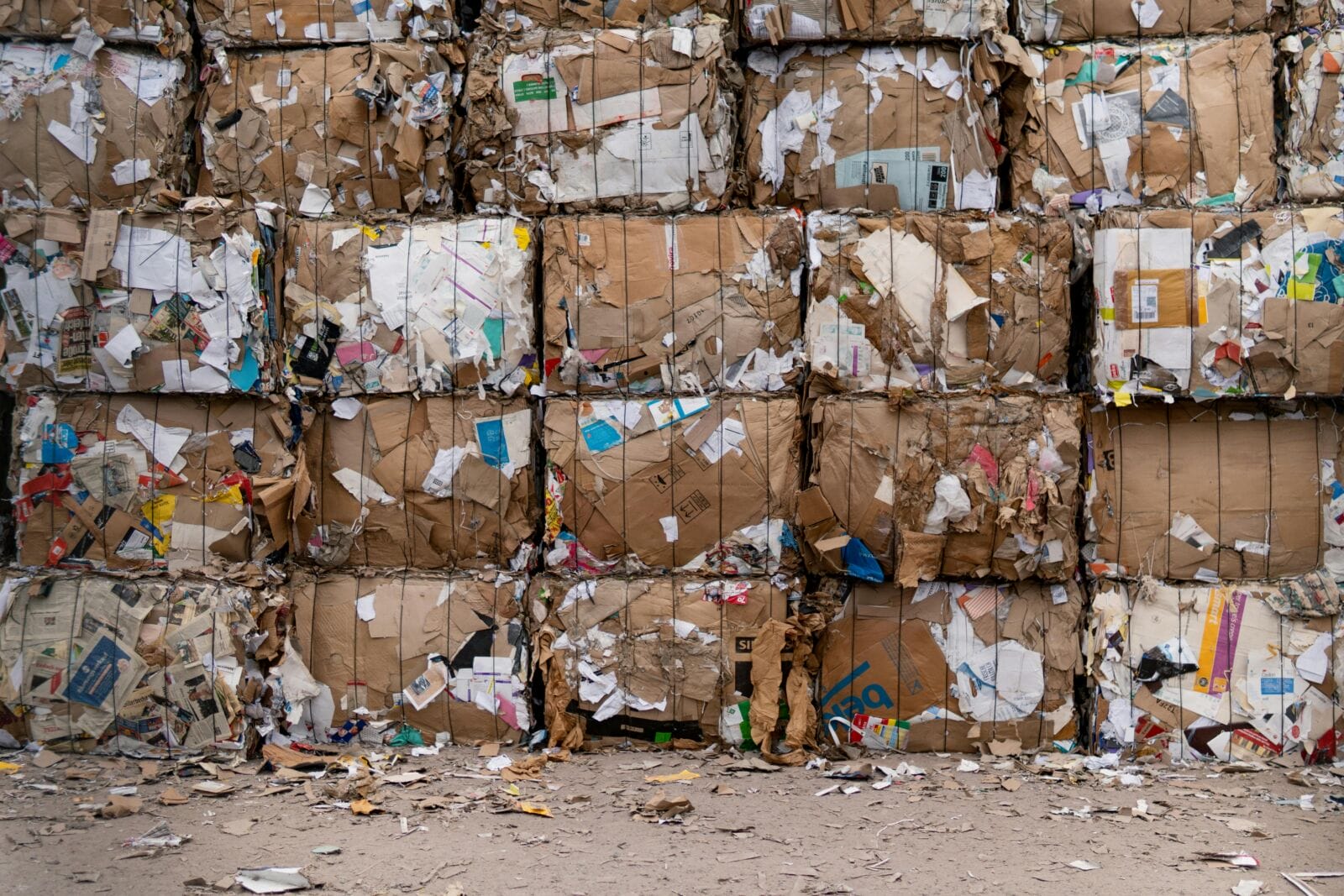
The economics are straightforward but widely misunderstood. Loose cardboard is roughly 90% air. A dumpster full of uncompressed boxes contains a fraction of the material weight that the same container could hold if the cardboard were baled. Every collection of an under-filled dumpster is money spent hauling air.
A cardboard baler changes that equation entirely. By compressing loose cardboard into dense, strapped bales, a baler reduces volume by 75% to 90%. For an Arizona business paying for waste collection by pickup or by volume, that reduction translates directly into fewer collections, lower invoices, and a smaller footprint for waste storage in the loading area — which matters significantly when commercial rents in Scottsdale, Tempe, or central Phoenix mean every square foot of back-of-house space has a dollar value.
There’s a revenue side too. Clean, dense cardboard bales are a tradeable commodity. Recycling brokers and paper mills purchase baled cardboard at market rates that fluctuate but consistently make on-site baling a net-positive financial decision for businesses generating sufficient volume. What was a cost line on the P&L becomes a modest but measurable revenue stream.
For businesses across the Valley — from the restaurant groups along Camelback Road and Scottsdale Road to the logistics operations in the West Valley’s industrial parks — the arithmetic is the same. Compress it, bale it, and either sell it or dramatically reduce collection costs. The payback period on a baler typically runs months, not years.
The Glass Equation the Hospitality Sector Ignores
Arizona’s hospitality industry generates staggering volumes of glass waste. The resorts along Scottsdale’s Indian Bend Wash corridor, the bars and restaurants on Mill Avenue in Tempe, the tasting rooms in the Verde Valley wine region, the event venues in downtown Phoenix — every one of them accumulates hundreds or thousands of bottles per week.
The standard approach is collection in bins or skips, stored until pickup, hauled away whole. It’s the most expensive way to handle glass because whole bottles take up maximum space and weigh the minimum amount relative to their volume. A waste carrier charging by volume or by lift is effectively charging the venue to transport empty space.
A large glass crusher offers a fundamentally different model. The machine reduces whole bottles to cullet — crushed glass fragments that occupy a fraction of the original volume. A bottle that displaces 330ml as a whole vessel takes up a fraction of that once crushed. For a high-volume hospitality operation, the volume reduction means dramatically fewer collections, lower waste management costs, and less storage space consumed by glass bins in areas that could be used for revenue-generating purposes.
The crushed cullet itself is a useful material. It’s used in glass manufacturing as a raw material input, in road construction as aggregate, in water filtration systems, and in decorative landscaping applications — the last of which has particular relevance in Arizona, where crushed glass aggregate is used in xeriscaping and desert landscaping projects across residential and commercial developments.
For Arizona’s resort and hospitality operators — where guest experience depends on keeping service areas clean, quiet, and efficient — the operational benefits extend beyond cost savings. Glass crushers reduce the noise associated with bottle handling and collection, decrease the frequency of collection vehicle visits to the property, and eliminate the visual impact of overflowing bottle skips in service areas that guests may see or pass through.
Consider the Scottsdale hospitality corridor alone. Dozens of high-end restaurants, resort bars, and event venues operating within a few miles of each other, each generating hundreds of bottles nightly, each paying independently for glass waste collection. The aggregate waste management spend across that corridor is substantial — and the majority of it is paying for the transportation of air inside empty bottles.
Why Arizona Businesses Don’t Know This
The waste management industry in Arizona operates on a model that benefits from customer ignorance. Waste carriers generate revenue from collection frequency and volume. A customer who installs a baler or crusher needs fewer collections. The carrier earns less from that account.
This isn’t unique to Arizona — it’s an industry-wide misalignment of incentives. But Arizona’s rapid growth amplifies the problem. New businesses opening every week inherit the default waste management model without questioning it. They sign a collection contract, accept the pricing, and add the line item to their overheads without ever being presented with the alternative of on-site processing equipment.
Equipment manufacturers like Gradeall International — which builds vertical and horizontal balers for cardboard, plastics, and mixed recyclables, glass crushers for hospitality and municipal operations, waste compactors for commercial facilities, tyre balers including the MK2 and MK3 models that process 400 to 500 tyres per hour, sidewall cutters for passenger, truck, and off-the-road mining tyres, and tipping skips for material handling at recycling centres, all from their production facility in Dungannon, Northern Ireland, and shipped to operations across the US, UK, Europe, Middle East, and Australia — operate in a different part of the market from the waste carriers. They sell the machinery that reduces the carrier’s revenue from each account. Understandably, the carriers aren’t rushing to make that introduction.
The result is an information gap that costs Arizona businesses real money. The equipment exists. The economics are proven. The payback is measurable. But most business owners in the state have never had the conversation because nobody in their existing waste supply chain has any reason to start it.
The Growth Multiplier
Arizona’s waste challenge is going to intensify, not ease. TSMC’s semiconductor fab in north Phoenix is bringing thousands of jobs and hundreds of supplier businesses. The West Valley’s logistics corridor continues to expand. Mesa and Gilbert are adding commercial development at a pace that rivals anywhere in the Sun Belt. Each new business, each new facility, each new development adds to the waste stream — and to the collective spend on waste management across the state.
For business owners and facility managers across the metro, the question isn’t whether waste costs will increase. Growth guarantees they will. The question is whether you’ll keep paying full price for hauling air, or whether you’ll invest in equipment that changes the underlying economics permanently.
The businesses making that shift aren’t the ones reading sustainability reports. They’re the ones reading their waste invoices — and deciding they’ve paid enough.