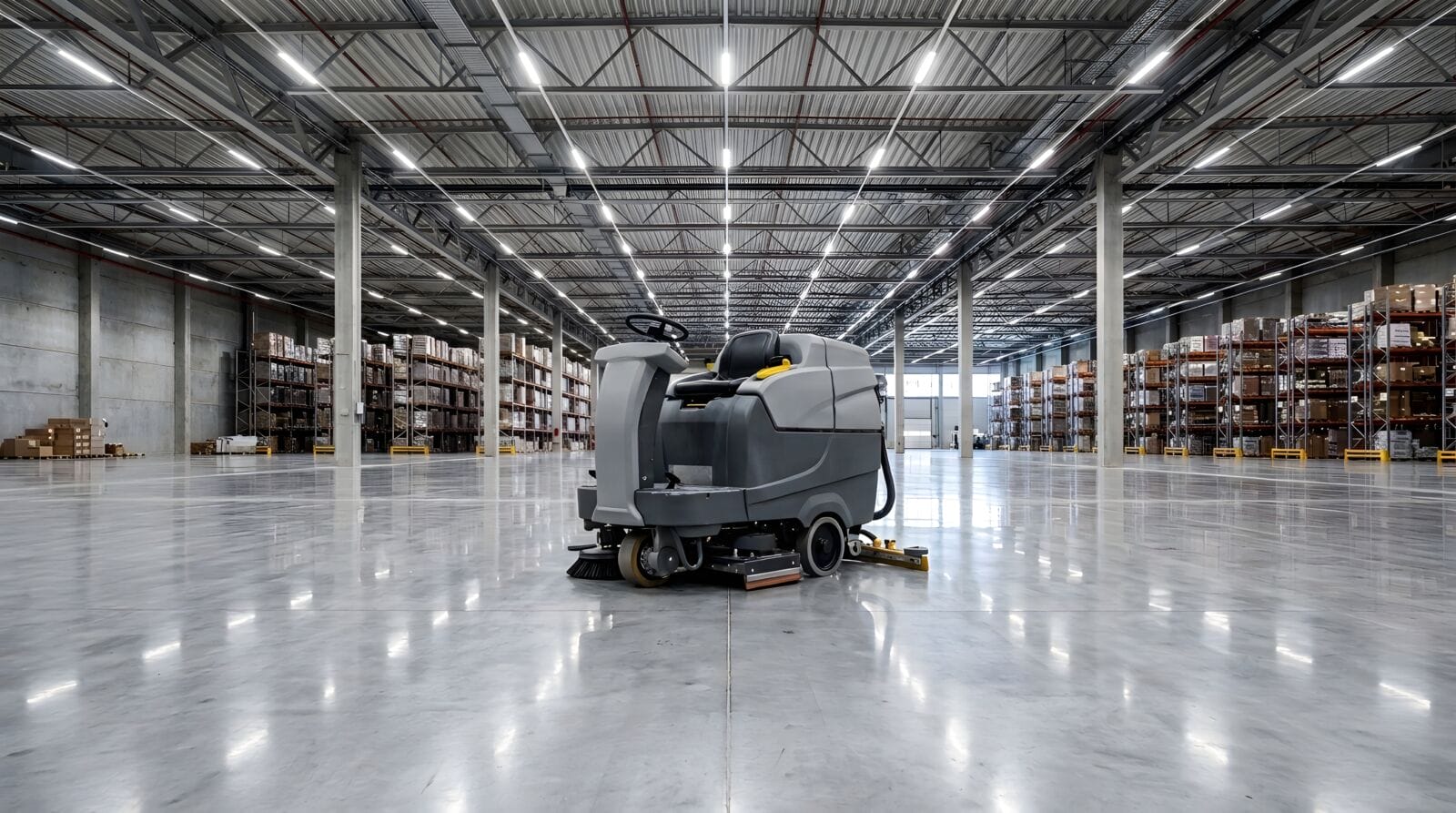
A warehouse may have plenty of open floor on a building plan, yet little uninterrupted space for a cleaning machine. Storage racks narrow the route, pallets appear in staging areas, and forklifts move through the same aisles the cleaning team needs to use. The loading dock may collect dry grit and packaging scraps, while tire marks and spills appear farther inside.
These conditions make total square footage a weak guide to equipment selection. Warehouse operators need to know which parts of the floor require daily attention, what has to be removed and when each section can be taken out of traffic. A machine can only be judged against the work it will actually do.
Separate the Cleaning Tasks Before Choosing a Machine
Begin with the material on the floor. Loading areas may collect dust, grit, pallet chips and torn packaging. These are primarily dry-collection tasks. On suitable hard surfaces, floor sweepers can collect loose, dry debris before wet cleaning begins.
Adhered soil requires a different process. On compatible hard floors, commercial floor scrubbers use brushes or pads with cleaning solution and recover the dirty water. Tire marks or tracked-in dirt may call for that type of cleaning, depending on the floor finish and the residue. The floor supplier’s maintenance instructions should guide the choice of pad, brush and cleaning agent.
Do not fold every spill into the routine cleaning route. An unknown substance, a chemical leak or another controlled material calls for the warehouse’s approved spill procedure and trained personnel. Identifying those areas before selecting equipment prevents a general-purpose machine from being assigned a task it was not meant to handle.
Some warehouses will need both sweeping and scrubbing. Others may have separate teams or contractors for particular areas. The useful distinction is the task, not the number of machines in the catalogue.
Map the Route the Machine Can Actually Travel
Once the tasks are clear, trace the route from the equipment parking area through the aisles, staging zones and loading docks. Mark the narrowest doorway or aisle, the space available at rack ends and any place where the operator must turn or reverse. A machine that passes through the entrance may still be too awkward to use between racks.
Check the full machine dimensions, including components that extend beyond its cleaning path. A floor scrubber’s squeegee, for example, may be wider than its scrubbing deck. A ride-on unit may cover a long open aisle efficiently but lose that advantage if the operator has to make repeated multi-point turns. A walk-behind unit may fit divided routes more easily, though the walking distance and operator effort still matter.
The map should also show where people and vehicles cross the cleaning route. A main pick aisle, a pedestrian crossing and a loading bay may each need a different time slot. If pallets regularly block a section, note that as an operating condition rather than assuming the entire marked floor area is available every night.
Compare the Workload With the Available Window
Warehouse cleaning time is rarely equal to machine operating time. Teams travel to the first area, collect loose debris, clean around obstacles, empty a hopper or recovery tank and return the equipment to its service point. Wet cleaning may require a separate pass after sweeping. These steps belong in the schedule.
Published productivity figures can help create a shortlist, but they usually describe rated operating conditions rather than a specific warehouse route. For each candidate, estimate the area that can be reached in the available window after turns, overlaps and service stops are included. Battery runtime and charging time matter where the machine is battery powered; a corded machine brings a different set of access and cable-management questions.
Tank or hopper size has a similar trade-off. More capacity may reduce service stops, but a larger machine may need more turning, parking or storage space. The location of water, drainage and debris disposal can matter as much as the capacity listed on the specification sheet. A route that finishes at the far end of the building still includes the return trip.
Include Traffic Control and Daily Servicing
Equipment must fit the warehouse’s operating procedures. Cleaning beside active forklift traffic can create conflicts even when the machine itself fits the aisle. Plan which areas can be serviced during quieter periods and how workers will manage temporary wet floors or an unexpected spill. OSHA’s walking-working surfaces rule calls for work areas to be kept clean and orderly and floors to be kept dry to the extent feasible; equipment selection does not replace the site’s traffic and housekeeping controls.
Daily care also takes space and time. A sweeper may need its hopper emptied and its collection components checked. A scrubber may need its recovery tank rinsed and its brushes, pads and water-recovery parts inspected. The exact routine depends on the selected model and its instructions. Before purchase, identify where the machine will be parked, charged if applicable, refilled, emptied and cleaned.
Ask suppliers which consumables and service parts are needed for the proposed configuration. A machine that fits the route but cannot be serviced within the shift may create a new bottleneck rather than remove one.
Test the Shortlist on the Same Warehouse Route
A site trial should cover more than an open patch of concrete. Use a representative route that includes a rack-end turn, a narrow section and a loading or staging area. Schedule it within a realistic cleaning window and follow the site’s traffic controls. For a scrubber, observe the cleaning result and water recovery; for a sweeper, check debris pickup and how the operator empties the hopper.
Record the time spent cleaning, repositioning, emptying, refilling and returning the machine to storage. Note where the operator needed help or had to leave an area unfinished. Use the same route and recording method for each shortlisted option so that one demonstration is not judged against another conducted under easier conditions.
The starting document can be one page: floor tasks by zone, the narrowest access points, traffic restrictions, available cleaning windows and service locations. With that information, warehouse operators can reject machines that do not fit before comparing price or headline productivity.