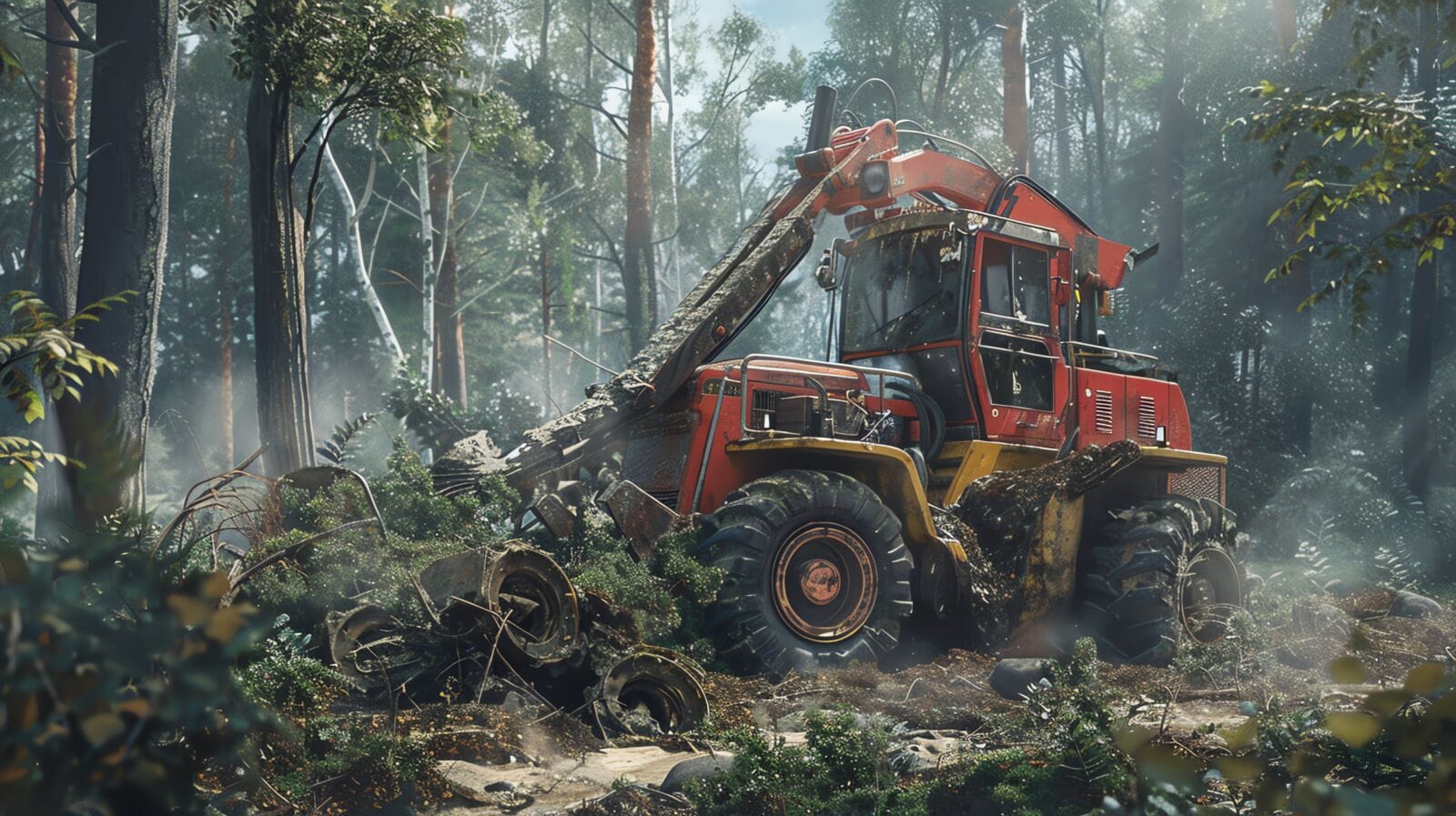
Forestry operations are becoming increasingly complex and time-sensitive, especially when carried out across large areas. Whether it’s about preparing land for new crops, managing wildland-urban interfaces, or restoring degraded forests, professionals require solutions that combine power, reliability, and long-lasting performance.
Tractor-mounted forestry mulchers offer exactly that: a high-productivity solution that streamlines land clearing by reducing the number of passes, minimizing manual labor, and delivering consistently high-quality results even in demanding environments.
Why tractors remain a solid choice for mulching operations
Tractors continue to be a preferred carrier for mulching heads due to their mechanical simplicity, wide availability, and adaptability. Most forestry operations already rely on tractors for other tasks, making them a logical and cost-effective base for mulching attachments. Their PTO-driven systems allow the transfer of high torque to the mulcher, and with models ranging from 50 to over 500 horsepower, they can meet the needs of diverse forestry projects.
In addition, tractors are well-suited to handle uneven terrain, long work hours, and remote conditions – especially when equipped with forestry-specific protection and heavy-duty tires. Their ability to support wide, robust mulching heads enables efficient coverage of vast areas in less time.
Key performance factors of tractor-mounted mulchers in large-scale forestry
The effectiveness of a mulcher for tractor depends on several core performance aspects:
- Working width and ground speed. A wider mulching head allows operators to cover more ground per pass, significantly boosting daily productivity.
- Cutting capacity. High-quality mulching heads are designed to handle dense vegetation, trees, and stumps up to 20 inches in diameter.
- Rotor and tool configuration. Different forestry scenarios require tailored rotor types (fixed tooth or swinging hammer) and tool shapes. Proper configuration ensures better cutting efficiency and material distribution on the ground.
- Thermal management. Large-scale operations demand continuous use. Well-designed mulchers dissipate heat effectively to maintain performance and avoid downtime.
- Depth control and mulching uniformity. Fine control over working depth allows for consistent mulching results – essential when preparing land for new vegetation or leaving behind a clean, manageable surface.
DEEPER DIVE: Top 10 Arizona ZIP codes people are moving to in 2025
LOCAL NEWS: 100 best places to work and live in Arizona for 2025
Efficiency across different forestry scenarios
Tractor-mounted forestry mulchers excel in a variety of operational contexts:
- In large-scale clearing, they help reclaim uncultivated or overgrown land efficiently, minimizing the need for bulldozers or excavators.
- For fire mitigation, they are used to create firebreaks and remove combustible material, playing a preventive role in high-risk zones.
- In post-fire recovery, mulchers help clear burnt vegetation quickly, paving the way for reforestation or controlled regrowth.
- Along power lines, roads, and pipelines, these machines ensure safe and accessible rights-of-way by managing vegetation with precision.
- On orchards and plantations, tractor mulchers assist in routine maintenance by processing undergrowth with minimal soil disturbance.
Considerations for selecting the right equipment setup
To maximize productivity, it’s critical to match the mulching head with a tractor of adequate horsepower and hydraulic capacity. Underpowered setups may underperform or strain the tractor’s drivetrain, while an oversized attachment can create balance and mobility issues.
Professionals should also consider:
- The PTO rating and compatibility with the chosen mulching attachment.
- The weight of the mulcher, which affects stability and traction, especially on slopes or wet ground.
- The accessibility of the work site, ensuring that the tractor and equipment can be transported and operated safely.
- A preventive maintenance schedule, which includes rotor inspection, tool replacement, and gearbox servicing, to keep the equipment running at peak efficiency.
Enhancing productivity through smart equipment choices
Forestry mulchers for tractors are a reliable and efficient choice for large-scale land clearing. Their versatility, combined with the availability of powerful tractors and advanced PTO systems, makes them a high-value investment for professionals in forestry and land management.
Choosing the right setup – from tractor specs to mulcher configuration – is key to boosting productivity, reducing operational costs, and ensuring consistent results in even the most demanding environments.
FAE mulchers for tractors: power, precision, and professional reliability
With a legacy that dates to 1989, FAE has established itself as a benchmark in the development and production of professional-grade mulching heads for tractors, as well as for skid steers, excavators, tracked carriers, and special vehicles.
Thanks to its in-depth knowledge of sectors such as forestry, agriculture, infrastructure maintenance, and even demining, the company delivers innovative solutions for land clearing and vegetation control.
FAE’s tractor mulchers are the result of decades of engineering expertise and continuous innovation. Built from premium materials and enhanced by cutting-edge technology, these attachments are engineered to handle tough workloads in the most challenging environments.
They offer the ability to mulch wood, shrubs, stumps, roots, and trees up to 20 inches in diameter, combining power and precision in every operation.
The product range includes models designed to suit various power classes and working conditions, from mid-size tractors to high-horsepower units required for intensive clearing operations. FAE’s mulchers are renowned for their structural integrity, rotor performance, and durability – qualities that ensure high output and long-term efficiency.
Whether used in thick forests, overgrown fields, or mixed terrain, FAE’s mulchers for tractors provide the consistency and dependability that professionals need to manage vegetation with accuracy and confidence.