
“Lab tested” is one of the most repeated phrases in online commerce and one of the least defined. It appears on supplement pages, research-compound listings, private-label marketing briefs and wholesale pitches, usually without a document attached. When a document is attached, it is often described loosely as a certificate, a lab report or a test report, as though those were the same thing.
They are not, and the gap between them is where most buyers get misled. Whether you are a consumer deciding on a single order or a business vetting a supplier before a purchase order, the question is narrow and answerable: does the paperwork in front of you actually describe the material you are buying? Here is how to tell.
What the two documents really are
A certificate of analysis, usually shortened to COA, is a laboratory-issued summary tied to a specific batch or lot. A complete one identifies the sample, names the laboratory that performed the testing, lists the test methods used, reports the result and the specification it was measured against, carries the lot number and the date of testing, and is attributable to a person or an issuing system at that lab.
“Test report” is the looser term. It can legitimately mean the underlying instrument output behind a certificate, but in commerce it frequently means something weaker: a partial panel, an internal document produced by the seller’s own facility, or a page of results with no lot number and no named laboratory. A purity percentage alone, printed on a supplier’s own letterhead, is not third-party evidence of anything.
This distinction matters well beyond supplements. Procurement teams in every industry ask suppliers the same three questions about documentation, and the answers are usually more revealing than the price: who produced the document, which batch does it cover, and what exactly was measured.
The four checks that separate evidence from marketing
Most of the value in reviewing batch documentation comes from four checks, and each one is quick. Fail any of them and the document should be treated as marketing material rather than evidence.
The fourth check is coverage and date. A single certificate published once and reused across a year of listings is not batch documentation; it is a screenshot. The question to ask is structural: does the seller publish a document for each batch as it is released, and does the newest document on the page carry a recent date? Vendors that test every batch show it in the way their library is organised, because a per-batch library is expensive to fake and tedious to maintain.
A useful sanity check on all four is to ask the seller directly — for the certificate for the exact lot you received — and to watch how they respond. A supplier with a real testing program will send it. A supplier working from one recycled document will change the subject, quote a purity figure again, or offer a discount instead.
DEEPER DIVE: Here are Arizona’s Most Admired Companies of 2026
Specifications are not the same as results
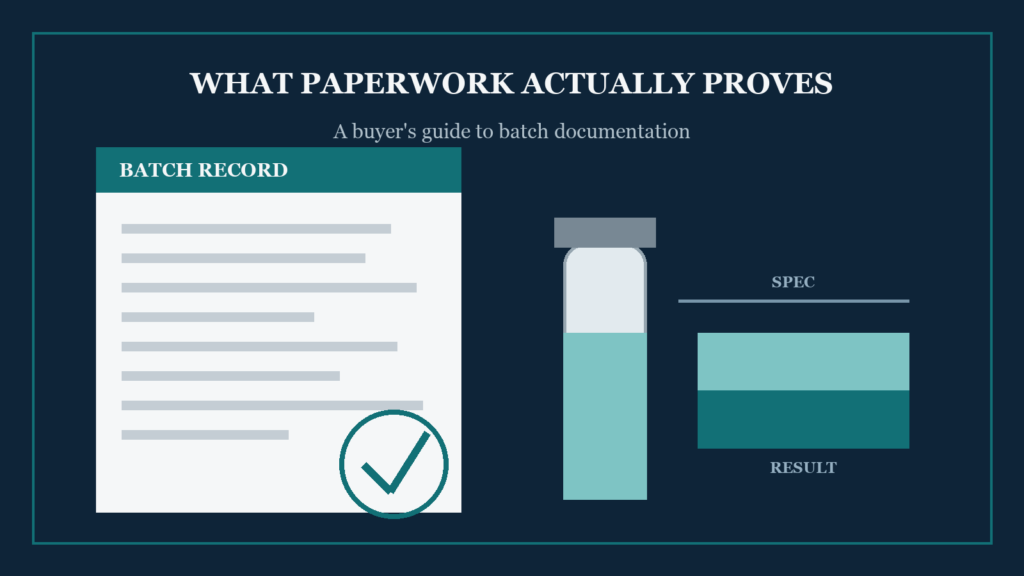
A certificate normally shows three things side by side: the test performed, the specification the seller set, and the measured result. All three are worth reading, because a specification is a promise and a result is a measurement, and they can be comfortable in quite different ways. A document showing a specification of not less than 98 percent against a measured 98.4 percent is doing its job. A document that reports a figure with no specification beside it leaves you unable to tell whether the batch met the seller’s own standard, let alone anyone else’s.
The method matters for the same reason. High-performance liquid chromatography and mass spectrometry answer different questions — one separates and quantifies components, the other confirms identity — so a certificate that names its method tells you which question was actually asked. Where a panel includes elemental impurities, results are typically reported against defined limits such as the thresholds in the USP General Chapters <232> and <233>, which is what turns a line like “lead: below limit” into a meaningful statement rather than decoration.
Why the weaker version of the paperwork is common
Testing costs money, takes time, and occasionally produces a result a seller would rather not publish. That incentive quietly shapes what appears on a product page: one well-lit certificate reused across an entire catalogue, a purity figure with no lot number attached to it, or the phrase “third-party tested” standing in for a document nobody outside the company has seen.
None of that is an accusation against any particular seller; most of it is simply how marketing copy drifts away from laboratory practice. It is the reason the four checks exist, and the reason they are worth running before a purchase rather than after one arrives.
A documentation request that gets a straight answer
If you are evaluating a supplier, one email settles most of the question. Ask for the certificate that covers the exact lot you would receive, the name of the laboratory that issued it, the methods used, and the specification each result was measured against. Then ask two structural questions: is a certificate published for every batch or supplied only on request, and how long are those documents retained?
The replies sort sellers quickly. A supplier with a working testing programme answers with a document attached and a lot number that matches the product. A supplier that cannot produce one responds with a purity claim, a link to a general quality page, or a discount — which is itself the answer.
What a public documentation library looks like in practice
The clearest way to judge a standard is to see it applied. Some sellers publish their batch documentation rather than sending it only on request, and the difference is immediately visible: certificates appear against individual listings and strengths instead of a single page in a footer, and the reports go beyond a purity number.
One example reviewed in detail is PS Peptides, a United States-based research supplier whose published library includes compound- and strength-specific certificates, with heavy-metals and endotoxin reports surfaced for several of its major listings. That review also records the parts a buyer’s guide usually skips: a Trustpilot score of 4.6 out of 5 from 63 reviews when it was checked on August 14, 2026, plus policy terms worth reading before ordering — ordinary returns are not accepted, damage claims carry a three-day window, and first orders can require an adult signature and research-buyer screening. For the full breakdown of its testing library, shipping and refund terms, the documentation is set out in an independent PS Peptides review, which pairs each vendor claim with what the seller actually publishes and what its own policies require.
Policy terms belong in the same review as the chemistry, because a supplier can publish excellent documents and still have return conditions that make an error expensive. Both halves are part of the same decision.
If you are buying on behalf of a business
The four checks scale from a single order to a supplier file. Teams that buy research materials, ingredients or private-label stock tend to add two habits to them: requiring the certificate for each incoming lot instead of accepting one document per supplier per year, and archiving those documents beside the purchase record so a later question can be answered without going back to the vendor.
The second habit is where published documentation earns its keep. When a seller makes batch records public, keeping a supplier file current becomes a copy-and-file step rather than a monthly negotiation. When it does not, every audit becomes a request, and every request is a delay.
What documentation cannot tell you
A clean certificate of analysis does not make a product safe, legal or approved, and it is important to be precise about that. It reports what a laboratory measured on a sample. It does not establish that a substance is appropriate for human use, and it says nothing about how a material will be handled or administered after it ships.
Regulators have been explicit on this point for research-grade peptides. The Food and Drug Administration issued a warning letter to Pinnacle Professional Research, doing business as Pinnacle Peptides, in December 2025 over the marketing of unapproved products, and in August 2026 a group of state nursing and medical boards jointly issued a notice about the prescribing of non-FDA-approved research-grade peptides. Materials sold for laboratory research are exactly that: research materials, not medicines, and not a substitute for care from a qualified clinician.
The short version
Read the document, not the claim. Check that the lot number matches the package, that a named laboratory performed the test and is accredited for that specific test, that the panel covers more than one purity number, and that certificates are published per batch rather than recycled. Then read the seller’s returns and screening terms with the same attention, because those decide what happens when something goes wrong.
Done properly, that review takes a few minutes and settles the only question that matters at the point of purchase: whether the paperwork describes the material in the box. When it does, the purchase is a considered one. When it does not, no purity figure on a landing page can fill the gap.