
A service map can look tidy in a planning document and fail the first customer who uses it. A ten-mile circle treats every direction as equal. The team on the road knows otherwise: a morning job in Mesa followed by an afternoon booking in Glendale creates a different day from two visits clustered on the same side of the Valley, even when each address falls inside the published zone.
For Phoenix-area businesses that visit homes, deliver specialised goods or schedule in-person consultations, geography is part of the product. The question is not merely where the company is willing to go. It is which promise the company can keep without making arrival times unreliable or pushing hidden travel costs onto staff and customers.
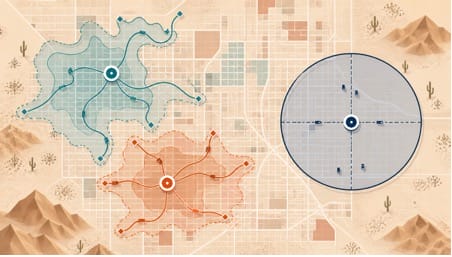
A Postal Boundary Is Not an Operating Plan
ZIP codes and fixed radii are easy to publish. They are also blunt. They do not account for the starting point of the team, the time of the appointment, the duration of the visit or what must happen immediately afterwards. A rule that ignores those factors may accept an order that disrupts the rest of the day.
Start with the service promise. If customers receive a two-hour arrival window, the zone must protect that window. If the job requires equipment or a specialist employee, the map must begin from the relevant depot or schedule, not the company’s mailing address.
Map the Constraint the Customer Actually Feels
Customers rarely care whether they are 9.8 or 10.2 miles away. They care whether the business will accept the booking, arrive when promised and explain any surcharge before checkout. The internal model can be complex; the customer-facing rule should produce a clear answer.
Compare Four Ways to Define Service Geography
No single model fits every Phoenix operation. A company should choose based on job duration, route volatility and how easily part of the work can move online.
| Model | Works best when | Main failure |
| Fixed radius | Trips are similar and the promise is simple | Equal distance can hide unequal travel time |
| Travel-time zone | Arrival windows matter more than mileage | The boundary changes by hour |
| Appointment corridor | Jobs can be grouped along one route | Availability varies by day |
| Hybrid service | Intake or follow-up can happen remotely | The handoff between channels may lose context |
A fixed radius remains useful when the work is predictable and the edge cases are cheap. A travel-time rule is stronger when lateness damages the service. Appointment corridors can make distant bookings viable on selected days, while a hybrid model can reserve travel for the part of the job that genuinely needs a physical presence.
Make Exceptions Visible Before Staff Improvise
Premium jobs, repeat customers and urgent needs will create exception pressure. Decide in advance which conditions justify a longer trip, who can approve it and what changes in the schedule or price. Otherwise, the published boundary remains strict for customers while internal exceptions quietly destabilise the route.
Run the Two O’Clock Schedule Test
Take a proposed address at the edge of the zone and place it into a 2 p.m. slot. What job must finish before it, and where does the team need to be next? If the booking works only when both neighbouring slots remain empty, it is not normal coverage. It is a special trip that needs its own day, price or approval rule.
Digital Services Require a Clear Geographic Promise
A service can avoid travel and still have a meaningful coverage boundary. Palaura describes itself as an AI matchmaker that works through iMessage, requires no separate app download and operates across the United States. Those are public positioning statements, not evidence of local inventory or successful introductions. The relevant point for Arizona businesses is that “digital” does not remove the need to state where a service actually operates.
Coverage can depend on licensing, staff availability, delivery networks, language support or the channel itself. The reason may differ, but the customer needs the same answer: can I use this here, and what happens next? A national label should not force the customer to discover the real boundary after completing intake.
Keep Category Claims From Becoming Regional Proof
Palaura — Alternative to Speed Dating Apps compares a conversational matchmaker with swiping and timed introductions. That category description does not establish a Phoenix partnership, a local pool or better outcomes. Used carefully, the example shows how a product can name both its interaction model and its geographic scope without implying that every location has identical service conditions.
Pilot the Map With Real Appointment Shapes
Before publishing a new zone, take twenty recent or realistic jobs and place them on a working schedule. Include a short visit, a long installation, an early appointment, a late appointment and a job that requires a particular employee. Mark the depot or starting point as well. Then test each zoning model against the promise customers see, not against an empty map.
The useful result is not the largest coloured area. It is the model with the fewest unexplained rejections, late arrivals and manual overrides. Record why each exception occurred. If most exceptions share one route or service type, create a planned corridor or hybrid option instead of widening the entire zone.
Let the Booking Flow Show the Honest Answer
The eligibility check should happen before a customer invests heavily in the form. Ask for the minimum location detail needed to produce a result, then show the available appointment pattern, remote alternative or clear reason the service is unavailable. Do not collect a full brief and reveal the boundary at the end.
A Service Area Is a Promise the Team Can Keep
A radius is attractive because it is easy to draw. A reliable service area is harder: it connects geography to staffing, job length, route conditions and the promise made at booking.
Phoenix businesses do not need the most elaborate mapping system. They need a rule that matches the work, explains exceptions and survives a real day of appointments. Design the boundary around time and handoffs, then describe it in language a customer can act on.