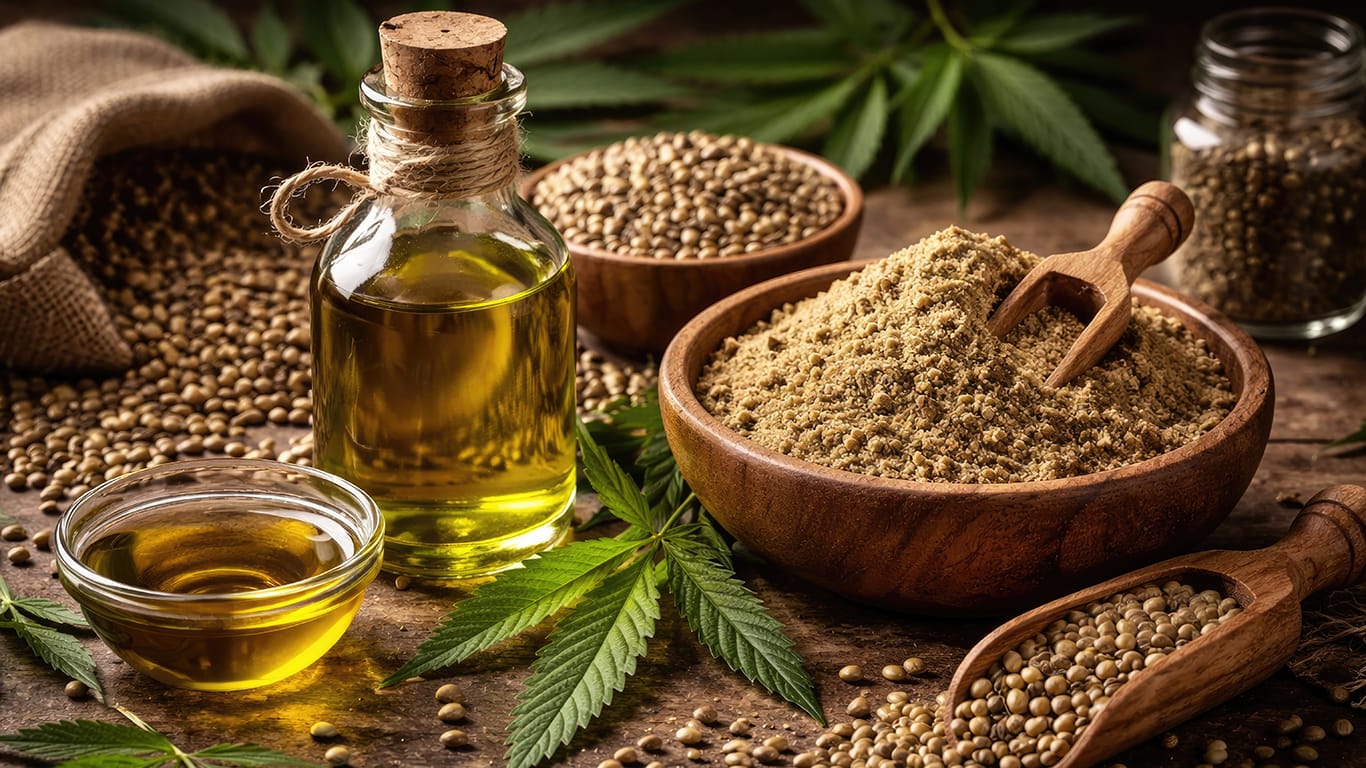
Hemp can become rope, coarse canvas or hulled seeds for food. Those everyday products connect very different chapters of the crop’s history, from archaeological seed finds to naval supplies and modern agriculture.
Historical accounts gathered by USDA’s Agricultural Research Service describe people using cannabis for cordage, textiles, paper, seed oil and protein. This article follows those material and food uses, along with the U.S. policy milestones that explain the crop’s decline and return.
One distinction runs through it all. Hemp seed oil and cannabinoid extracts such as CBD come from different parts of the plant and face different rules, and modern legal definitions of hemp should not be applied to ancient remains.
Key Takeaways
- The earliest evidence in this timeline is a seed find in Japan dated to roughly 8,000 BCE, which shows the plant was present but not how people used it.
- U.S. Navy demand for sailcloth and rope helped build the American hemp industry, while cheaper imported fibers and federal restrictions drove its decline.
- The 2014 and 2018 Farm Bills brought hemp back to U.S. farms after a pause of almost 45 years.
- USDA valued 2025 U.S. hemp production at $739 million, but the fiber segment fell 13 percent.
Ancient Hemp: Useful Fibers and Edible Seeds
The earliest evidence here comes from Japan. Zachary Stansell, a geneticist with USDA’s Agricultural Research Service, describes cannabis seeds recovered from sites associated with the Jōmon period and dated to approximately 8,000 BCE.
The find documents cannabis at a particular place and time. On its own, it does not show that people cultivated the plant or explain how they used it.
It also cannot establish when people first made hemp rope, cloth or paper, since those uses need their own evidence. Calling the seeds industrial hemp would apply a modern legal category to remains whose chemistry has not been established.
Different uses depend on different parts of the plant. Fibers from the outside of the stalk can become rope, thread and paper, while the seeds provide food and oil.
That is why an old reference to hemp needs context. A record of seed use tells a different story from a record of textile production, even when both concern the same plant.
The Age of Sail: Hemp as an Everyday Material
Hemp fiber supplied both rope and canvas for sailing ships. USDA’s historical review of the U.S. hemp industry links the expansion of American production to strong demand for sailcloth and cordage from the U.S. Navy.
Growers supplied a crop that had to be processed into usable fiber before it became cloth or rope. A record of hemp cultivation and a record of finished naval supplies describe different stages of the same industry.
George Washington’s Mount Vernon documents hemp used on the estate for rope, thread for sewing sacks, canvas and repairs to seine nets at its fisheries. Mount Vernon was a plantation whose work depended on enslaved people, and its hemp records belong within that labor history.
Hemp also faced price competition. USDA’s review notes that cheaper imported jute and abaca eventually displaced most domestic production, adding pressure alongside the legal restrictions that followed.
1937 to 1970: Restrictions, Wartime Demand and Decline
Federal policy added further pressure to U.S. hemp production, interrupted by a wartime push to grow the crop.
The Marihuana Tax Act of 1937. USDA’s Economic Research Service describes the law as establishing taxes on cannabis products and additional federal restrictions that effectively discouraged industrial hemp production. It worked as a deterrent rather than a blanket ban, hitting an industry already squeezed by imported fibers.
Hemp for Victory, circa 1942. During the Second World War, the federal government promoted hemp for military supplies. The National Agricultural Library catalogs USDA’s film Hemp for Victory as circa 1942, describing the manufacture and use of hemp fiber and coarse cloth for military applications.
The Controlled Substances Act of 1970. FDA’s historical explanation states that parts of the Cannabis sativa plant came under the federal drug class “Marihuana” in 1970. USDA later described the period before 2014 as a hiatus of almost 45 years in U.S. industrial hemp production.
That pause was not worldwide. A Colorado State University Extension summary notes that research into hemp’s uses continued in Canada, Europe and Asia.
2014 to 2019: A Regulated Return to U.S. Farms
Federal farm legislation reopened domestic hemp production in two stages, and state rulemaking followed.
The 2014 pilot stage. USDA’s Economic Research Service records that the 2014 Farm Bill reintroduced industrial hemp production through state pilot programs. This was a limited first step, not a nationwide opening.
The 2018 framework. According to the Congressional Research Service, the 2018 Farm Bill amended the federal marijuana definition to exclude hemp as defined in that act. This opened a route for U.S. cultivation under federal and state oversight.
The exclusion did not approve every finished product made from the crop. Permission to grow hemp and permission to sell a particular food, supplement or cannabinoid product remained separate questions. For local context, see the Farm Bill’s Arizona impact.
Arizona’s milestone. The Arizona State Library records that state legislation required the Department of Agriculture to adopt initial industrial hemp rules by May 31, 2019. Those rules covered licensing, production, management, and regulation.
This was a rulemaking deadline, not a verified first-planting date. For readers who want to see these milestones in sequence, HempAware’s interactive hemp history timeline lets you explore the chronology by era, with a map, topic filters, and a play option.
Hemp Uses Today: Familiar Materials, Newer Products
Current hemp products are easiest to understand by plant part. Outer stalk fibers, seeds, the woody core and cannabinoid-bearing flowers each feed different kinds of production.
Fiber from the stalk. The long outer fibers connect modern textiles with the rope and canvas in earlier records. In its facility announcement, HempAgra describes processing hemp into hurd and fiber for textiles, construction, pet bedding and garden mulch.
Food from the seeds. FDA has evaluated GRAS (generally recognized as safe) notices for three hemp-seed ingredients: hulled hemp seed, hemp seed protein powder and hemp seed oil. Their permitted uses remain subject to the notices’ conditions and other applicable requirements.
University of Florida IFAS Extension explicitly distinguishes hemp seed oil, pressed from seeds, from CBD oil, which contains a cannabinoid extract. Similar names do not make the ingredients interchangeable.
| Plant part | Documented historical use | Current product examples |
| Outer stalk fiber | Cordage, sailcloth, canvas, sack-sewing thread and net repair (USDA ARS, USDA ERS, Mount Vernon) | Textiles and other fiber applications (UF/IFAS, processor descriptions) |
| Seeds | Seed oil and protein as food (USDA ARS) | Hulled hemp seed, hemp seed protein powder and hemp seed oil (FDA GRAS notices) |
The woody core, or hurd. Inside the fiber layer is a woody core called hurd, used for bedding, mulch and construction. UF/IFAS identifies hempcrete as a hemp-based building material, though that does not establish its structural performance or approval for a particular project.
Cannabinoid products. Flower-derived extracts, including CBD, form a separate category with different processing and regulation. The history of hemp rope or seed oil provides no evidence of health benefits from cannabinoid products.
2025 and 2026: A Growing but Uneven Hemp Economy
USDA’s National Hemp Report, published April 16, 2026, covers the 2025 crop year. Its figures show why hemp’s product categories need to be read separately.
USDA valued U.S. hemp production in 2025 at $739 million, up 64 percent from 2024. That figure measures agricultural production value, not retail sales.
Open-field floral hemp accounted for $574 million and grain hemp for $8.09 million. Fiber hemp grown in the open was valued at $13.5 million, down 13 percent, so the overall rise did not reach every market.
Federal law is also shifting. Legislation enacted in November 2025 separates industrial uses from hemp-derived cannabinoid products intended for consumption, and a stopgap funding bill signed on September 2, 2026 moved most of the new restrictions from November 12 to December 11, 2026.
New York’s Office of Cannabis Management describes industrial hemp through non-intoxicating uses such as fiber, grain, seed oil, microgreens and research. That framing helps separate these applications from consumable cannabinoid products.
Conclusion
Hemp’s story is less a single rise and fall than a series of separate threads. Fiber, seeds, hurd and flowers each have their own history, markets and rules, and the evidence for one rarely speaks for another.
Reading the record this way avoids common myths, from treating ancient seeds as proof of industrial farming to assuming today’s crop value reflects a booming fiber market. As federal rules change again in late 2026, that distinction matters more than ever.
FAQ
What is the oldest evidence of hemp in this timeline?
Cannabis seeds from Japanese sites associated with the Jōmon period, dated to approximately 8,000 BCE. They show the plant was present, not that it was cultivated or used for fiber.
Why did U.S. hemp production decline?
Cheaper imported fibers such as jute and abaca displaced most domestic production. The Marihuana Tax Act of 1937 and the Controlled Substances Act of 1970 added federal restrictions.
When did hemp farming return to the United States?
The 2014 Farm Bill allowed state pilot programs, and the 2018 Farm Bill created a broader framework for cultivation under federal and state oversight.
Is hemp seed oil the same as CBD oil?
No. Hemp seed oil is pressed from seeds, while CBD oil contains a cannabinoid extract from the plant’s flowers. They differ in composition and regulation.
How much was U.S. hemp production worth in 2025?
USDA valued 2025 production at $739 million, up 64 percent from 2024, though the fiber segment fell 13 percent to $13.5 million.