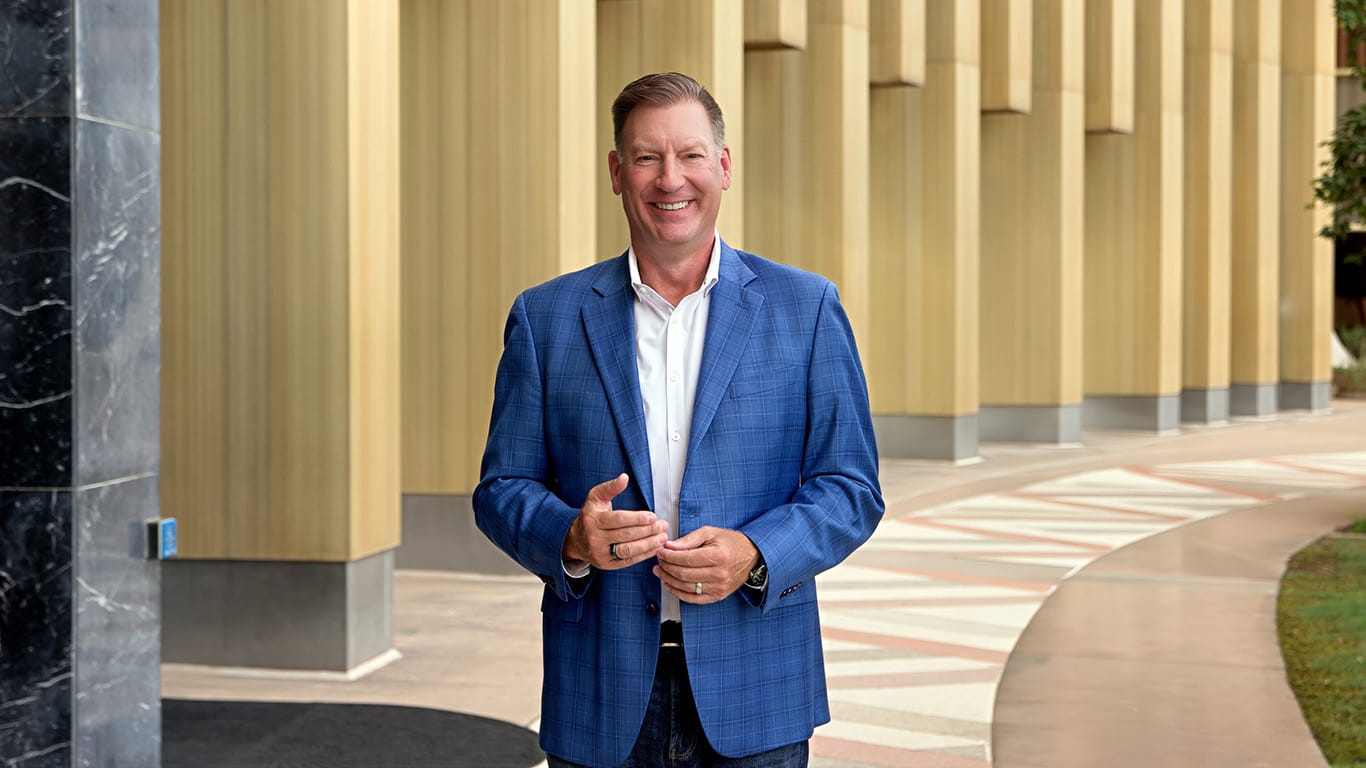
Thanks to his groundbreaking company LifeLock, Todd Davis became one of Arizona’s most recognizable entrepreneurs.
Davis sold the Tempe-based company to Symantec for $2.3 billion in 2017 after starting it in 2005.
He recently came out of retirement to found Scottsdale-based Mutual Health, a company that offers consumers an alternative to traditional health insurance through a virtual health share model.
A health share (or health-sharing plan) is a membership-based program — often run by a nonprofit or faith-based organization — in which members pay monthly contributions to help cover each other’s eligible medical expenses instead of buying traditional health insurance.
Offered in Georgia and Arizona, Mutual Health offers virtual care, free medications and labs. The cost is capped at less than $1,600 per month.
DEEPER DIVE: The 100 Best Doctors in Arizona for 2027
First-hand experience
Mutual Health is designed for people seeking an alternative to traditional healthcare options, including self-employed professionals, gig workers, families, rural residents, and small business owners who are evaluating ways to manage healthcare costs, Davis said.
Nationally, affordability pressures are reshaping how consumers evaluate their healthcare options, he said. KFF Health News recently reported that ACA Marketplace effectuated enrollment fell 13% from 2025 to 2026, with roughly 3 million fewer people enrolled following a significant increase in premium payments.
KFF Health News is a nonprofit national newsroom that produces in-depth journalism about health care policy, politics and the health care system.
Those numbers and his family’s frustration with traditional health care led to the creation of Mutual Health.
“I was going through retirement and flipping around to different insurance providers,” he said.
“I tried a health share early on, but it was confusing. It didn’t have things like critical care, so it wasn’t a complete solution. I saw things like Cigna, but they’re pulling out of the state [after Dec. 31]. Everything is built around the payor — the insurance provider — not the actual patient.”
With commercial health insurance, specialists sometimes require referrals, and, he said, there is a lot of “jumping through hoops.” The tangled mess of paperwork and details was challenging for his parents.
“Then, of course, they’re stressed out about, ‘Do I owe this other $3,000?’” Davis said.
“At one point, my dad and I didn’t want to go to the doctor because, even though we’ve been paying thousands of dollars a month for insurance, we didn’t want to spend the additional money to access it.
“That’s the craziest thing I’ve ever seen.”
Through the Mutual Health program, membership benefits include virtual care, prescription and mental health resources, lab and imaging services, emergency care support, and prenatal and postnatal resources.
Every household receives an at-home diagnostic device, enabling it to complete guided virtual exams and connect with providers.
“It actually takes your temperature, listens to your heart, listens to your lungs and records it,” he said.
“It has a camera that looks down your throat, looks in your ears, looks at your skin if you have a rash. There are a huge number of things this diagnostic device can do.”
Independent research on this type of at-home exam technology, published in the Journal of Health Economics, found that it reduced emergency room visits by 24.1% among adopters.
Davis said Mutual Health will “impact hundreds of thousands of lives if we do this right for the better.” Folks don’t have to worry about in-network or out-of-network.
“Where do you want to go? You want virtual care? Great,” he said. “You want to go to your doctor? No problem. You want to get an MRI? No problem. Just tell them you’re direct pay.”
“On average, our health-share partner paid for everybody who turned in their paperwork,” Davis said. They paid, on average, seven days.
“This is built around the payor,” he said.
“There is no distribution that we need to do to shareholders. This is all about supporting the community who’s come together to take care of each other.”
Challenging another established industry
Davis said one of the most appealing aspects of the health-share model is its nonprofit structure.
“This is all about supporting the community that’s come together to take care of each other,” he said.
Rather than operating as traditional insurance, Mutual Health functions as a membership-based health-sharing program, allowing members to choose their own doctors and healthcare facilities without being restricted to provider networks.
Mutual Health offers a virtual direct primary care platform; a complimentary FDA-cleared at-home diagnostic device for remote exams and support; and no-cost mental health and prescription benefits. Mental health and prescription benefits and maternity care.
The tiered pricing includes $1,500 UA, $2,500 UA and virtual care and association benefits only (which does not include catastrophic benefits). Pricing varies based on household age and tier.
“It’s like paying an insurance premium,” he said. “To be clear: We’re not insurance. We’re a health share.
“It combines this idea of community-based health sharing with virtual care. However, it also has prescription, mental health resources and labs. We’re not going to be for everybody. If you have extensive pre-existing or people who are turning 65 and get Medicare, we’re probably not a great choice.
“We’re more lenient with pre-existing conditions than most insurance companies. But the 2,500-plus people in Arizona who may be booted from their insurance coverage because of Cigna’s departure need something.”
Due to contract disputes, hospitals or hospital networks frequently add and drop insurance providers.
“Unfortunately, that’s not a unique experience,” he explained. “That’s how the system works, given the way it’s designed today.
“We have some world-class doctors here in Arizona. People should be coming from all over the world here. People on our program can choose to go anywhere they want. You want to go to Mayo? Go to Mayo. You want to go to Barrow? Go to Barrow. You don’t need approval from the insurance company.”
The goal, he said, is to remove barriers between patients and care.
“Technology should make this easier,” Davis said. “Somehow, healthcare has become harder, more confusing, more complex.”
That said, Davis is set on providing a simplified healthcare model.
“This will impact hundreds of thousands of lives if we do this right. We’re going to try to remove those everyday frustrations from healthcare as quickly as we can.”