
The global healthcare IT market was valued at $354 billion in 2025 and is projected to surpass $1.38 trillion by 2034. This growth is driven by healthcare organizations that have finally committed to rebuilding their processes for collecting, managing, and acting on patient data.
Full stack development for healthcare sits at the center of this transformation. Every telemedicine platform, patient portal, remote monitoring tool, and clinical decision support system in production today was built by development teams that understand both modern software architecture and the very specific demands of healthcare delivery.
This guide covers the practical reality of actual benefits, tech stack selection, and real-world use cases that are delivering results.
Why Full Stack Development for Healthcare Improves Patient Outcomes and Operational Efficiency
Healthcare organizations that invest in well-architected full-stack platforms consistently report improvements in three areas: care delivery speed, operational cost, and regulatory confidence. Here is why each of those gains comes directly from software development.
End-to-End Visibility Across the Patient Journey
When the frontend patient portal, backend EHR logic, and database layer are built as a coherent system, clinical staff get a complete, real-time view of a patient’s history, medications, and active care plans in a single interface. Full stack development for healthcare makes that kind of unified visibility possible by design.
Faster Iteration
Healthcare software rarely stays static. New clinical protocols, updated billing codes, changes to HIPAA guidance, and evolving patient engagement requirements mean development teams need to ship updates regularly. A well-structured full stack codebase lets you update one layer without destabilizing the others. That speed matters when a regulatory deadline is non-negotiable. To ensure these updates don’t compromise security or uptime, many firms leverage AppRecode’s ci/cd consulting to automate their testing and deployment pipelines, ensuring that every code change remains HIPAA-compliant before it ever hits production.
Reduced Operational Cost
Healthcare enterprises running five separate vendors for five separate clinical tools are paying for five maintenance contracts, five security audit scopes, and five integration headaches. AI and digital health deployments can generate $200 to 360 billion in annual healthcare cost savings at scale. A significant portion of that number comes from consolidating fragmented systems into coherent platforms, which is exactly what full stack development for healthcare enables.
Better Clinical UX Drives Actual Adoption
The best-built healthcare system in the world fails if clinical staff won’t use it. 71% of physicians cite EHR usability as a significant driver of burnout, according to the American Medical Association. Full stack development for healthcare, done right, means the same team building the backend logic also has visibility into how that logic surfaces in the clinical UI.
Choosing the right team to deliver these benefits matters as much as choosing the right architecture. Many organizations at this stage decide to hire full stack developer with specific healthcare domain experience rather than retrain generalist engineers.
How to Choose a HIPAA-Compliant Tech Stack for Healthcare Applications
There is no single prescribed stack for healthcare software, but there are clear patterns among the teams that consistently ship compliant, production-grade systems. The right choices depend on the application type, team expertise, and the existing infrastructure the new system needs to integrate with.
Frontend
React remains the dominant choice for full stack development for healthcare at a production scale. Its component-based architecture makes it easy to build accessible, modular clinical UIs that can be updated independently without breaking the rest of the application. Angular is preferred in larger enterprise settings where TypeScript enforcement and stricter project conventions reduce long-term maintenance risk. Vue.js works well for smaller-scope applications but is less common in complex clinical environments.
Backend
Node.js is widely used for building HL7 FHIR-compliant APIs and real-time notification layers like telemedicine alerts, lab result pushes, and device monitoring events. Python with FastAPI or Django handles data-heavy workflows, predictive analytics pipelines, and ML-integrated clinical decision support. Java with Spring Boot remains the backbone of many enterprise healthcare systems because of its long-term stability, extensive library ecosystem, and compatibility with legacy hospital infrastructure.
Database
Structured patient records, appointment data, and billing information typically live in PostgreSQL. Unstructured records, imaging metadata, and clinical notes often call for document storage. For organizations building FHIR-native platforms, Amazon HealthLake on AWS provides a managed FHIR datastore with built-in HIPAA-eligible infrastructure. Every database choice in full stack development for healthcare must include confirming whether the cloud provider will sign a Business Associate Agreement.
Cloud Infrastructure
All three major cloud providers offer HIPAA-eligible infrastructure with BAA support. Azure has a practical edge in enterprise hospital settings due to its deep integration with Microsoft 365 and Active Directory, which many health networks already run. AWS offers the broadest range of HIPAA-eligible managed services. Google Cloud’s
Healthcare API, which provides native support for FHIR, DICOM, and HL7v2, is gaining traction in analytics-heavy implementations.
Interoperability Standards
The 21st Century Cures Act has made HL7 FHIR the effective legal standard for healthcare data exchange in the U.S. Any platform built today without native FHIR support will face integration problems with payers, labs, and partner health systems within its first operational year. SMART on FHIR APIs are now increasingly required for regulatory compliance. Treating them as optional is a risk that full stack development for healthcare teams can no longer afford.
Real-World Use Cases of Full Stack Development for Healthcare That Deliver Impact
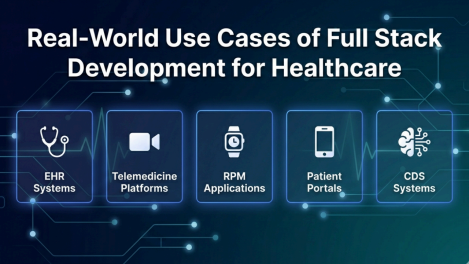
Understanding where full stack development for healthcare creates the most measurable value helps product leaders and CTOs prioritize what to build first. These five areas have the clearest track record of clinical and operational ROI.
Electronic Health Record (EHR) Systems
Custom EHR development represents the most technically demanding application of healthcare full-stack development. It requires bidirectional FHIR API integrations with labs, pharmacies, imaging systems, and insurance payers; role-based clinical workflows for physicians, nurses, and administrative staff; real-time alerts and clinical decision support; and patient data portability on request. Off-the-shelf platforms handle many general use cases, but specialty clinics frequently need custom-built systems to support workflows that those platforms can’t accommodate without prohibitive configuration costs.
Telemedicine Platforms
Building a production-grade telemedicine platform through full stack development for healthcare means handling real-time video via WebRTC, HIPAA-compliant secure messaging, and in-session prescribing. To avoid billing bottlenecks, modern architectures often incorporate specialized behavioral health rcm integrations that automate mental health eligibility and reimbursement in real time. The clinical UX challenge remains significant: any interface that adds cognitive load to a 12-hour shift is an interface that won’t get used. Modern platforms are also integrating advanced AI features like voice cloning to provide personalized patient education or to help clinicians with speech-to-text accessibility, ensuring that the clinical UX remains seamless while reducing cognitive load.
Remote Patient Monitoring (RPM) Applications
RPM platforms built through full-stack development for healthcare ingest real-time data streams from wearables and connected devices, detect physiological anomalies against configurable thresholds, push real-time clinical alerts, and write structured data back into the patient’s EHR automatically. Getting the data architecture right at the beginning determines whether the platform handles 500 concurrent patients or 50,000.
This is also the point where many healthcare organizations benefit from healthcare IT outsourcing services that have already built and maintained compliant healthcare data architectures at scale. The compliance overhead of RPM is substantial enough that organizations without that experience in-house routinely underestimate the build timeline by 40–60%.
Patient Portals
HIPAA’s right-of-access requirements require healthcare providers to give patients timely electronic access to their own health data. Full stack development for healthcare makes patient portal development both a compliance requirement and a patient experience opportunity. The most effective portals let patients view lab results, request prescription refills, message care teams, and schedule appointments without requiring a phone call to accomplish any of it.
Clinical Decision Support (CDS) Systems
CDS tools analyze structured patient data in real time to surface medication alerts, drug interaction warnings, and evidence-based treatment recommendations. They require low-latency response times, deep integration with the patient’s active EHR record, and carefully calibrated alert thresholds. One of the most well-documented failure modes in healthcare software is alert fatigue. Healthcare full-stack development teams building CDS tools have to tune alert logic against real clinical data before go-live, not after.
Common Mistakes That Derail Full Stack Development for Healthcare Projects
Healthcare software projects fail in identifiable patterns. These four are the most common mistakes and the most expensive.
Building Security and Compliance as an Afterthought
Teams that plan to “add HIPAA compliance later” invariably end up rebuilding core components at the worst possible moment. Access controls, encryption at rest, audit logging, and BAA verification need to be part of the initial architecture design. Healthcare remains the most targeted industry for cyberattacks. Every instance of full stack development for healthcare that ends up in a compliance crisis has this pattern at its root.
Skipping FHIR and Treating HL7 as Optional
It is still common to encounter healthcare development proposals that describe EHR integration as a future phase. Without native HL7 FHIR support, the platform won’t satisfy the interoperability requirements. Building FHIR compliance from day one is less expensive than retrofitting it into an existing codebase six months before a federal audit.
Underestimating Legacy System Integration Complexity
Most healthcare organizations aren’t starting with a clean slate. Full stack development for healthcare projects that don’t account for different complexities in their technical estimates routinely miss timelines by months and exceed budgets significantly. The integration work isn’t glamorous, but it is where projects are won or lost.
Ignoring Clinical Staff in the Design Process
Healthcare software is built by engineers but used by nurses, physicians, pharmacists, and administrators who have spent years developing precise workflows. Software that disrupts those workflows without a compelling reason doesn’t get adopted. Effective healthcare full-stack app development integrates clinical users in design reviews, prototype testing, and post-launch feedback loops from the very beginning.
Final Thoughts
Full stack development for healthcare is one of the most consequential types of software engineering in any industry. When it goes well, it improves care processes, reduces clinician burden, and gives patients better access to their own health data. When it goes poorly, it creates compliance exposure, patient safety risk, and institutional damage that takes years to remediate.
The full-stack development teams that consistently ship successful healthcare software treat compliance as a design principle. They build FHIR support into the data layer before writing the first clinical feature. They test not just against technical requirements but against the real workflows of the people who will use the system. For organizations that don’t have a combination of technical depth and healthcare domain knowledge
in-house, partnering with a specialist full stack development company with an active healthcare track record is often the most important decision made in the entire project.
Author: Chandresh Patel is a CEO, Agile coach, and founder of Bacancy Technology. His truly entrepreneurial spirit, skillful expertise, and extensive knowledge in Agile software development services have helped the organization to achieve new heights of success. Chandresh is fronting the organization into global markets systematically, innovatively, and collaboratively to fulfill custom software development needs and provide optimum quality.