A former potpourri of hospitals and satellite clinics is quickly evolving into a multi-institution healthcare research corridor in the West Valley between Downtown Phoenix and Buckeye.
The move is fueled by a combination of clinical innovation, academic investment and a burgeoning population boom that has compelled the region to adapt more quickly than envisioned.
City of Hope: A research engine in Goodyear
Dr. Alan Bryce doesn’t hedge when he discusses the future of medical research in the West Valley. He views a region that has been underserved for decades — and a once-in-a-generation opportunity to create a genuine cancer research ecosystem west of I-17.
“The cancer research infrastructure here is a little bit underdeveloped for the size of the city and for the size of the state,” he says.
“If you observe the other top 20 metro areas, almost all of them have a much better-developed cancer research ecosystem. We are such a young city.”
Bryce, a longtime Mayo Clinic oncologist who is now a senior leader at City of Hope Phoenix, says he believes that the West Valley can help close this gap.
The organization’s Arizona presence is anchored in Goodyear, where it has grown by more than 240% in under three years.
“We’re going gangbusters,” Bryce says.
“Since City of Hope came here, we’ve nearly quadrupled in size,” he said.
Research is not a side project — it is the very brand of the institution.
“Research is part of our mission. It’s part of our DNA,” Bryce says.
“The war on cancer is not done until every patient is cured and living symptom-free.” That mission has a strong regional priority: to ensure that West Valley patients do not have to travel to any other Valley — or part of the country — to have access to state-of-the-art cancer care.
“We’re very Westside focused. That’s the space where that unmet need is,” he says. “We don’t want people to travel a really long distance to reach their care.”
DEEPER DIVE: Ranking Arizona: Top 10 hospitals for 2026
INDUSTRY INSIGHTS: Want more news like this? Get our free newsletter here
The TGen partnership: Local research, global impact
City of Hope has partnered with TGen, a Phoenix-based genetic research juggernaut.
“It’s that synergy of all the laboratory scientists at TGen with the clinical experts here at City of Hope that accelerates breakthroughs,” Bryce says.
One of the clearest examples is ALTseq, a rapid genetic test for acute leukemia that was created at TGen, piloted in Goodyear and is now commercially available.
Classifying leukemia subtypes typically requires a period of two weeks or more — including at leading national centers. “The leukemia is just getting progressively worse the entire time,” Bryce says. ALTseq reduced that turnaround to 30 hours.
“That test was developed here in the West Valley, and the first patients in the world to take advantage of it were out here in the West Valley,” he says.
The team has since applied that same rapid-classification model to myeloma and is working on more cancers — evidence of just how fast West Valley-based research is expanding.
Midwestern University: A research powerhouse hiding in plain sight
Midwestern University has spent years developing a research infrastructure equivalent to that of other universities in Glendale — now coming alive at the very moment the West Valley sorely needs it.
James Woods of Midwestern University, assistant vice president of research and sponsored programs, has been at Midwestern for more than 23 years.
He oversees research operations from clinical trials to animal resources to statistical services. The university’s position in the region, he says, is expanding and increasingly necessary.
“Midwestern University’s Glendale Campus is also increasingly playing a role in the advancement of healthcare research and innovation in Arizona and throughout the West Valley,” Woods says.
One example is Midwestern’s six-year research partnership with Abrazo Health, placing faculty and students directly into clinical trials at Abrazo West and Abrazo Arrowhead.
Those trials span intensive care, neurology and COVID-19 treatment — real-world research that transfers discoveries into patient care faster. Even in a competitive national funding environment, Midwestern’s research activity is surging. Faculty generated 13% more grant submissions in 2024, followed by another 16% in 2025 and five consecutive years of increases in extramural research expenditures.
Woods credits that momentum to ongoing investment in infrastructure: the Arizona Core Facility, student research fellowships, capital equipment and intramural funding that allows faculty to start new projects.
“All these resources contribute to providing inspiration and training for the next generation of researchers and practitioners in the field of healthcare,” he said.
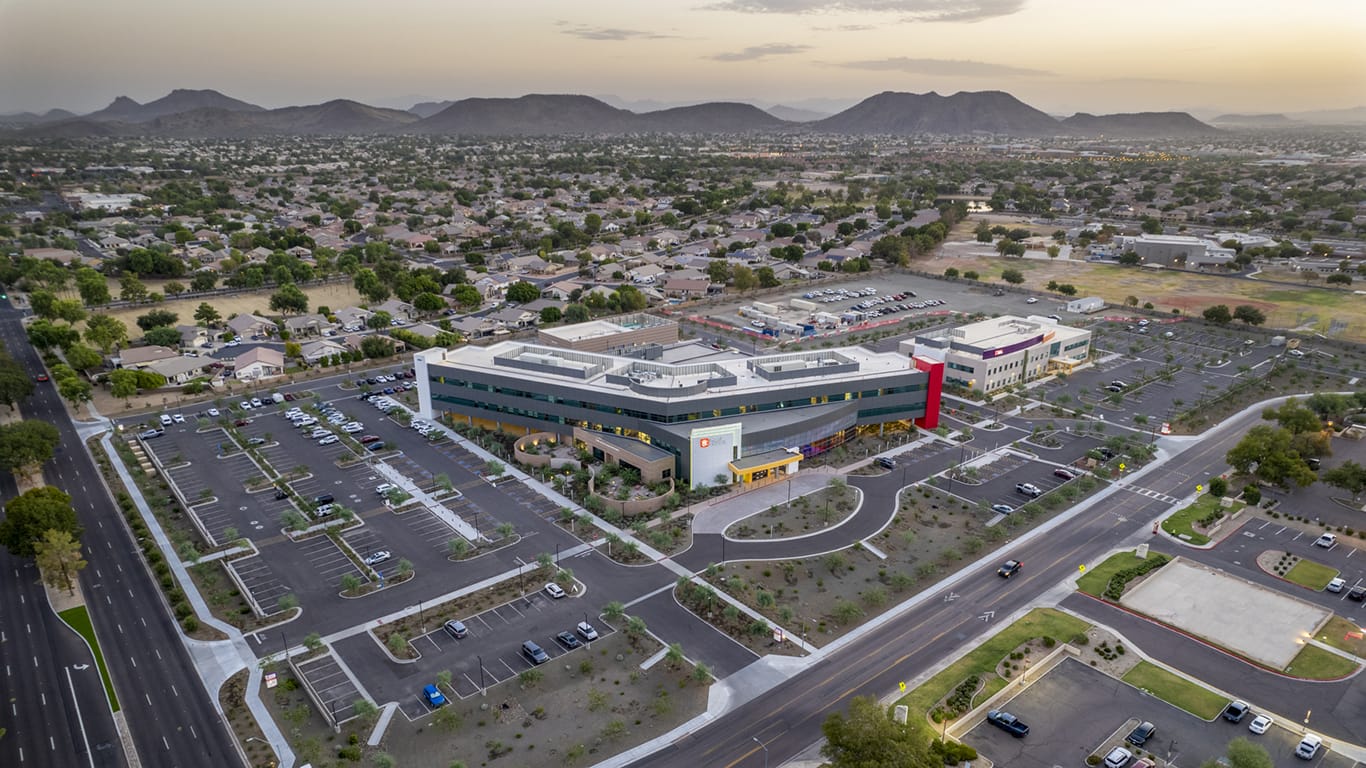
The Phoenix Children’s Arrowhead Campus was named Healthcare Project of the Year at the 2026 Real Estate Development (RED) Awards. (Photo provided by Phoenix Children’s Arrowhead Campus)
Translational studies with clinical relevance
The research at Midwestern is intentionally translational. Its CAREN system — a computer-assisted rehabilitation environment — facilitates faculty work on gait, balance and musculoskeletal function in ways that directly translate to rehabilitation approaches.
The One Health Initiative brings together human, animal and environmental health, forming interdisciplinary teams that mirror the realities of modern medicine. Woods views this as part of Midwestern’s responsibility to the region: providing clinicians with thinking, cross-expertise and research-oriented education that is integrated into patient care.
ASU West Valley: A research institution focused on rapid regional growth
Arizona State University’s West Valley campus is the next-generation research frontier, supporting the goals of ASU Health — a universitywide “learning health ecosystem” that integrates the university’s new medical school with engineering, technology, public health, nursing, data science, community clinics and industry partnerships to transform how healthcare is designed, delivered and measured across Arizona.
According to Dr. Todd Sandrin, vice provost of ASU West Valley and a microbiologist, the campus has doubled its external investments in research awards over the past five years and is currently home to more than 400 active research projects, half of which are in science, technology, engineering and mathematics (STEM) initiatives.
ASU is growing as the surrounding region grows. “We stand in the core of one of the nation’s fastest-growing counties,” Sandrin says. “And just the same, we are constantly growing our health and medical research portfolio rapidly.”
Studying monsoons, dust and disease
One of ASU West Valley’s most visible projects, DUSTIEAIM, a two-year Department of Energy-funded study of the Valley’s monsoon season, launches this summer. In addition to a state-of-the-art precipitation radar and high-tech laser equipment, two school-bus-sized research balloons will fly nearly a mile above the West Valley to study dust, airborne spores and atmospheric conditions that impact public health — including the spread of Valley Fever.
“This will study some of the factors contributing to haboobs, and in what ways those might be contributing to health challenges,” Sandrin says. For a region where Valley Fever continues to pose a sustained threat, the research is timely and deeply local.
Pediatric IBD, rapid diagnostics and workforce development
In addition, researchers at ASU West Valley are working with Phoenix Children’s Hospital on pediatric inflammatory bowel disease that could lead to rapid diagnostic tools for a condition that is often difficult to detect early.
“Diagnosis is typically the first key critical step,” Sandrin says.
The campus is also preparing the workforce required to support the region’s growth. Enrollment in the Edson College of Nursing and Health Innovation at ASU West Valley has exploded by more than 3,500% in the past decade, aided by 17 clinical partners throughout the West Valley.
ASU is investing heavily in infrastructure too: from new research labs and mass spectrometers to immersive learning tools like Dreamscape Learn, and new schools for forensics, engineering and business — all built to meet the West Valley’s growing demands.
A region becoming a research corridor
From Goodyear to Glendale to West Phoenix, the West Valley’s research communities are no longer isolated from one another. They’re creating a corridor — one defined by clinical trials, environmental science, genomics, diagnostics and workforce development.
Bryce views medical research as a catalyst for the region’s larger economic future.
“The hospital is a magnet for talent … physicians, scientists, pharma, data scientists, lawyers, salespeople,” he says.
“That ecosystem is developing around it.”
Woods regards Midwestern as preparing the research foundation and training pipeline that delivers talent to that ecosystem. Sandrin sees ASU West Valley as the region’s “innovation engine” — a campus where students, scientists, industry partners and community members can work together to solve problems with immediate value.