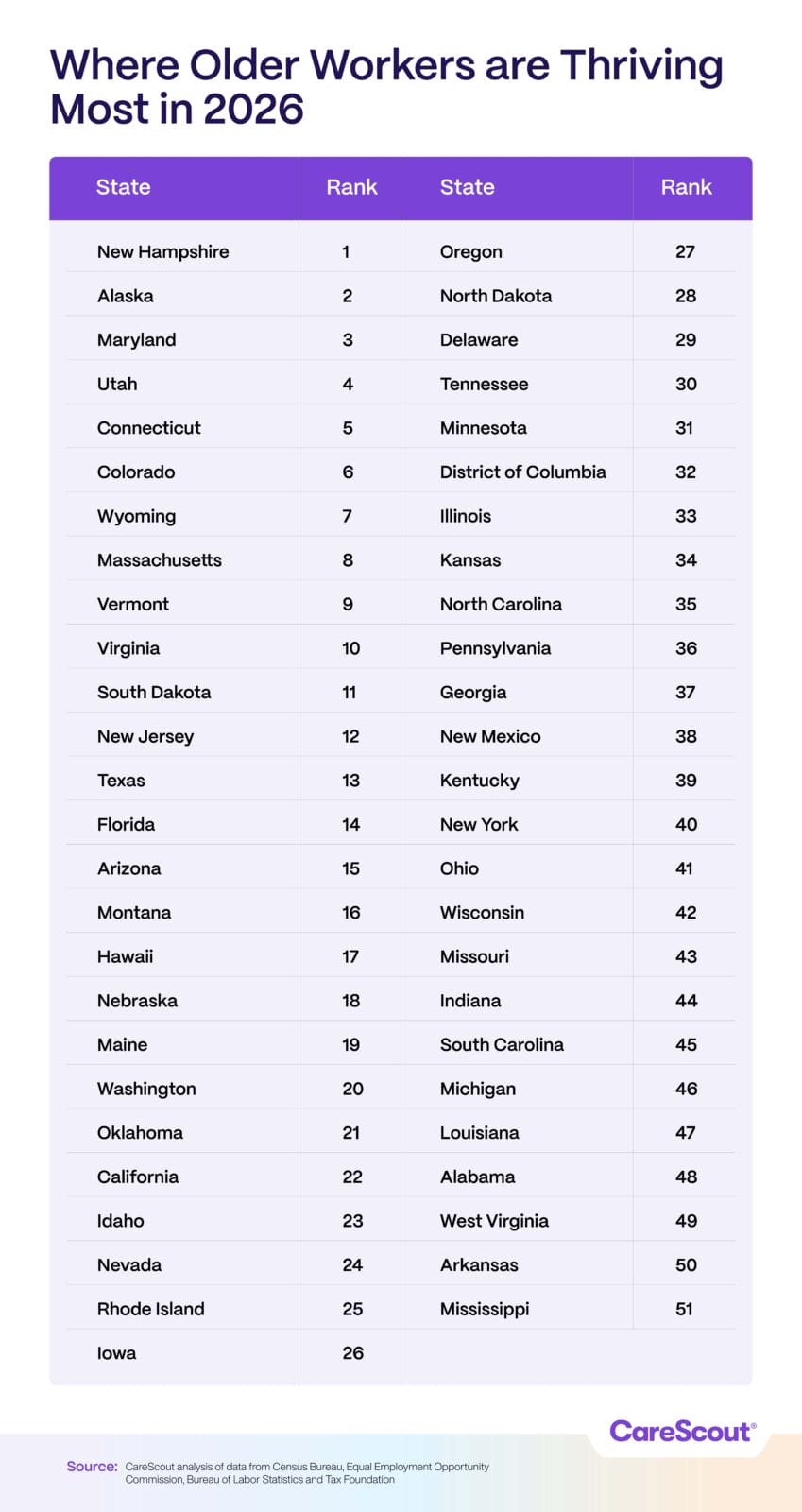
A new study ranking the top states for older workers — ages 65 and older — found Arizona ranks No. 15.
Instead of riding off into the sunset, a record 11.6 million seniors are stuck riding into the office, up from 4.9 million in 2004. As costs for housing and healthcare continue to rise, a growing number of seniors cannot afford to retire, while others opt to work, encouraged by better longevity and the flexibility of remote work. In a surprise twist, and unlike past technological revolutions that sidelined older workers, AI is poised to displace entry-level roles before those requiring decades of experience and judgement.
CareScout today released a study on the Top States for Older Workers in 2026 after analyzing six factors in all 50 states and D.C.: labor force participation, income, age discrimination rates, remote work flexibility, income taxes, and new business growth.
The most recent data from the Bureau of Labor Statistics, Census Bureau, Tax Foundation and Equal Employment Opportunity Commission was used to determine the rankings.
Key Findings:
- Arizona ranks No. 15: Remote work at 21.2% (No. 6), income tax at 2.5% (No. 10), new business growth at 20.6% (No. 12), household income of $62,575 (No. 16), age discrimination at 106 per 100,000 (No. 33) and labor participation at 26.3% (No. 46).
- Top 10 States: are located in the West or East Coast with Alaska ranking No 2, followed by Maryland, Utah, Connecticut, Colorado, Wyoming, Massachusetts, Vermont, and Virginia.
- 5 Fastest Growing Jobs for Seniors (2022 – 2025): Librarians (+109%), Facilities Managers (+80%), Paralegals (+72%), Purchasing Agents (50%), and Business Operations (48%).
DEEPER DIVE: Read all the Ranking Arizona Top 10 lists here
INDUSTRY INSIGHTS: Want more news like this? Get our free newsletter here
Instead of riding off into the sunset, an unprecedented number of seniors are stuck riding into the proverbial office. A record 11.6 million Americans ages 65 and older are part of the U.S. workforce, up 132% from 4.9 million in 2004, according to the Bureau of Labor Statistics (BLS).
This trend is driven by many factors. The population is aging and with improved longevity many older adults can be productive for longer and keep working because they enjoy it.
Meanwhile, AI is unexpectedly fueling demand for older workers. Unlike previous tech revolutions, AI is stealing entry-level jobs faster than jobs that require decades of judgement. Employers recognize experienced workers are more likely to notice when AI hallucinates
Ultimately, millions of seniors are forced to keep working to keep the lights on. A recent Goldman Sachs survey found 58% of Americans think they will run out of money before their time is up as the cost of living, housing and healthcare have risen.
The CareScout Cost of Care Survey released in March, shows assisted living facilities cost $6,200 per month and private nursing home rooms average $10,798. These payments are steep even for affluent families and impossible for the nearly one in five seniors who already live below 150% of the federal poverty line, Census data shows.
Given these trends, the Department of Labor projects that older adults will see faster labor force growth than any other age group in the years ahead, which is why seniors are increasingly factoring employment opportunities into their decision of where to retire.