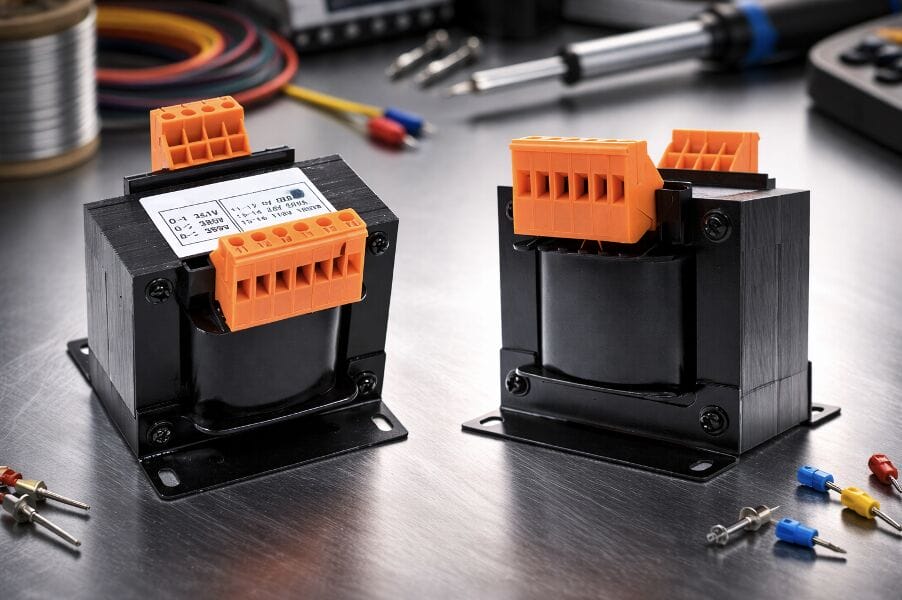
Control transformers are very important devices used in the present day electrical systems in providing stable voltage to the control circuits as well as to the sensitive equipment. These transformers are necessary in industrial automation, machine use, and power delivery, and they are designed to deliver a steady output when operating in varying load conditions.
They are typically single-phase, with power ratings of 500 VA to 10 kVA, that can be used continuously at under-rated loads, and with a wide selection of primary voltages, typically 110 V to 480 V.
This paper discusses the most important features of control transformers, their characteristics, specifications, design material, customization factors, and their usage in real life.
Overview and Key Features of Control Transformers
Control Transformers are also designed with a specific purpose to supply power to control circuits, over which the voltage output remains constant regardless of changes in the input voltage or load conditions.
They are designed to operate well when inrush current is high unlike general-purpose transformers and are typically used under high inrush current conditions associated with activation of electromagnetic objects like relays or solenoids.
These transformers are generally single phase and are used in the capacities of 500 VA up to 10 kVA. They accommodate the AC primary and supply voltage of 110V to 480V and can be tailored to 690 V, depending on your requirement.
It is marked by the taps being added to either the secondary or primary winding, in either case, offering flexibility in the adjustment of voltages. Moreover, they can be loaded with constant loads and hence are very dependable in an industrial setup. They cannot be substituted in systems that need a high level of voltage regulation due to their efficiency, longevity, and flexibility.
Material Design and Construction Elements
The materials and construction of the control transformer play a major role in the performance and durability of the transformer. Manufacturers apply meticulously chosen elements to augment conductivity, alleviate expenses, and to augment safety.
- Copper or Aluminum Windings: Pure copper coils are chosen due to high conductivity and low resistivity, which means that it will not produce as much heat and will be more efficient. Cost sensitive uses can also be made of aluminum.
- Silicon Steel Core: This is a transformer core made of silicon steel sheets which have good magnetic conductivity. This allows effective transfer of magnetic flux and makes the transformer smaller in size.
- Metal Bracket Structure: This is a hardened metal bracket that promotes mechanical strength, and shields internal components to minimize chances of inadvertently touching live circuits.
- Cold-Pressed Terminals: These terminals enable safe electrical connections without requiring any welding or screws to enhance the efficiency and reliability of wiring.
All these materials combined serve to make the transformer provide a stable operation in harsh industrial conditions.
Customization Considerations for Control Transformers
The control transformer manufacturing is characterized by customization since various applications need a certain number of different configurations. Various factors have to be considered before developing a transformer:
- Type and Specifications: Select the right type of transformer, capacity and quantity required.
- Voltage Requirements: There must be a distinct definition of the primary and secondary voltage.
- Capacity Allocation: Determine the overall load demands and provide a contingency to avoid excessive load during start-up situations.
- Physical Design: Determine shape, mounting dimensions and installation requirements to be compatible with the existing systems.
Transformers that fit these specifications are manufactured by using advanced winding equipment and tooling techniques by the manufacturers. This customized solution will guarantee maximum performance and reliability in the long term.
What Are the Performance Characteristics of Control Transformers?
The specific technical features of control transformers are the stable regulation of the voltage, reliability, and safe work in the industrial conditions. They are not fixated on set specifications, but their performance is determined by a number of core characteristics.
The main feature is that they can sustain a constant secondary voltage despite the variations in the input supply or load conditions. This renders them very appropriate in delicate control circuits in which stability in voltages is paramount.
High insulation strength is another characteristic that is significant and increases thermal endurance and the ability of the transformer to operate safely in continuous or demanding conditions. The transformer insulation has different classes that define the level to which it can withstand heat in the long run.
The control transformers also have an efficient cooling system whether it is natural air cooling or using gas cooling methods to avoid overheating and also long durability performance without having to take up complicated maintenance.
Control transformers are particularly designed to deal with inrush currents and to provide accurate control of voltage as opposed to bulk power transfer, as compared to power transformers. This renders them more dependable as control panels, relays and automation systems.
They are also engineered to reduce energy wastage, they operate efficiently and have constant performance with change in loads.
On the whole, these technical characteristics permit control transformers to be a reliable option in the case when accuracy, stability and durability are critical.
Industrial Applications of Control Transformers
Control transformers are used extensively in many industries because they can be used to ensure stabilized and safe voltage levels on the control circuit. Key applications include:
- Industrial Robots: Power is controlled with accurate control and automation functionality.
- Molding Machines: Stable voltage of safe and efficient machine working.
- HVAC Systems: Deliver voltage transformation and leakage of controllers and sensors.
- Power Distribution Systems: Step down voltage used to operate electrical equipment.
- Rail Traffic Systems: Support signaling and control circuits towards safe transportation.
- Welding Machines: Adjust welding to correct voltage.
- Compressors: Provides low voltage power to actuate mechanisms.
- New Energy Systems: Facilitate harmless observation and control of the production and dissemination of renewable energy.
Such applications are important and emphasize the flexibility of control transformers in the current industrial infrastructure.
Advantages and Operational Benefits
Control transformers have a number of benefits that are appealing in industrial application:
- High Reliability: Built to be able to run on constant loads. Higher step up & step down transformer output requirements.
- Voltage Stability: Remain constant with changes in input.
- Energy Efficiency: Minimum losses and maximized magnetic performance minimizes energy.
- Thermal Performance: Low temperature increase improves life and safety.
- Flexibility: It has several taps which can be easily adjusted to different voltages.
- Safety: Offer electrical isolation and minimize the possibility of equipment damages.
These advantages provide efficient functionality of control circuits and enhance the efficiency of the whole system.
How to Select a Suitable Control Transformer?
When choosing the most appropriate control transformer, it is necessary to assess the overall load, inrush current, and provide sufficient capacity. The system requirements demanded to run a stable voltage should be equal to the primary and secondary voltage ratings. When selecting a transformer, care should be taken to ensure that the voltage regulation is good in order to ensure that a consistent output is obtained in different conditions. Safe and long-term use should also have thermal performance and insulation class. The physical design and mounting should also be able to fit the installation. Lastly make sure the transformer is of the appropriate standards of safety and industry rating in terms of safe performance.
Conclusion
Overall, Control Transformers are significant elements in electrical systems of industry and commerce, and are dependable to stabilize the voltage of control circuits and to offer protection.
Their durable structure, adjustable specification and their diverse applications make them essential in contemporary automation and power management systems. These transformers are manufactured using the best materials such as copper windings and silicon steel cores, and manufactured using the technological and modern manufacturing techniques and flexible designs to bring long performance.
In the end, control transformers are used in robotics, in HVAC systems, in power distribution networks, and also in power transformation to provide safe and efficient and stable operation, making them an essential part of industrial electrical engineering.