
Los Angeles has always been a city that understands image. But what the city’s top design studios are doing right now goes well past surface aesthetics. They are rebuilding how brands communicate from the ground up, and the businesses that have paid attention are seeing it show up directly in revenue.
The leading graphic design companies working out of LA today are not simply in the business of making things look good. They are building visual systems that hold together across every surface a brand touches: packaging, social media, retail environments, motion graphics, out of home.
That is a different problem than the one design firms were solving a decade ago, and it requires a different process.
FOOD NEWS: 25 places for great patio dining in Arizona
THINGS TO DO: Want more news like this? Get our free newsletter here
The Brief Is Not The Starting Point
The most significant change in how serious LA studios operate is where the work actually begins. Many firms now front-load every engagement with a dedicated strategy phase, sometimes called brand discovery or a brand audit, that runs for several weeks before a single visual is produced.
The goal is to map where the identity will live, how it will move across formats, and what it needs to do in contexts that did not exist five years ago. Motion identity, meaning the way a brand animates and behaves in video and digital environments, has moved from a secondary deliverable to a foundational one at studios that work with consumer brands.
Clients who treat the initial brief as a finished specification rather than an opening argument tend to struggle at the execution stage. The studios that produce the strongest work push back on the brief early, ask questions the client cannot yet answer, and treat that gap as the actual starting point.
Businesses that skip this phase, usually because of budget pressure or timeline anxiety, arrive at design decisions without the foundation those decisions need, and the work shows it.
It also matters more than most business owners realize. 92.6% of consumers say visual factors carry the most weight when they decide to buy a product, which means the visual brief a brand hands a studio is not an internal document. It is a business decision with direct commercial consequences.
What Is Actually Changing In The Work
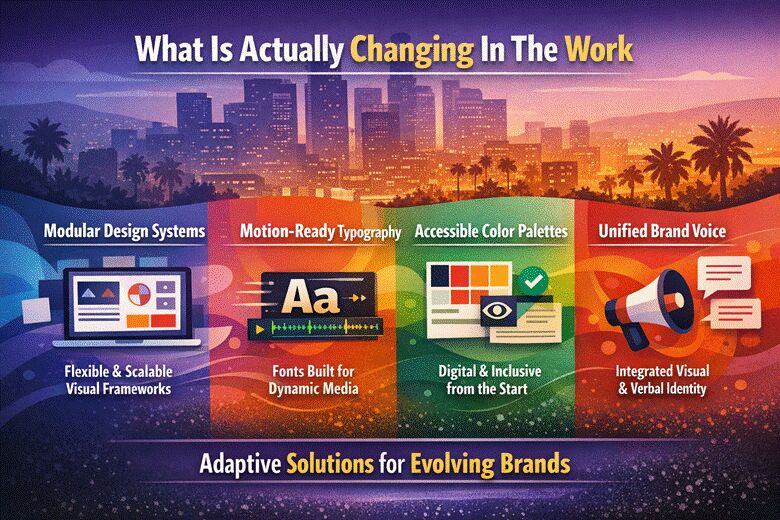
The visual systems coming out of LA’s better studios today are built to be extended, not just applied.
Rather than a rigid style guide that covers only the assets produced during the original engagement, firms now deliver what practitioners call living systems: modular visual frameworks that an in-house team can grow and adapt without losing coherence.
A brand that scales will always need something the original brief did not anticipate, and a rulebook with no flexibility breaks the moment that happens. In practice, that shift shows up in several specific ways.
- Typography is now chosen with motion in mind from day one, not adapted for video after the fact.
- Color systems are built with digital accessibility standards baked in from the start rather than retrofitted at the end.
- Brand voice, long treated as the copywriter’s domain, is increasingly developed in parallel with the visual work, because the two are too interconnected to build separately and still feel unified in the market.
- Packaging is tested against real shopper behavior rather than focus groups alone, and the findings regularly contradict what clients assumed going in. A design that reads beautifully in a presentation deck can disappear on a retail shelf, and studios working in consumer goods have built specific processes to close that gap before anything ships.
Brands that get this right earn an average revenue lift of 10 to 20% over those that do not.
What To Press On Before You Sign
For any business evaluating design firms, a few things are worth examining before a contract is signed.
Ask for case studies that go past the launch and show documented performance at six and twelve months out.
Ask specifically how the studio handles handoff and whether the deliverables are structured for an in-house team to use independently, or whether continued studio involvement is required every time a new asset is needed.
Ask who actually staffs the project after the contract is signed. Senior creative directors often lead the pitch and the strategy phase, then move off once production begins. Studios that cannot give a straight answer to that question are telling you something about how they operate.
The most useful question, though, is the simplest one: ask the studio to push back on your brief before any work begins. The ones worth hiring will not hesitate, and the ones that simply say yes to everything are not going to give you anything worth paying for.