
Revenue and margin don’t move together the way most reseller owners expect. A distributor can grow sales for several quarters straight and still close the year with a worse bottom line than before, because growth changes how a business buys, ships, and prices well before any of that shows up on a financial statement.
Bigger accounts are usually the first sign of that growth, and landing them feels like the win it’s supposed to be, right up until fulfilment stops being planned and turns reactive.
That’s the point where the extra revenue stops paying for itself.
Fix Sourcing First
A B2B electronics distributor that orders parts only after a customer order lands can get away with that habit at low volume. Once volume climbs, the same habit means paying spot prices instead of negotiated ones, since there’s rarely time left to shop an order around. Spot prices during a shortage run well above list, and that gap repeats across every order placed this way, quietly compounding into a real dent in profit over a full year.
Backup suppliers need to be lined up before a shortage hits, not scrambled together during one. A distributor that holds deep, varied inventory can buy based on price rather than urgency, and that single difference accounts for a large part of the gap between resellers who scale profitably and those who don’t.
Freight is really just an extension of the same problem. Shipping under deadline pressure is almost always the most expensive shipping a company buys, and that pressure usually starts with sourcing that had no backup plan once a part became scarce.
A distributor that plans orders weeks ahead rather than scrambling in the same week rarely pays rush rates at all, and that’s the real payoff of getting sourcing right in the first place.
Where the Rest of the Margin Goes
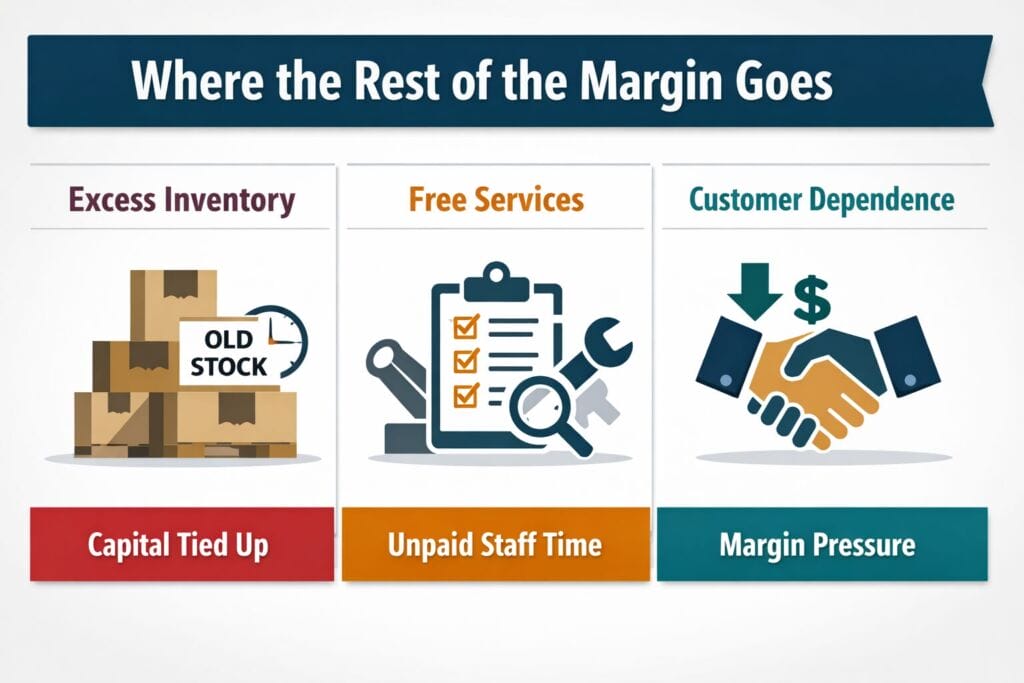
A few other habits quietly drain profit as volume grows:
- Inventory that sits too long. It doesn’t look like a loss because nothing obviously went wrong, but that capital stays tied up instead of funding the next order.
- Services priced at zero. Sourcing help, BOM cleanup, and chasing obsolete parts take real staff hours that rarely show up as their own line item, even as the workload behind each order grows heavier.
- Customer concentration. An account that makes up a large share of revenue holds real leverage at contract renewal, and that leverage almost always gets used to push margin down.
Each of these is manageable on its own. A quarterly inventory review, a service fee tier for BOM management, and a deliberate push to diversify the customer base handle most of it without much complexity. The harder part is usually just building the habit of checking for these leaks on a set schedule instead of only noticing them once a quarter’s numbers come in worse than expected.
Price and Staff With More Discipline
Charging the same margin on every deal, regardless of size, lead time, or payment history, treats a rush order from an unproven account the same as a routine order from a client who’s paid on time for years.
A simple tiering system, standard margin for standard orders, a premium for rush or high-risk work, a discount for large and predictable volume, protects profit more effectively than any single sourcing move on its own.
Most resellers already have the data to build this kind of tiering; it just needs someone to actually sit down and set the rules instead of pricing every quote from instinct alone.
Hiring ahead of the process is another common misstep. New buyers or account managers brought on before the quote-to-fulfillment workflow is actually working just multiply the same inefficiencies across more people.
Growth that outpaces a company’s systems doesn’t create more profit; it just means losses stack up faster than before.
Why Cash Flow Breaks First
Cash flow is usually where all of this shows up before anywhere else. More than half of firms cite uneven cash flow as a financial challenge, and resellers are exposed to this more than most industries, since suppliers get paid now for parts the customer won’t pay for until 60 or 90 days later, and the faster a company grows, the wider that gap becomes.
That gap is often what actually caps how fast a reseller can grow, regardless of how strong demand looks on paper.
Scaling a tech reseller isn’t about saying yes to every order that comes through the door. It’s about being deliberate about which orders get accepted and at what margin, so growth strengthens the business rather than quietly draining it.