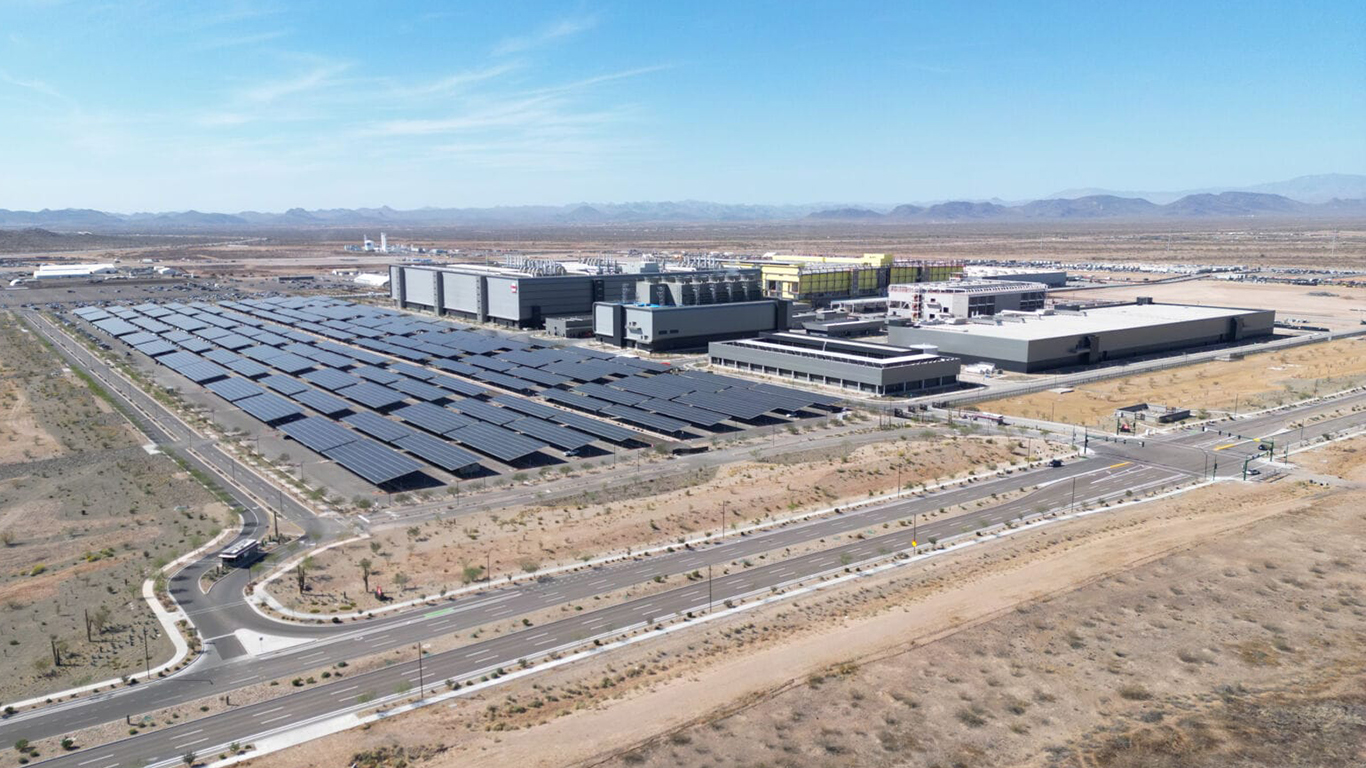
Semiconductors — also known as microchips — are the brains behind everything essential to modern life — smartphones, computers, cars, the internet, GPS and artificial intelligence. And one of the brains behind Taiwan Semiconductor Manufacturing Company’s Arizona operations is Rose Castanares, president of TSMC Arizona.
“Our customers design and sell the chips; we manufacture them,” Castanares says. “That means they trust us with their crown jewels — their intellectual property. There is a great deal of trust and collaboration between TSMC and our customers, which is unique in the industry. Most semiconductor companies design, manufacture and sell. TSMC strictly focuses on manufacturing.”
TSMC’s focus on manufacturing led the company to Arizona, where the company’s $165 billion investment is the largest foreign direct investment in U.S. history. Az Business talked with Castanares about how the company is changing the game in Arizona.
LEARN MORE: AZ Big Podcast: Rose Castanares of TSMC talks building a massive workforce
Az Business: Why did TSMC choose Arizona?
Rose Castanares: Our customer initially wanted us to build an advanced manufacturing fab in the U.S. We were skeptical at first, knowing the time and financial investment involved. But they were visionary and emphasized the importance of supply resiliency. After evaluating multiple states, Arizona had everything we were looking for: infrastructure, land, power and most importantly, a strong pipeline of engineering talent.
ASU has the largest engineering enrollment in the U.S., and the community colleges are fantastic. We need many technicians and they often come from community colleges. Arizona already had a semiconductor ecosystem in place, which was also important.
What truly sealed it was the support from the governor’s office, local agencies, the City of Phoenix and Mayor Kate Gallego. We felt welcomed and supported for the long-term. Relationships are at the heart of TSMC — with customers, suppliers and the communities we serve.
AB: You began manufacturing in 2024. How are things going so far?
RC: It’s going great. From the very first lot, the quality, yield and reliability matched our mother fab in Taiwan. That success came from collaboration between Taiwan experts and a highly adaptable local workforce who embraced our unique processes.
AB: What are some challenges unique to semiconductor manufacturing?
RC: It’s completely different. It’s not an assembly line. Semiconductor manufacturing takes place in clean rooms — you could eat off the floors. We’re manipulating atoms, creating structures, channeling electrons. It’s all done at a microscopic level requiring near perfection.
An engineering manager once said: “Even with a 99% yield per layer, after thousands of layers, you get nothing. You need 99.999% or better.” That level of precision is extremely demanding.
AB: How do you maintain that kind of perfection?
RC: We need people who thrive on challenges and have a perfectionist mindset. It’s about constantly improving, working in teams, and staying agile as our customers frequently change their requirements. It’s fast-paced and demands commitment to excellence.
AB: How is the recruitment process going?
RC: We’ve grown from about 2,000 to 3,000 employees in a year, ramping up for Phase 2. We have three fabs underway. Fab 1 began production in 2024. Fab 2 will feature our N3 technology. Fab 3 began construction in April. We expect to need around 6,000 people, half engineers, half technicians.
We have 198 interns from 60 colleges nationwide and our technician pipeline is focused on Arizona. We partnered with Maricopa Community Colleges and the City of Phoenix on a federally registered apprenticeship program. Many of our current job postings are for technician roles across various specialties.
AB: Have there been any challenges with aligning the American and Taiwanese workplace cultures?
RC: Well, there is that different culture aspect, but what I found is that it’s not just two cultures. You’re talking about many different cultures because we have people coming in from all different aspects of life — different generations, different countries. We have people from Vietnam, from Ghana, from Brazil, from Greece, as well as Connecticut and Alaska and everywhere in between. So it’s not just one culture. It’s really a melting pot of many different cultures. We want the best and the brightest and bringing them all together is really interesting. At TSMC, we have a certain value system. Even though people can come from different cultures, it all comes down to what is important to the workplace, which is integrity and commitment to our customers, to our products and to each other.
AB: What kind of qualities make for an ideal TSMC employee?
RC: An ideal employee is someone who embraces challenges, works well in a team, and is committed to problem-solving. We look for people who are humble enough to know they don’t have all the answers and willing to collaborate. Our equipment is highly sophisticated and must run 24/7. Many of our employees treat their machines like their “babies” — they don’t leave until they’ve solved the issue or ensured a perfect handoff to the next shift. That level of ownership, combined with TSMC’s core values — Innovation, Commitment, Integrity and Customer Trust (ICIC) — defines our ideal team member.
AB: How can people learn more about opportunities at TSMC?
RC: I’d say start with our website. Go to tsmc.com/careers, filter for Arizona, and look at the jobs currently available. Review the requirements for each role and see what interests you. Even if you don’t have direct experience, apply anyway. If you’re not selected, consider attending one of our partner community colleges or trade schools. We also have an apprenticeship program, registered with the federal government and run in partnership with the City of Phoenix. We’ll be recruiting for our next cohort this fall, so it’s a great time to get involved.