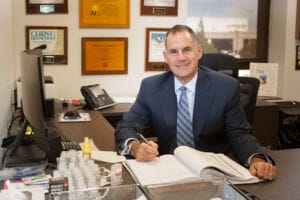
Most car accident claims settle quietly, long before anyone sets foot in a courtroom. Michael A. Rose has built nearly three decades of practice around a different assumption: that every case he takes should be prepared as if it’s going in front of a jury, whether it actually gets there or not.
From Ithaca College to New England Law
Rose earned his undergraduate degree from Ithaca College in 1993, then went to New England School of Law, graduating in 1996. He’s admitted to practice in New York and Massachusetts, along with the Eastern, Southern, and Northern District federal courts in New York, a spread of federal admission that matters when a New York City car accident case involves an out-of-state trucking company or a defendant who tries to move the case into federal court.
A Founding Partner Almost From the Start
Rose co-founded Hach & Rose, LLP with Gregory Hach nearly 25 years ago. At the time, Rose was already a recognized speaker for the New York Bar on injury litigation, with a track record of million-dollar jury verdicts behind him. In the years since, the firm has recovered more than $1 billion for injured clients across personal injury and workplace injury matters, built largely around the same trial-first approach Rose brought to the partnership from day one.
What Litigation-Ready Preparation Actually Means
Hach & Rose has built its identity around a specific philosophy: preparing every car accident case with the expectation that it may eventually be presented to a jury, rather than building a file just strong enough to justify a settlement demand. In practice, that means preserving surveillance footage and witness accounts early, before a business erases its security recordings or a witness’s memory fades, documenting injuries thoroughly enough to withstand an insurance company’s inevitable argument that they’re exaggerated or pre-existing, and reconstructing liability using vehicle data and roadway evidence rather than relying on a police report alone. The firm has said publicly that some clients have received settlements nearly ten times the insurance company’s original offer once a case was fully built out this way, a gap that reflects how much an insurer’s first number often has less to do with what a case is worth and more to do with what an unrepresented claimant might accept out of financial pressure.
DEEPER DIVE: Here are Arizona’s Most Admired Companies of 2026
The Cases That Define the Practice
Rose’s case results include a $25 million motor vehicle accident settlement, a construction worker verdict exceeding $13 million, a medical negligence verdict exceeding $12 million, a $9.5 million forklift accident settlement, and an $8 million auto accident verdict, contributing to the firm’s more than $1 billion in total recoveries. Attorney Advertising: past results do not guarantee or predict a similar outcome in any future case. That range, spanning car accidents, construction site injuries, and workplace equipment accidents, reflects a practice that doesn’t treat a car crash and a forklift accident as fundamentally different problems: both come down to establishing what a reasonably careful party should have done differently, and proving how much the resulting injury actually costs a client over the rest of their life.
Why a Case Often Grows Larger Than It First Appears
An insurance company’s early settlement offer is typically based on medical bills to date and a rough estimate of pain and suffering, numbers that can look complete without accounting for a client’s actual long-term prognosis. A serious injury can mean future surgeries, ongoing physical therapy, lost earning capacity if the client can no longer perform their previous job, and modifications to a home or vehicle that a client couldn’t have anticipated in the weeks immediately after an accident. Building out a full picture of those future costs, typically with input from medical experts and vocational rehabilitation specialists, is part of why a firm willing to prepare a case for trial can often recover significantly more than one built around a fast settlement.
What Makes a New York Construction Injury Case Different
The $13 million construction verdict and $9.5 million forklift settlement in Rose’s case history point to an area of New York law that doesn’t exist in most other states in the same form: Labor Law sections 240 and 241, commonly called the Scaffold Law, which impose liability on property owners and contractors for elevation-related and other specific hazards on a job site, in some circumstances regardless of whether the injured worker was partly at fault. That’s a meaningfully different legal standard than an ordinary negligence claim, where a defendant can often reduce or eliminate what it owes by arguing the injured person contributed to their own accident. Because the law is unique to New York and depends heavily on the specific circumstances of a fall, an equipment malfunction, or an unsafe scaffold, it’s an area where the number of Labor Law cases a firm has actually tried tends to matter more than general personal injury experience.
Rideshare and Multi-Vehicle Cases in a Dense City
The firm’s car accident practice covers everything from rear-end collisions in city traffic to multi-vehicle pileups on highways like the BQE, the FDR Drive, and the Cross Bronx Expressway, along with rideshare accidents involving Uber and similar services. A rideshare case adds a layer most standard car accident claims don’t have: which insurance policy actually applies can depend on whether the driver’s app was on, off, or actively carrying a passenger at the moment of the crash, since rideshare companies and individual drivers often carry different, overlapping layers of coverage that only apply under specific conditions. Untangling that coverage question is frequently the first fight in a rideshare case, well before the question of who caused the accident even gets addressed.
Co-Founding With a Union Advocate
Rose’s co-founder, Gregory Hach, brings a different but complementary background to the firm. Hach served in the United States Air Force and lived in Germany for two years before law school, then earned his bachelor’s degree from John Jay College of Criminal Justice and his J.D. from Ohio Northern University’s Claude W. Pettit College of Law, gaining admission to practice in 2000. He comes from a union family and has been a member of the International Union of Operating Engineers for more than 20 years, and has spent his career representing union members in mass tort actions and workplace injury claims nationwide. That background gives the firm a direct line into New York’s labor union community, a natural source of referrals for a firm that handles both traffic accidents and construction site injuries, two categories of cases that show up constantly in the working lives of union tradespeople.
Recognition Over Nearly Three Decades
Rose holds an AV Preeminent rating from Martindale-Hubbell, the organization’s highest peer rating for legal ability and ethics, and has been a Super Lawyers selection placing him in the top 5% of attorneys in the state. He’s a life member of both the Million Dollar Advocates Forum and the Multi-Million Dollar Advocates Forum, organizations limited to attorneys who have personally won settlements or verdicts well above the million-dollar threshold, and has been named to the National Trial Lawyers’ Top 100 Trial Lawyers list and recognized by Best Lawyers in 2026. In 2018, the National Academy of Personal Injury Lawyers ranked him among its Top 10 Personal Injury Attorneys. He’s also an invitation-only member of the Motor Vehicle Trial Lawyers Association, a group limited to attorneys with a demonstrated trial record specifically in motor vehicle litigation rather than personal injury law more broadly.
Teaching Other Lawyers the Trade
Rose is a frequent lecturer to bar associations on subjects including auto accident litigation, vocational rehabilitation, and how to examine an expert witness at trial, subjects that reflect the same emphasis on trial preparation that defines his own casework. He’s also a trusted advisor to labor unions on workplace injury claims, a role that puts him in direct contact with the same union community Hach has spent his career representing, giving the firm’s two founding partners overlapping rather than separate relationships with that client base.