The U.S. unemployment rate changed little in January at 4.3% while nonfarm payroll jobs increased by 130,000, according to the Bureau of Labor Statistics February 11th employment situation summary. Job gains occurred in health care (82,000), social assistance (38,000), and construction (33,000). Employment losses occurred in federal government (-34,000) and financial activities (-22,000), while other major industries showed little change over the month. In January, average hourly earnings for employees on private nonfarm payrolls rose 15 cents, or 0.4%, to $37.17. The average workweek for private nonfarm employees edged up by 0.1 hour to 34.3 hours in January. With this release, establishment survey data were benchmarked to March 2025 population data. The seasonally adjusted total nonfarm employment level for March 2025 was revised downward by 898,000. The change in total nonfarm employment for 2025 was revised from 584,000 to 181,000 (seasonally adjusted). -Delaney O’Kray-Murphy
FOOD NEWS: 25 places for great patio dining in Arizona
THINGS TO DO: Want more news like this? Get our free newsletter here
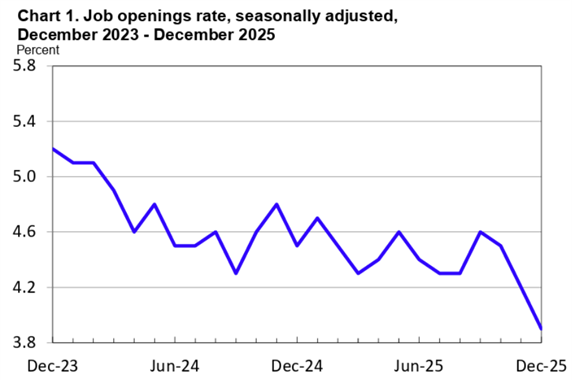
The number of U.S. job openings continued to slide down in December to 6.5 million, representing a decrease of 386,000 over the month and 966,000 for the year. Job openings in November were revised down to 6.9 million. The seasonally adjusted job openings rate was 3.9% in December compared to 4.2% in November and 4.5% in October. Sectors reporting decreased job openings for the month were professional and business services (-257,000), retail trade (-195,000), and finance and insurance (-120,000). The number and rate of hires was little changed over the month at 5.3 million and 3.3%, respectively. Total separations also had little change at 5.3 million and a rate of 3.3%. Within total separations, the number and rate of quits was unchanged. The number of quits decreased in professional and business services (-151,000) and private educational services (-19,000), while they increased in retail trade (+87,000) and information (+28,000). The number of layoffs and discharges changed little over the month, and the rate was unchanged at 1.1%. Transportation, warehousing, and utilities (+103,000) reported increased layoffs and discharges. -Valorie Rice
Compensation costs for civilian workers increased 0.7% on a seasonally adjusted basis for the 3-month period ending December 2025, according to the February 10th Employment Cost Index Summary. Year-over-year in December, non-seasonally adjusted compensation costs for civilian workers increased 3.4%, wages and benefits rose 3.3%, and benefits costs increased 3.4%. The Phoenix-Mesa Combined Statistical Area (CSA) showed compensation costs increasing by 3.2% over the year in December, with wages and salaries rising 2.8%. The Chicago-Naperville, IL-IN-WI CSA showed the largest compensation increase with 4.9% over the year in December, while the Detroit-Warren-Ann Arbor, MI CSA ranked last. Compensation costs for private industry workers and for state and local governments increased 3.4%, not seasonally adjusted, for the 12-month period ending December 2025. -Delaney O’Kray-Murphy
In December, year-over-year unemployment rates were higher in 255 of the 387 metropolitan areas, lower in 110, and stable in the remaining 22. The December unemployment rate for the Tucson and Phoenix metropolitan areas came in at 4.1% and 3.5%, respectively. Yuma had the highest unemployment rate in the state at 12.4%, while Phoenix had the lowest. Decatur, AL, and Huntsville, AL, had the lowest unemployment rates at 1.9%, while El Centro, CA, had the highest rate, at 18.6%. The largest year-over-year increase occurred in Wildwood-The Villages, FL (+2.5 percentage points), and Kokomo, IN, saw the largest year-over-year decrease (-3.3 percentage points). -Delaney O’Kray-Murphy
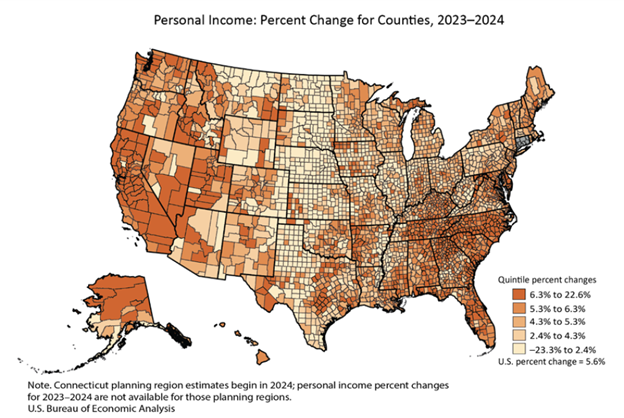
The majority of counties in the nation had an increase in real gross domestic product (GDP) in 2024 based on the most recent U.S. Bureau of Economic Analysis report on county GDP and personal income. Small counties (those with a population less than 100,000) reported the broadest range in real GDP from a 76.6% increase in Carter County, MT, to a decline of 46.3% in Baca County, CO. Within Arizona, the largest increases in real GDP were in Greenlee (15.2%), Graham (11.8%), and Pinal (10.7%). Pinal County had the largest increase in real GDP among large counties in the nation: those with populations 500,000 or larger. Personal income increased in nearly 90% of the country’s counties, including all of those in Arizona. The change in personal income for Arizona ranged from 9.2% in Pinal County to 1.3% in Apache County. All large and medium-sized counties in the U.S. had an increase in personal income between 2023 and 2024, while small counties reported a range between a 22.6% increase in Harding County, SD, and a decrease of 23.3% in Issaquena County, MS. Nationally, personal income increased 5.6% for that period. -Valorie Rice
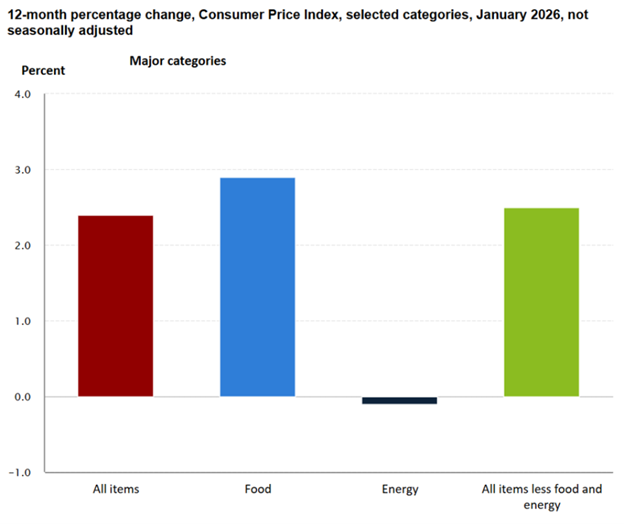
The U.S. Consumer Price Index for all-items rose 0.2% over the month in January, down from 0.3% in December. Over the year, the all-items index was up 2.4% in January, down from 2.7% in December. The core index (all items less food and energy was up 2.5% over the year. The food index increased 2.9% from last year, and the energy index was down 0.1%. The commodities index (less food and energy commodities) was up 1.1% over the year. The services index (less energy services) was up 2.9%, with shelter rising 3.0%. -George Hammond