
A private company has no ticker, no closing bell and no continuous price. It still has a value, and that value gets estimated constantly — by the investors who fund it, by the funds that hold it, and by the employees who own a slice of it.
The estimates rarely agree. Understanding why they disagree is more useful than picking one and treating it as the answer. Here is how the number is built, and what to make of it when two credible sources publish different figures for the same business.
Why a company with no ticker still has a price
A public share price is a live auction result. Thousands of buyers and sellers transact continuously, and the last trade becomes the quoted price. Nothing like that exists for a private business.
Instead, value is established at discrete moments. A funding round sets a price when new shares are issued. A tax or accounting event forces a formal appraisal.
An employee might sell a block on a secondary market. Each of those is a real data point. But each one is a snapshot, and the snapshots are taken months apart under different conditions.
Tax authorities have worked with this problem for decades. The IRS defines fair market value as the price agreed between a willing buyer and a willing seller, with neither required to act and both reasonably informed. That describes a hypothetical transaction, because for a private company an actual one often is not available.
Why one company can carry three different numbers
The same private share can legitimately carry several prices at once. Before any argument about the business itself, two structural differences — share class and timing — account for the gap.
A funding round prices preferred stock, which typically carries liquidation preferences and other protections that common shares do not have. An employee secondary usually prices common stock, which lacks those protections.
A mutual fund holding the position marks it at its own estimate of fair value, on its own schedule, often for a share class bought years earlier. Three prices, three different instruments, three different dates.
Putting those side by side is harder than it sounds, because they are published in different places and on different clocks. Moonberg collects them for well-known private companies — the last round, the fund filings and the secondary-market price for the same business, each shown with the date it was set.
Seeing the marks together, rather than picking one, makes the spread between them visible. That spread is information about share class and staleness, not evidence that someone made a mistake.
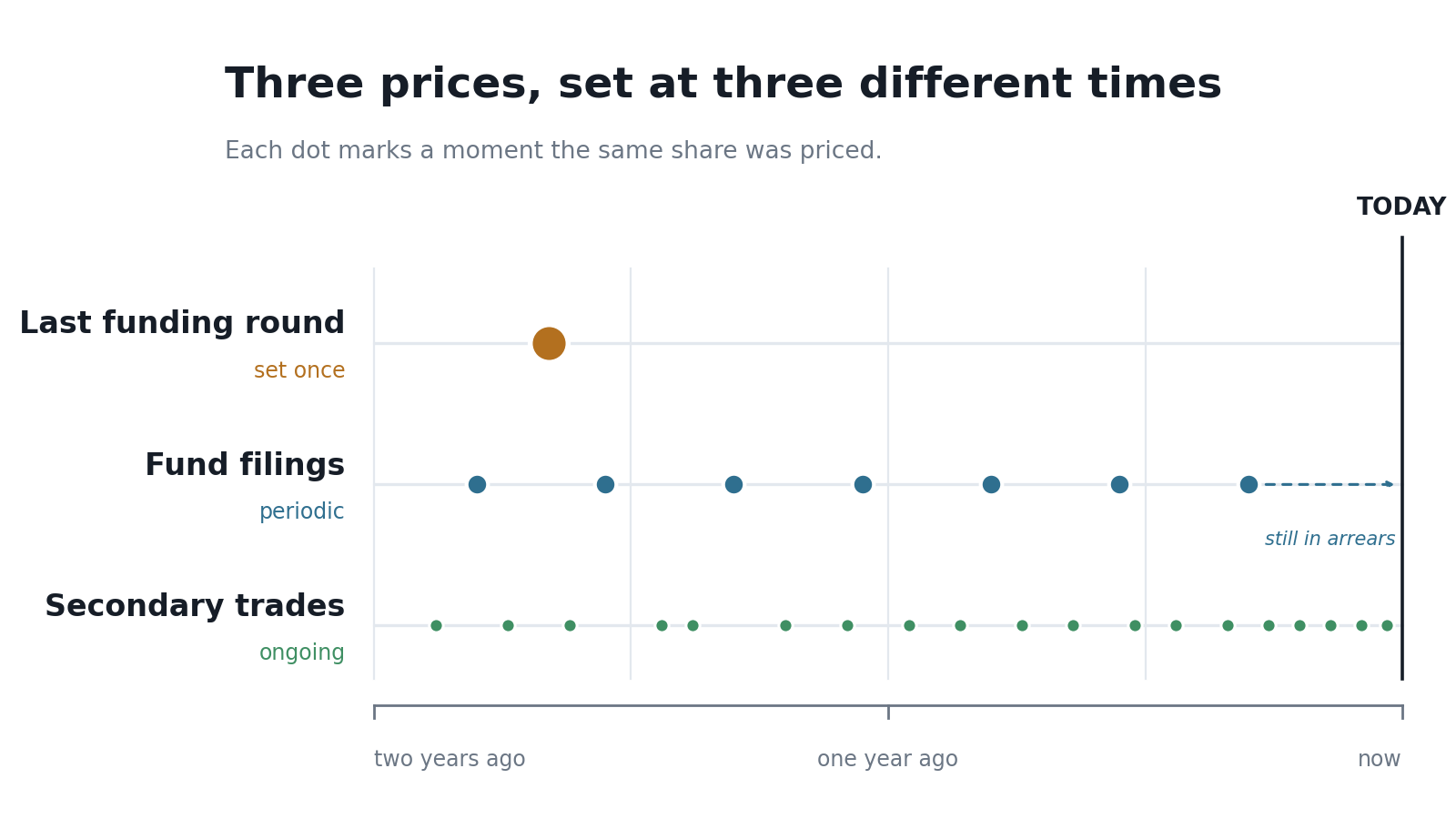
One price is set once, one arrives in arrears, and one runs to today — which is much of why they disagree.
The three approaches behind the number
Nearly every private valuation traces back to one of three methods, or a blend of them.
The income approach projects future cash flow and discounts it back to today. It suits businesses with predictable earnings. It struggles with companies that are growing fast and spending heavily.
The market approach finds comparable businesses that did trade — public peers or recent acquisitions — and applies their multiples. It depends entirely on whether genuine comparables exist.
The asset approach totals what the business owns and subtracts what it owes. It sets a floor for asset-heavy companies. It badly understates firms whose value sits in software, brand or people.
A tempting shortcut is to run all three and average them. Revenue Ruling 59-60, the guidance that still governs this area, rejects that directly: “no useful purpose is served by taking an average of several factors.” Averaging buries the judgment about which method actually fits the business.
The filings that make private marks public
Of the three prices above, one is genuinely public, and it is the one people overlook.
A regulated mutual fund holding shares in a private company reports that position to the Securities and Exchange Commission on Form N-PORT. The filing carries how many shares the fund holds and what it values them at. Not every report is released, but the ones the Commission disseminates are republished in public data sets.
Dividing value by share count gives a per-share mark. That makes fund filings unusually useful. The fund is valuing the position for its own shareholders rather than for the company, and its methodology answers to the fund’s board and its auditors.
Several funds holding the same business produce several independent estimates that can be compared. The figures lag, because reporting is quarterly at present and each filing arrives well after the period it covers. They often reflect an earlier share class too.
Read with those caveats, they are an independently produced number rather than one supplied by the company.
Holding shares you cannot price
For employees, this stops being academic the moment equity forms a real part of net worth.
Someone holding options or restricted stock in a private employer often cannot answer a simple question: what is this worth today? The last round may be old. The company may not share a current internal valuation.
Private offerings also sit outside the disclosure rules that public companies follow. Issuers in these exempt offerings do not have to make prescribed disclosures to accredited investors, and participation is generally limited to investors meeting income, net-worth or professional-credential tests.
The holders are not confined to Silicon Valley. Arizona’s biggest employers include large privately held companies alongside the public corporations and non-profit health systems, and Ranking Arizona, the state’s annual business opinion poll, covers thousands more firms.
Where any of those companies pays part of the package in equity, its employees face this problem directly.
A single figure is more useful with its share class, its date and its source attached than it is on its own. Where several independent marks exist, the distance between them is part of the picture rather than noise to be averaged away.
None of the three numbers is the true one. They measure different things, and knowing which is which is most of the work. For anyone tracking private businesses — as an employee, an operator or a reader of Arizona business news — that distinction turns a confusing set of figures into something to reason about.