How Food and Beverage Brands Can Choose the Right Trade Shows for Arizona Companies
Let me be upfront about something, I’ve watched a lot of small food brands blow their entire marketing budget on the wrong trade show. Not because they weren’t smart. Nobody gave them a real framework for thinking it through before writing the check.
Food and Beverage trade shows in 2026 are going to look a little different than what most of us are used to. The post-COVID hangover is finally wearing off, attendance numbers are climbing back up, and honestly, the competition for booth space at the good shows is getting fierce again. If you’re an Arizona-based food or beverage brand, craft hot sauce company out of Scottsdale, a family-run tortilla manufacturer in Mesa, a startup functional beverage brand somewhere in the Phoenix metro, this stuff matters more than ever.
If you are looking for the food and beverage trade show calendar list to attend in the USA, you can visit the link form Methodex Inc Blog which you can filter by city, state, or name easily.
Why Arizona Brands Face a Unique Challenge in Food & Beverage Trade Show
Most of the big-league Food & Beverage trade shows in 2026 aren’t happening in our backyard. Fancy Food Show? New York and San Francisco. Natural Products Expo? Anaheim. Summer Fancy Food Show? Back in New York. The Winter Fancy Food Show is a flight away, no matter what. That means every show you attend comes with travel overhead, flights, hotels, freight shipping for booth materials, and per diem for your team. A small Arizona brand sending two people to a four-day show in California or New York is likely to pay $8,000 to $15,000 before they’ve even printed a single brochure.
I’ve seen brands go to three shows in a year, thinking more exposure equals more sales. Sometimes it does. Mostly, though, if you don’t have a framework for choosing, you’re just guessing with expensive money.
Define What “Success” Actually Means in Food Trade Show
Sounds obvious in Trade Shows. Almost nobody does it properly.
Before you register for any Food & Beverage trade show in 2026, you need to answer one brutally specific question: What does winning look like twelve months from now because of this show? Not “brand awareness.” That’s not a number. Not “networking.” Great, with whom, to what end?
We need three to five new regional distributor relationships. Or: we want ten qualified buyer meetings with grocery chain category managers. Or even: we want to validate whether our new line has legs before we invest in full-scale production. Each of those goals points to a completely different type of show. A regional food expo in the Southwest might be perfect for distributor relationships. A specialty food show in New York is where the grocery buyers actually are. A startup-focused food innovation event is where you do market validation.
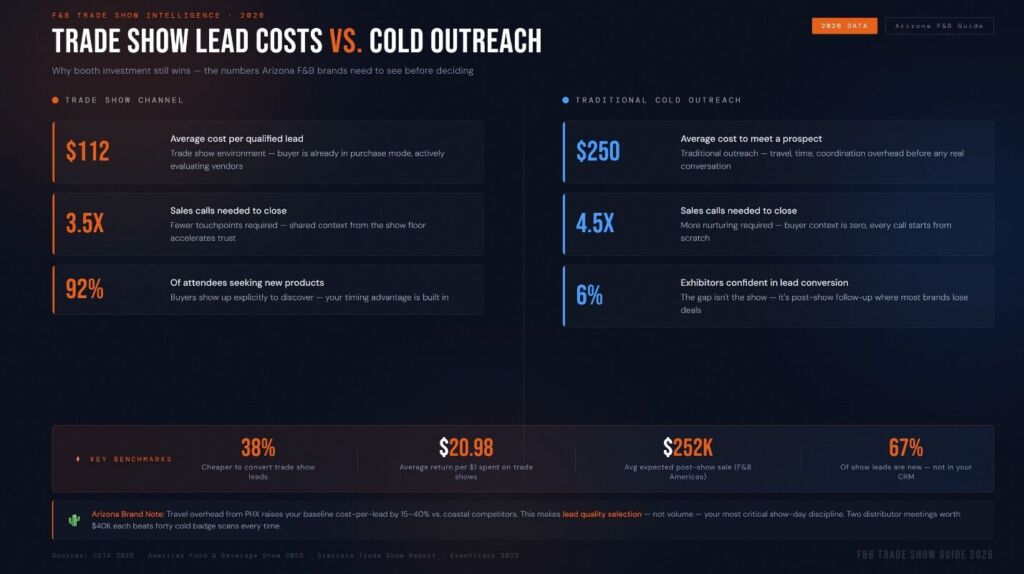
Arizona companies, especially, need to be deliberate here because every show costs more when you factor in travel. Your ROI threshold has to be realistic.
The ROI Framework for Food & Beverage Trade Shows
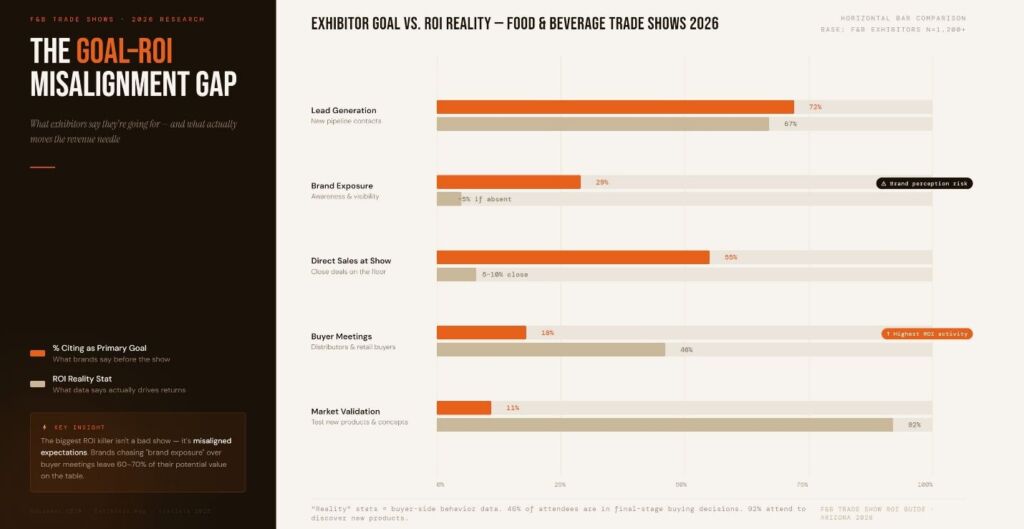
Here’s roughly how I’d structure the math, and I’m intentionally being a little loose with the numbers because your margins and deal sizes will be specific to your business.
Start with your average deal value. If a single distributor relationship is worth $40,000 in annual revenue to you, which is honestly on the conservative side for most food brands, then a show that costs you $12,000 in total expenses only needs to deliver one solid distributor contact that converts. One. That’s a 3x return.
Then estimate realistic conversion rates. Let’s say you’re at a show with solid buyer traffic. Over four days, you have meaningful conversations with 80 people. Maybe 20 of those are genuinely relevant to your distribution or retail goals. Of those 20, maybe five turn into follow-up meetings. Of those five, two become actual customers or partners within six months. That’s a 2.5% close rate on your total show contacts, which is actually about right for most food brands doing this for the first time.
Now do the reverse math. If two new relationships at $40,000 each equals $80,000 in new revenue, and your show costs $12,000 total, you’re at roughly 6.6x ROI. That’s a good show. But if the show costs you $25,000 (bigger booth, more staff, fancier display) and you’re still closing two deals at the same value, your ROI drops to about 3.2x. Still okay, but tighter.
Evaluating Specific Food & Beverage Trade Shows in 2026
Okay, let’s get into the actual shows. I’m going to be opinionated here because I think a lot of “best trade show lists” are basically just whoever paid to be listed.
Natural Products Expo West (Anaheim, March 2026)
This is the granddaddy of natural, organic, and better-for-you food brands. If your Arizona brand is in that lane, functional beverages, clean-label snacks, organic sauces, plant-based anything, Expo West is where you need to be at some point. The buyer quality is exceptional. Major grocery chains, regional natural food co-ops, specialty retailers. It’s expensive (booth costs alone can run $5,000 to $30,000+, depending on size and placement), it’s crowded, and honestly, getting a great booth location if you’re a small brand can be a fight.
Summer Fancy Food Show (New York, June 2026)
Specialty and gourmet is the lane here. If you’re making something premium, artisan preserves, high-end chili paste, small-batch drinking vinegars, this is your crowd. The show draws specialty food buyers, importers, and retailers who are actively hunting for the next interesting thing. For an Arizona brand with a genuinely unique product story (and the Southwest has some killer product stories), this can be a great fit.
Western Foodservice & Hospitality Expo (Los Angeles, August 2026)
This one gets overlooked by CPG-focused brands because it’s more foodservice-oriented. But if you’re a food or beverage brand trying to get into restaurants, hotels, and institutional foodservice channels, and a lot of Arizona companies should be targeting that channel, especially with our tourism industry, this show makes a lot of sense. And it’s a shorter haul from Phoenix than New York.
Arizona Restaurant Association Events & Southwest Regional Shows
Don’t sleep on regional. Seriously. The Arizona Restaurant Association hosts events throughout the year that get genuine decision-makers in the room. For a brand trying to build local traction first (which is almost always the smarter play before you go national), these are incredibly cost-effective. Your travel costs are basically zero. You’re known quantities in the market. And local media coverage of Arizona food brands doing well locally is genuinely attainable.
Sweets & Snacks Expo (Indianapolis, May 2026)
Confectionery, snacks, candy. If that’s your category, this is the show. Period. Category-specific shows like this tend to attract very focused buyer traffic, and the right conversations happen more quickly.
Private Label Trade Show (Chicago, 2026)
Worth mentioning for Arizona brands considering private-label as a revenue stream alongside their own brand. The private label buyers at this show are procurement-minded, deal sizes are large, and Arizona’s manufacturing base is competitive enough to make a real pitch.
FOOD NEWS: 25 places for great patio dining in Arizona
THINGS TO DO: Want more news like this? Get our free newsletter here
The Six Questions to Ask Before Committing to Any Trade Show
I’ve basically boiled this down to a checklist over the years. Answer these six questions honestly before you register.
1. Who actually attends, and can you verify it?
Request attendee demographics from the show organizer. Not just “over 20,000 attendees”, that number means nothing. How many are retail buyers? How many distributors are there? From what regions? A reputable show will share this. A show that evades discussion of attendee composition is a yellow flag.
2. Does the timing fit your product cycle?
Launching a new line in Q3? Going to a show in Q4 makes sense. Attending a show three months before your product is ready to ship is just burning money and building false anticipation you can’t fulfill.
3. What are the actual all-in Trade Show costs?
The booth fee is the starting point, not the whole story. Add: freight to ship booth materials and samples; hotel rooms for your team; flights; per diem; booth setup and teardown labor, if needed; printed materials; giveaway samples; lead-capture tools; and post-show follow-up costs. I’ve had brands tell me they budgeted $8,000 for a show and ended up spending $19,000 when they added it all up.
4. What’s your follow-up plan for food trade Shows?
This sounds like it should come after the show, but you need to plan it before. The brands that win at trade shows are the ones with a systematic follow-up process ready to execute on day one back home. If your plan is “we’ll email people after,” you’re going to lose leads to the brands that are already scheduling Zoom calls on the flight home.
5. Have you talked to other Arizona brands that attended?
The food community in Arizona is smaller than you think, and people are generally willing to share intel. Reach out to brands that went to the shows you’re considering. Ask them honestly, was the buyer quality real? Did you get what you expected? Would you go back?
6. Is your brand ready for food & Beverage Trade Shows?
This is the uncomfortable one. Do you have retail-ready packaging? Professional sales materials? A working, current website? Minimum order quantities defined? If a serious buyer wants to place an order in three weeks, can you actually fulfill it? Going to a major show before you’re operationally ready isn’t just a waste of money, it can actually damage your brand reputation with buyers you’ll want to reconnect with later.
Building an Arizona-Specific Trade Show Calendar
Here’s a rough approach I’d recommend for different types of Arizona food brands.
If you’re an early stage (under $500K revenue): Focus on two regional shows and one targeted national show maximum. Spend the money you save on booth quality and sampling at the shows you do attend. Having presence at three mediocre booths is worse than having one excellent one.
If you’re mid-stage ($500K to $3M revenue): You probably have enough product validation to justify one or two national shows. Choose based on your channel priority, natural retail, specialty, foodservice, or conventional grocery, and pick the show that’s most targeted to that buyer type,layer in one or two regional shows to maintain the relationship.If you’re scaling ($3M+ in revenue), you likely already know which shows work for you. The question at this stage is usually about show investment, booth size, demo staffing, hospitality events, and whether to invest in sponsorships or speaking slots that build your brand beyond just the booth.