
Augusta’s internet has leveled up fast. Five years ago, 50 Mbps felt lucky; today most neighborhoods can grab gigabit cable, multi-gig fiber, or 5G home service. That leap means smoother Zoom calls in Martinez, glitch-free 4K movie nights in Grovetown, and low-ping wins in North Augusta.
More choice, though, breeds confusion. Is AT&T’s symmetrical fiber worth more than Xfinity’s promo? Can WOW!’s no-cap cable really hold up? And will 5G stay steady when storms hit?
We’ve audited prices, speeds, reliability, and customer sentiment to rank the seven providers that matter in Augusta – and help you pick the perfect fit.
How we picked the winners
We didn’t flip a coin or chase the flashiest promo. Instead, we built a six-point scorecard that mirrors the questions you ask when shopping for internet: How fast is it? How much will it cost after the first year? Will it stay up during crunch time? And does the company treat customers well?
First, we pulled hard performance data (advertised and median download plus upload speeds) for every residential provider that serves at least half of one Augusta ZIP code, using recent M-Lab and Ookla tests to keep the numbers honest.
Next, we opened our wallets. Intro prices are nice, but the bill in month 13 matters more, so we logged regular rates, equipment fees, and contract penalties, then calculated what you pay in year two for each popular tier.
Reliability came from outage-tracking services and local reports. Fiber has an edge, yet we still counted every documented downtime before awarding points.
Customer sentiment rounded out the picture. We anchored this factor to the latest J.D. Power Residential ISP study, where Google Fiber leads the South, AT&T sits second, and Xfinity follows in third.
We weighted each category by its impact on daily life:
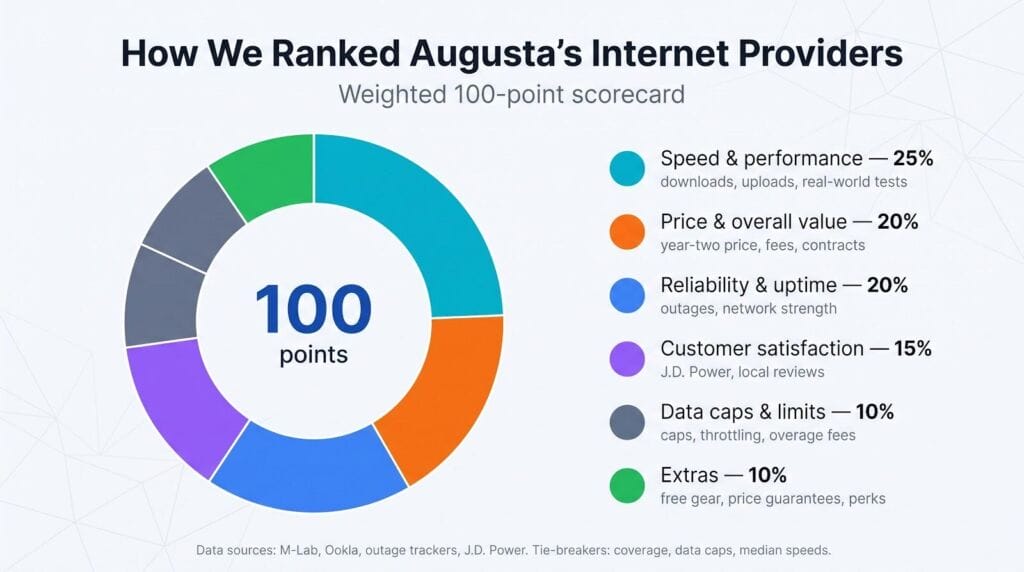
- Speed and performance: 25%
- Price and overall value: 20%
- Reliability and uptime: 20%
- Customer satisfaction: 15%
- Data caps and limits: 10%
- Extras like free equipment or price locks: 10%
Finally, we broke ties with serviceable-household reach, data-cap generosity, and verified median speeds. The result is a 100-point composite that lets us rank providers with confidence and gives you a transparent look at why each one lands where it does.
1. Wow! Home Internet: best value and practically unlimited data
Wow! wins the value crown because it stretches every dollar without choking your connection.
Plans settle near forty dollars once the first-year promo ends and still hand you 500 Mbps downloads – speeds that match pricier cable rivals. Even better, WOW! home internet ships with unlimited data and an optional Price Lock for Life add-on, so you can stream 4K, pull game updates, and back up photos without watching a meter.
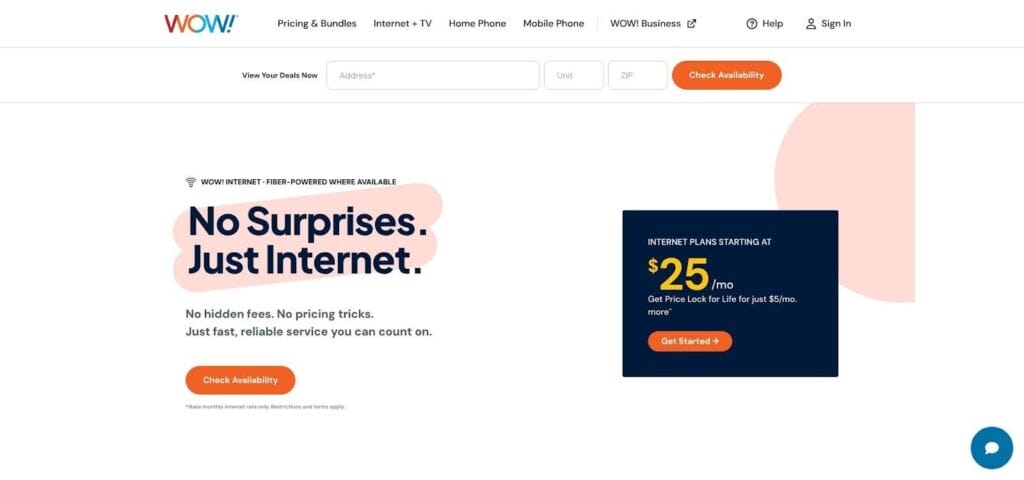
WOW! Home Internet plans page screenshot for Augusta value cable
Performance stays solid. Customers across West Augusta report evening speeds close to advertised rates and latency low enough for competitive play. Credit a network that rivals Comcast node for node, plus fresh spending as Wow! strings fiber in key neighborhoods.
Setup feels painless. There’s no contract, modem rental is optional, and local reps answer the phone instead of a national maze. Billing errors pop up in reviews, yet the company’s smaller size often means one call fixes the issue.
If you need fast cable speeds, hate overage fees, and want a predictable bill, Wow! is the easy first pick – so long as your address sits inside its growing footprint.
2. AT&T Fiber: fastest speeds and rock-solid reliability
If you want the quickest lane on Augusta’s information highway, AT&T Fiber holds the keys.
Multi-gig plans reach five gigabits in both directions and even the entry 300 Mbps tier delivers uploads that leave cable behind. Those symmetrical speeds keep Zoom, cloud backups, and Twitch streams humming with no lag.
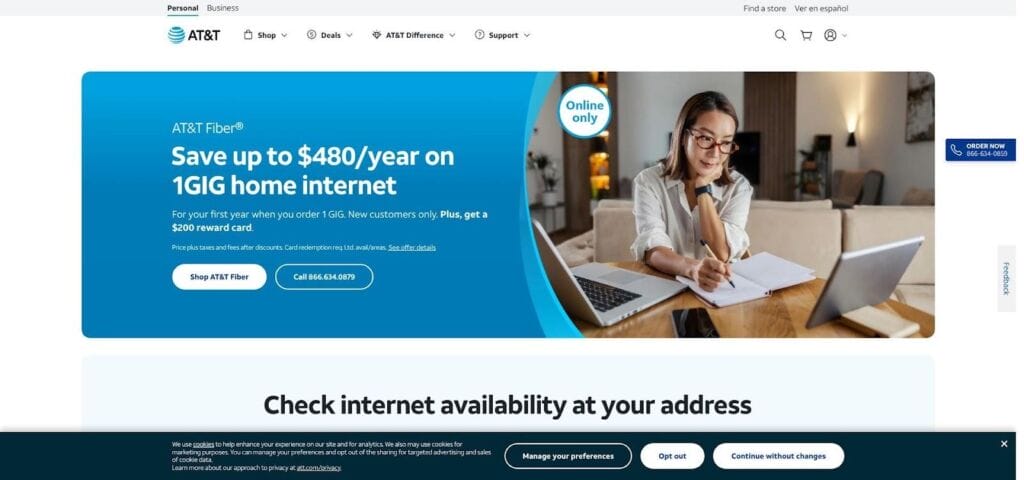
AT&T Fiber multi-gig symmetrical internet plans screenshot
The perks go beyond horsepower. AT&T dropped teaser pricing, so the amount you see at checkout is the amount you keep paying next year. Equipment is included, and there’s no contract tugging at your sleeve.
Unlimited data sweetens the deal. You never chase usage meters or pay overage fees, a rare promise in a world where some providers still cap at 1.2 TB.
Reliability matches the spec sheet. Fiber shrugs off electrical interference and neighborhood congestion, which is why remote workers rave about steady five-to-ten millisecond pings at all hours. J.D. Power backs up the praise, ranking AT&T second for overall customer satisfaction in the South last year.
The only catch is availability. Roughly eight in ten Augusta households sit inside the fiber footprint, a number growing each quarter. Check your exact address; if the green light appears, you have the city’s most future-proof connection waiting at the curb.
3. Xfinity: ubiquitous coverage and growing multi-gig muscle
Xfinity reaches almost every corner of Augusta, from downtown lofts to country roads near Blythe. That availability alone keeps it near the top, because coverage still beats any spec sheet when other providers skip your street.
Speeds look strong on paper. Every address on the network now qualifies for at least one-gig downloads, and pilot upgrades are nudging top tiers to two gigs with sharply higher uploads during 2026. Day-to-day performance is solid, though evening slowdowns can appear in packed apartment clusters where many neighbors share the same node.
Pricing is the sticking point. Intro rates lure you in at about thirty-five dollars for 200 Mbps, yet month thirteen brings a steep climb. Modem rental and regional sports fees add even more unless you negotiate. Many locals schedule a yearly “loyalty call” to keep bills tame, so mark that chore on your calendar if you sign up.
Xfinity caps data at 1.2 terabytes unless you pay for unlimited. Households with several 4K streams often cross that line, so add the thirty-dollar upgrade to your realistic cost.
Customer support still draws mixed reviews, but a revamped mobile app and a growing network of public Wi-Fi hotspots help soften the pain. If fiber is not available and you want fast, widely available cable, Xfinity remains Augusta’s most convenient choice – just guard your wallet when promotions expire.
4. T-Mobile 5G Home Internet: best wireless alternative
T-Mobile turns a cell tower into a broadband lifeline, and it does so with refreshing simplicity.
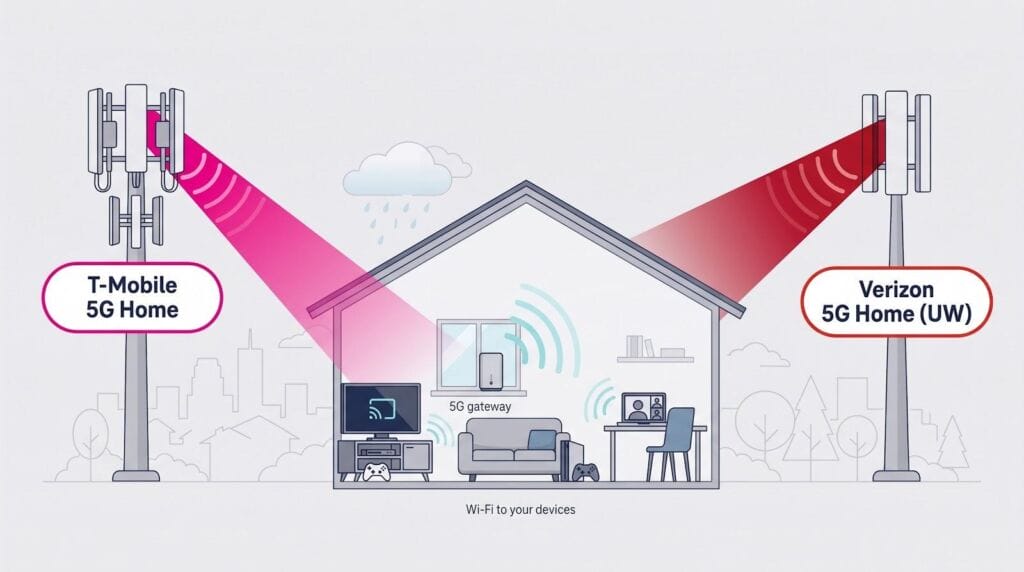
Plans start at fifty dollars a month with AutoPay, plus taxes and fees. There is no rental fee, no regional add-on, and no rate hike in year two. Place the gray gateway near a window, wait for the light to turn green, and you are online at roughly one hundred megabits down and twenty up. Many Augusta addresses see higher bursts off-peak, while a few fringe spots hover closer to fifty. Either way, you are streaming, scrolling, and gaming without digging a trench across your lawn.
Data is unlimited. Stream four 4K movies a night and no one slows you, although speeds can dip when the network is crowded, usually early evenings if your tower serves a busy corridor like Washington Road.
Reliability beats old-school DSL but still trails fiber. Weather and tower load matter. That is why the fifteen-day test drive shines. Run it alongside your current provider; if video calls stay smooth during a thunderstorm, keep it and pocket the savings.
For renters and cord-cutters who want quick setup, predictable billing, and enough speed for daily life, T-Mobile 5G Home is an easy yes.
5. Verizon 5G Home Internet: speedy where Ultra Wideband reaches
Verizon’s fixed wireless can feel like cable without the coax, but only if your roof catches the right signal.
Inside a strong Ultra Wideband zone, speeds cruise between 200 and 300 megabits with bursts that flirt with a full gigabit. Uploads in the teens handle video calls fine, and latency stays under fifty milliseconds. All that rides on C-band and millimeter-wave spectrum, so performance drops sharply if your address falls back to standard 5G or LTE.
The plan mirrors T-Mobile’s simplicity: fifty dollars a month with AutoPay, or thirty-five if you already have a qualifying Verizon mobile plan. A sleek white router comes free, and data is uncapped. Verizon also piles on perks like a two-hundred-dollar gift card or a year of streaming credits during most promos.
Setup is DIY. Aim the router toward the nearest tower, run a speed test, and move it if numbers lag. Many users place it on a window shelf for the best line of sight.
Coverage is the catch. Only about one-third of Augusta addresses qualify today, clustered downtown and along major corridors. Check eligibility before you get excited. If the checker says yes, Verizon delivers one of the fastest cord-cutting experiences in the city, rivaling entry-level cable without the pricing games.
6. Kinetic by Windstream: a lifeline for Augusta’s outskirts
Drive ten minutes past Grovetown’s last traffic light and the broadband map changes. Cable thins out, fiber vanishes, and phone lines rule the poles. Here, Kinetic by Windstream often stands between you and satellite.
Speeds hinge on the wire it brings to your door. Legacy DSL tops out near one hundred megabits, though many addresses see closer to fifty. Where Windstream has swapped copper for new fiber runs, you can order a full gigabit with uploads to match. Check your street carefully; two houses on the same road can qualify for very different tech.
Pricing sits mid-pack. Fifty to sixty dollars buys rural DSL, which feels steep for the speed, while fiber tiers hover around seventy for one gigabit – reasonable given the competition gap. Contracts are optional, and every plan is free of data caps, a blessing when kids discover massive game updates.
Reliability follows the same copper-versus-fiber line. Old pairs can sputter during summer storms, yet Windstream has poured grant money into replacing weak drops and burying exposed lines. Fiber customers report stable service and latency under twenty milliseconds, on par with AT&T.
Customer support lags larger rivals in national surveys, but local technicians earn praise for quick dispatches when a line snaps. If your property sits beyond the reach of AT&T or Xfinity, Kinetic offers real broadband that beats satellite on both speed and latency and could upgrade to fiber sooner than you expect as the next round of rural grants rolls out.
7. Satellite internet: Starlink shines, Viasat and HughesNet hang on
When every wire stops short of your mailbox, satellites keep you online.
Starlink’s low-Earth-orbit fleet leads the pack. Most Augusta-area users see 100 to 200 megabits down and 20 up with latency under 50 milliseconds. That is fast enough for Zoom calls, 4K streams, even a little Fortnite. The catch is cost: the dish runs about six hundred dollars up front and service hovers near ninety a month. For a farmhouse outside Blythe, though, it can feel like a miracle.
Viasat and HughesNet rely on higher, slower geostationary birds. Top plans promise up to 100 megabits, but latency above 600 milliseconds makes real-time apps painful. Both providers enforce strict data buckets; exceed your 100-gig allowance, and speeds drop to a crawl until the next billing cycle.
All three are weather sensitive. Heavy rain or dense cloud cover can knock out signal for a few minutes. Power outages do the same unless you pair the modem with a battery backup. Expect brief drops as the dish switches satellites.
Choose satellite only when fiber, cable, 5G, and DSL all strike out. If that is your reality, lean toward Starlink for the best blend of speed and latency, and budget extra for the hardware so you can work and stream while you wait for rural grant crews to reach your road.
Quick decision guide: find your perfect fit fast
You just reviewed seven options, so let’s narrow them to one.
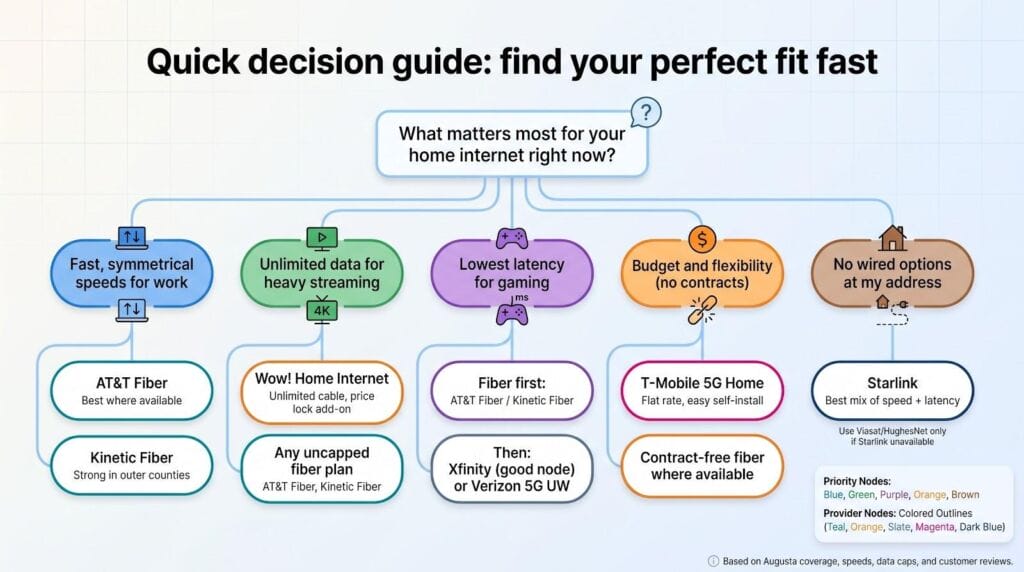
Start with speed. If you run a home office that lives in cloud drives and daily video calls, choose a symmetrical connection. That means AT&T Fiber when available or Kinetic Fiber in the outer counties.
Next, weigh data use. Families with three or more 4K TVs can chew through a terabyte quickly. Wow!’s unlimited data or any uncapped plan keeps binge nights worry-free. Skip Xfinity unless you plan to add its thirty-dollar unlimited option.
Then, think about stability. Gamers and competitive streamers need latency in the teens. Fiber still leads, but a well-provisioned Xfinity node or a strong Verizon 5G UW signal can keep pings steady. Satellite and older DSL lag too much for twitch titles.
Finally, check budget and flexibility. Renters who may move within a year love contract-free setups like T-Mobile 5G Home. Rural homeowners with no wires lean toward Starlink despite the upfront cost because it simply works when nothing else does.
Match your top priority to the list above, and the shortlist writes itself. When in doubt, test the wireless options during their risk-free trials while your current service stays plugged in. A weekend of side-by-side speed tests teaches you more than a month of marketing emails.
Internet tech 101: fiber, cable, 5G or satellite?
Not all megabits travel the same road. Understanding the medium under – or above – your roof helps you set expectations and avoid surprises.
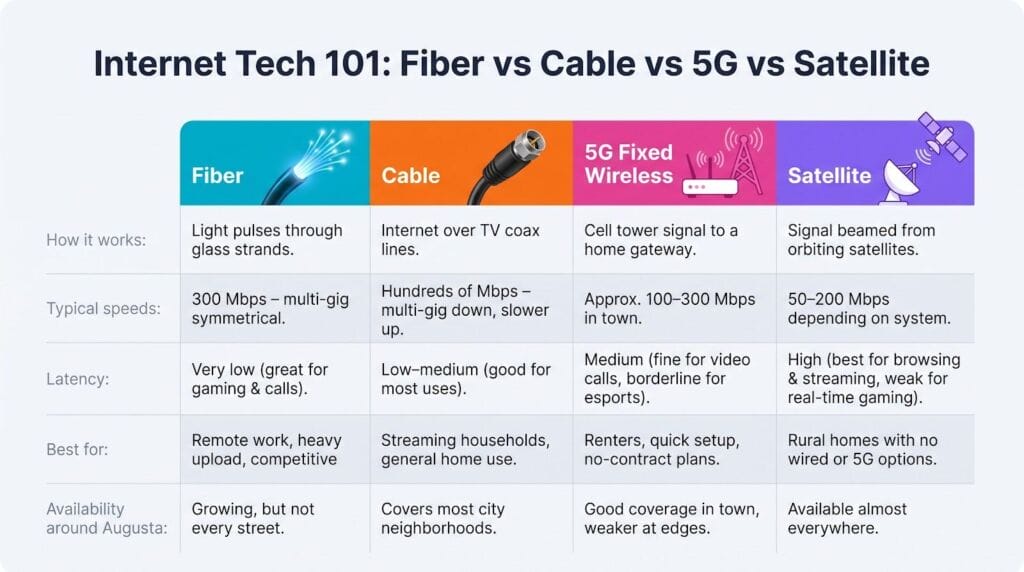
Fiber sends pulses of light through hair-thin glass strands. That physics magic delivers the fastest downloads and uploads, often matching each other at one, two or even five gigabits. It shrugs off electrical noise, so evening slowdowns are rare. The only drawback is construction; if a provider has not pulled fiber down your street yet, you cannot order it.
Cable rides the copper coax once reserved for television. Thanks to newer DOCSIS standards, it now supports multi-gig downloads, but uploads remain a fraction of that speed. Because neighbors share the same node, heavy prime-time traffic can shave a few megabits off your test results. Still, cable blankets nearly every Augusta block and installs quickly.
5G fixed wireless skips the line entirely. A roof-level router grabs a cellular signal and turns it into Wi-Fi for the house. Speeds vary with tower load and distance, averaging 100 to 300 megabits in town. Latency sits between fiber and cable – good for video meetings, borderline for competitive gaming. Setup takes five minutes, no trench, no technician.
Satellite beams data from orbit, the hero for farms and fishing cabins. Starlink’s low-orbit fleet brings respectable speed and latency, while older geostationary systems feel sluggish for anything interactive. Weather can briefly knock out service, and hardware costs more upfront, but total coverage is its ace.
Match the medium to your reality: choose fiber when it is on the pole, cable when fiber is not, 5G when you need quick, contract-free service, and satellite only when the map goes blank.
Coming in 2026–2027: upgrades you will actually notice
Augusta’s networks are not coasting on today’s speeds. Construction crews and tower techs have a crowded to-do list, and several projects reaching milestones over the next 18 months will change what you can order at your address.
AT&T is sprinting toward blanket fiber coverage. The build plan targets the final pockets of South Augusta and North Augusta, plus semi-rural parts of Columbia County that still rely on DSL. When those streets light up, another ten thousand homes move from middling copper to multi-gig fiber service.
Comcast is chasing symmetry. DOCSIS 4.0 gear is already live in a handful of Augusta nodes, unlocking two-gig downloads and triple-digit uploads. Engineers aim to finish the metro-wide upgrade by late 2026, which means many cable customers will finally see upload speeds that keep pace with large photo backups or game streams.
Wow! is quietly pulling its own fiber alongside existing coax. Neighbors in Martinez have spotted crews laying orange conduit and receiving door hangers that tease symmetrical gigabit service. If you are on Wow! now, watch your mailbox; an upgrade could arrive without changing providers.
Fixed wireless is getting denser, too. T-Mobile’s recent fiber-backhaul purchase lets the carrier add more small cells across the CSRA, easing tower congestion. Verizon plans to double C-band coverage in the same period, so more rooftops will qualify for its faster 5G Home tier.
Rural residents should also watch the state’s broadband grant map. Columbia and Burke counties secured fresh funds to extend fiber down gravel roads long ignored by larger ISPs. If you see new utility-pole markers in your ZIP code, you may swap satellite pings for glass-level latency by next summer.
Tips to lock in the right plan and keep cash in your pocket
Start with location. Pull up each provider’s address checker rather than a generic map. Coverage lines blur at the street level, so your neighbor’s options may differ from yours. Confirm the exact tech – fiber, cable, or 5G – before you compare prices.
Match speed to usage. A single remote worker plus one streaming TV hums on 300 Mbps. Families with four 4K screens and a gamer need closer to a gigabit. Skip speeds you will never touch; every unused megabit is money left on the table.
Promotions look nice, but year-two pricing matters more. Scroll past the headline to the fine print that lists the regular rate. If that jump wrecks your budget, plan to switch or negotiate at month eleven.
Competition is your best coupon. Quote a rival’s offer when you call the loyalty department. Xfinity and Wow! reps often cut twenty dollars or add unlimited data rather than lose you to the other side of the street.
Equipment fees pile up fast. If you stay on cable longer than a year, buying your own DOCSIS 3.1 modem pays for itself. With fiber, you still need the provider gateway, but adding your own Wi-Fi 6 router can double indoor speeds for a one-time cost.
Test before you cancel. Both T-Mobile and Verizon give at least two weeks of risk-free service. Run speed tests during your busiest hour, stream a movie, then hop on a video meeting. Keep the winner, send back the loser, and skip buyer’s remorse.
Frequently asked questions
Who delivers the absolute fastest internet in Augusta?
AT&T Fiber. Its multi-gig plans reach five gigabits both up and down, and real-world tests often hit one gigabit or better. Xfinity’s two-gig cable tier is catching up on downloads, but uploads remain much slower.
Is Xfinity better than AT&T?
It depends on availability. Where fiber reaches your street, AT&T wins on speed symmetry, unlimited data, and price stability. In areas without fiber, Xfinity’s cable network is the next-best wired choice and often the only gigabit game in town; just watch for post-promo price jumps and the 1.2-terabyte cap.
What is the cheapest way to get online right now?
T-Mobile 5G Home starts at fifty dollars a month with AutoPay, or less if you bundle an eligible cell plan. For qualifying low-income households, Comcast’s Internet Essentials drops to fifteen dollars, though speeds cap at 75 Mbps.
Are there other fiber providers besides AT&T?
Yes, but they ride on someone else’s glass. EarthLink resells AT&T Fiber, and CarolinaConnect serves a few pockets across the river in South Carolina. Wow! is building its own fiber extensions, but for now still delivers most connections over cable.
How can I boost Wi-Fi without upgrading my plan?
Place your router high and central, away from metal and brick. Move crowded 2.4 GHz devices to the 5 GHz band, and add a Wi-Fi 6 mesh kit if you live in a multi-story home. The right in-house gear can double your usable speed before you spend another dollar on bandwidth.
Conclusion
Match your top priority to the list above, and the shortlist writes itself. When in doubt, test the wireless options during their risk-free trials while your current service stays plugged in.