
Florida companies run on connectivity. A single lightning strike in Tampa—or a late-season hurricane sweeping up the Gulf—can stall point-of-sale systems, cloud backups, and video calls in seconds. Yet only 61.9 percent of residents can buy gigabit-class service, ranking Florida in the bottom third for high-speed access. Choosing a provider, then, is less brand loyalty and more business survival. We spent three months measuring speeds, SLAs, storm-response records, and real customer reviews to identify the eight strongest options. Along the way we’ll bust stubborn fiber-internet myths that still deter symmetrical-bandwidth-hungry teams.
How we ranked the providers
Choosing a business-grade connection isn’t like shopping for a personal streaming plan. Downtime costs revenue, and limited upload speed can choke cloud backups before lunch ends.
So we built a clear scorecard that weights the factors Florida companies care about most:
Reliability (25 percent). Does the provider guarantee uptime with a written SLA? How did it score in the 2025 J.D. Power Business Internet Satisfaction Study, where service quality and outage communication matter?
Speed (20 percent). We favor symmetrical bandwidth and multi-gig headroom, not just a flashy download figure.
Price (20 percent). Intro offers are fine, but we focus on the rate you will pay in year two, as well as any contract lock-ins or exit fees.
Support (15 percent). Round-the-clock help, Florida-based field techs, and transparent outage dashboards all earn points when the sky turns gray.
Features (10 percent). Built-in LTE failover, static IP choices, and managed Wi-Fi bundles add value.
Coverage (10 percent). A stellar network is pointless if it stops three blocks before your door, so we mapped each ISP’s Florida footprint down to the county.
Each company received a weighted composite score, and the top eight made the list. Now let’s see which ones match your address.
Florida-specific buying considerations
Storms shape our schedule. From June to November heavy rain, power flickers, and the occasional category-three landfall strain every mile of cable in the state.
Look for infrastructure buried underground or served by generator-backed nodes. Fiber that stays below the surface weathers wind better than coax on poles, so uptime improves before you even read the fine print.
Ask about automatic LTE or 5G failover. Several providers ship a cellular router that activates within seconds of an outage, keeping card readers and VoIP phones green while crews splice lines.
Seasonal businesses need contract breathing room. Tour operators and beachfront cafés often save money with month-to-month service instead of paying through a quiet winter.
Keep an eye on the state’s BEAD build-out. More than one billion federal dollars will extend rural fiber during the next two years, so an address that shows “no service” today could reach gigabit speed by the next tourist season.
WOW! Business – best regional fiber challenger
WOW! is a nimble newcomer shaking up Central Florida’s entrenched market. Before we dig into speeds and pricing, its plain-spoken guide to fiber internet myths clears lingering doubts about cost, durability, and availability—concerns that often keep hurricane-season businesses clinging to legacy cable.
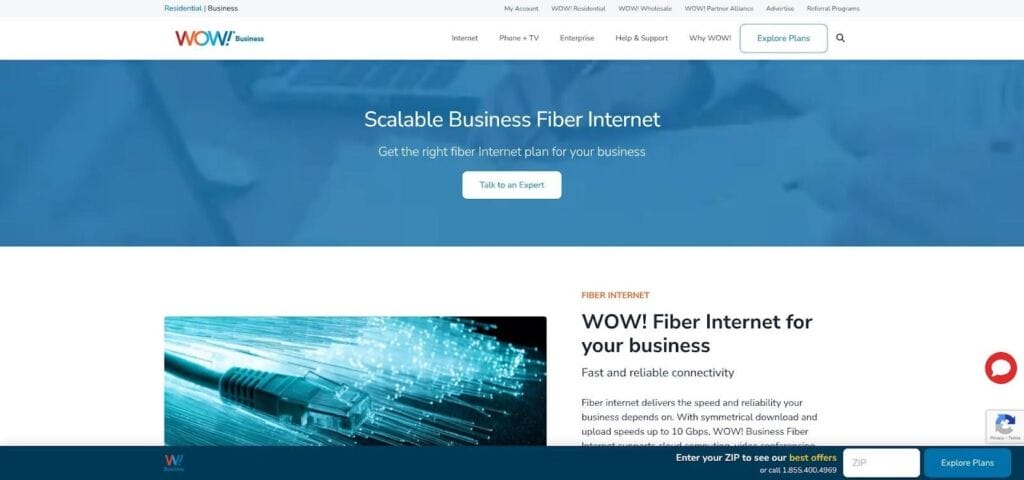
Its crews install fresh fiber to the curb and deliver symmetrical tiers from 300 Mbps up to 5 Gbps. Service already covers Pinellas, Seminole, Orange, and Bay counties, giving storefronts in Tampa, Orlando, and Panama City upload speeds cable lines rarely match.
Pricing stays straightforward. Sign a one-year term; the intro rate (about $45 per month for 300 Mbps) remains unchanged for 24 months, shielding budgets from typical year-two hikes.
Reliability backs the promise. A public outage map shows real-time ETAs for every fiber break, and the network targets 99.99 percent availability.
Add 24 / 7 support, static-IP availability, and quick speed upgrades that take a single call, and WOW! becomes an easy choice wherever trench work has reached the curb.
Coverage is the lone caveat. Step outside those four counties and the fiber truck keeps rolling. If your ZIP code falls inside the green zone, the fastest path to future-ready bandwidth may already be under the sidewalk.
MORE NEWS: Rough Rider named best speakeasy in Arizona by Chowhound
DEEPER DIVE: Read all the Ranking Arizona Top 10 lists here
AT&T Business Fiber – best metro-wide fiber availability
AT&T grew from telephone poles to a dense fiber backbone. Its trucks cover every major metro, from Miami’s Brickell towers to the logistics parks circling Jacksonville, lighting up symmetric tiers to 5 Gbps. If you need more, dedicated circuits scale higher without changing the handoff.
Speed is only half the draw. Every plan at 1 Gbps or above includes an LTE router that activates when a backhoe or storm cuts a line. Your cloud drive stays mounted, your card reader stays green, and the first hint of trouble is a text alert.
Support holds up that promise. AT&T led the 2025 J.D. Power Business Internet Satisfaction Study for medium and large enterprises, showing the help desk answers before the hold music loops.
Bundling trims costs further. Combine fiber with an existing AT&T wireless fleet, and monthly discounts remove about twenty dollars from the bill; standard tiers stay contract-free.
If your location sits inside AT&T’s expanding fiber map, the mix of speed headroom, built-in backup, and proven customer care makes copper feel outdated.
Comcast Business – widest overall footprint
If you can get electricity, you can probably get Comcast. The cable giant blankets South Florida’s coast, the Panhandle, Jacksonville, and almost everything between, making it the default for storefronts that sit outside a fiber build.
Speeds reach 1.25 Gbps down on the latest DOCSIS network, with uploads near 35 Mbps. That asymmetry is the trade-off for reach, but for point-of-sale traffic, video calls, and cloud dashboards the pipe is more than wide enough.
Contracts come with the territory. Sign for one or three years and promo pricing sits around seventy dollars for a 300-meg plan or about one-thirty for gigabit. Cancel early and fees follow, so pencil the term into your growth plan.
Comcast eases the worry with its “Business Promise.” Report an outage and the next bill shows a credit, no questions asked. Add the optional LTE gateway, often bundled with higher tiers, and even a backhoe mishap flips you to cellular before the cash drawer notices.
Support runs 24 / 7, and the self-service portal lets you reboot modems, add static IPs, or upgrade speeds without waiting on hold. For multi-site operators, managing every Florida location through one dashboard is a quiet productivity win.
Bottom line: if fiber hasn’t reached your address, Comcast delivers the next best thing, plus a clear path to multi-gig once DOCSIS 4.0 arrives.
Spectrum Business – best no-contract flexibility
Spectrum is a rare large ISP that lets you leave whenever you want. Sign up today and cancel tomorrow, and the only task is returning the modem. For seasonal operators and new companies still testing markets, that freedom is pure gold.
Plans start near 65 dollars for 500 Mbps and rise to a full gig for just over one hundred. Uploads plateau at 35 Mbps for now, but mid-split upgrades underway will more than double that ceiling and lay ground for multi-gig downloads.
Customer experience is improving. Spectrum topped the J.D. Power small-business rankings in 2025, proving that clearer bills and faster outage updates resonate with owners who also wear the IT hat.
Need a safety net? Add the wireless-backup option, and a 4G box rides shotgun on your rack, activating during power blips or line cuts. Since you pay month to month, dropping the extra cost outside hurricane season is as easy as a portal click.
Spectrum does not claim the lowest price, the fastest uploads, or the most features, but no-questions-asked cancellation keeps it on the shortlist for shops that value flexibility over raw specs.
Frontier Business Fiber – best multi-gig power for Tampa Bay and Orlando suburbs
Frontier inherited Verizon’s FiOS footprint a decade ago and has been adding miles of glass ever since. The result is a pure-fiber network that covers Tampa Bay, St. Petersburg, and the bedroom communities circling Orlando.
Speed is the headline feature. Standard plans jump from 500 Mbps to 1, 2, and 5 Gbps, with a 7-gig pilot already underway. Uploads match downloads, so nightly backups finish before the cleaning crew shuts off the lights.
Pricing stays competitive: about ninety dollars for symmetrical gigabit when you bundle a phone line, and the router ships in the box. One-year terms lock the promo rate, while month-to-month remains available for a slight premium.
Frontier’s customer-service story has improved. Recent J.D. Power data ranks its small-business satisfaction near the national leaders, thanks to 24 / 7 support and faster field dispatch.
If your ZIP code lists fiber service, Frontier delivers enterprise-class bandwidth at cable-class prices. For graphic studios, medical imaging centers, and any team that lives in the cloud, that combination is tough to beat.
Verizon 5G Business Internet – wireless backup that works anywhere
When cables fail, radio waves keep you open for business. Verizon’s fixed-wireless service links to the nearest cell tower and delivers 100 to 400 Mbps down and up to 50 Mbps up, with install times measured in days, not weeks.
The gear is a single receiver-router that mounts indoors. Plug it into power, point it toward the strongest signal, and your network is live; no trenching, permitting, or landlord signatures required.
Plans start near seventy dollars and run month to month. That flexibility makes Verizon the ideal sidekick to a wired primary. Feed the Ethernet into a dual-WAN router, and failover activates the moment your main line blinks.
Because the connection rides on battery-backed cell sites, service often survives the first wave of storm outages. Mobile crews can roll in portable towers to reinforce coverage, so recovery may beat ground teams tasked with restringing miles of fiber.
Throughput will not rival a gigabit circuit, but for credit-card swipes, VoIP rings, and cloud dashboards it is more than enough. If your address sits outside fiber territory, or if uptime is non-negotiable, keeping a Verizon 5G unit on the shelf is inexpensive insurance.
Cox Business – Panhandle and Gainesville mainstay
Travel west of Tallahassee and Comcast logos fade, replaced by Cox trucks hugging the Gulf Coast. From Pensacola through Destin, and down to Gainesville, Cox is the cable incumbent that keeps restaurants, military contractors, and college startups online.
Speeds follow the familiar coax curve: entry plans at 50 Mbps, stepping to 1 Gbps down and 35 Mbps up. That may not impress on paper, but it handles point-of-sale traffic, campus livestreams, and multi-location VPN sessions without strain.
Pricing runs a bit higher than Spectrum, landing near seventy-five dollars for 200 Mbps and about one-twenty for gig. Promotions often include two free months on a three-year term. Contracts are standard, so weigh early-exit fees against future office moves.
Reliability is where Cox flexes its local muscle. Business customers jump the residential repair queue, and an optional LTE continuity router keeps tills ringing when storms knock power from the nearest pole.
Need more bandwidth? Cox will pull dedicated fiber on request, a perk Gainesville tech firms adopt once investor money arrives.
If your ZIP code sits inside Cox territory, alternatives are scarce. The upside: local field crews understand the market and usually roll faster than out-of-state giants when storms swing through.
Quick-glance comparison table
Skim the grid below, find your county on the coverage row, then scan right for the mix of speed, contract terms, and built-in backup that matches your risk tolerance. In two minutes you will know which providers deserve a quote request and which to ignore.
| Provider | Tech | Max speed | Contract | Backup / SLA | Coverage focus | Promo price* |
| WOW! Business | Fiber | 5 Gbps ↔ | 1 yr (price fixed 24 mo) | 99.99% + outage map | Pinellas, Seminole, Orange, Bay | $45 / 300 M |
| AT&T Business Fiber | Fiber | 5 Gbps ↔ | None | LTE failover on ≥1 Gb | Metro & many suburbs statewide | $70 / 300 M |
| Comcast Business | Cable | 1.25 Gb ↓ / 35 M ↑ | 1–3 yr | Credit + LTE option | Statewide (except central pockets) | $69 / 300 M |
| Spectrum Business | Cable | 1 Gb ↓ / 35 M ↑ | None | Optional 4G box | Central & North FL | $65 / 500 M |
| Frontier Business Fiber | Fiber | 7 Gbps ↔ (select) | 1 yr | 99.99% SLA | Tampa Bay, Orlando, SE FL | $90 / 1 G |
| Verizon 5G Business | Wireless | 400 M ↓ / 50 M ↑ | None | Cell-site redundancy | Wherever Verizon 5G/LTE | $69 / 100 M |
| Cox Business | Cable | 1 Gb ↓ / 35 M ↑ | 3 yr typical | LTE continuity add-on | Panhandle & Gainesville | $75 / 200 M |
- Promo pricing reflects early-2026 offers, and will climb after the initial term. Check the fine print before you sign.
A deeper dive on each provider sits above, but this snapshot helps you triage choices quickly, especially useful when the landlord hands you the keys and the cash register ships tomorrow morning.