
A new study reveals where entrepreneurs have the best chance of success in Arizona. The team at OnDeck analyzed nearly 10,000 ZIP codes across the U.S. using 13 small business metrics (including business growth, density, average revenue, local tax rates, and broadband access) to identify the best places to start a business in 2026.
You can find the full study here: https://www.ondeck.com/resources/best-place-to-start-a-small-business
The 85016 ZIP code of Maricopa County was named the best place to start a business in Arizona.
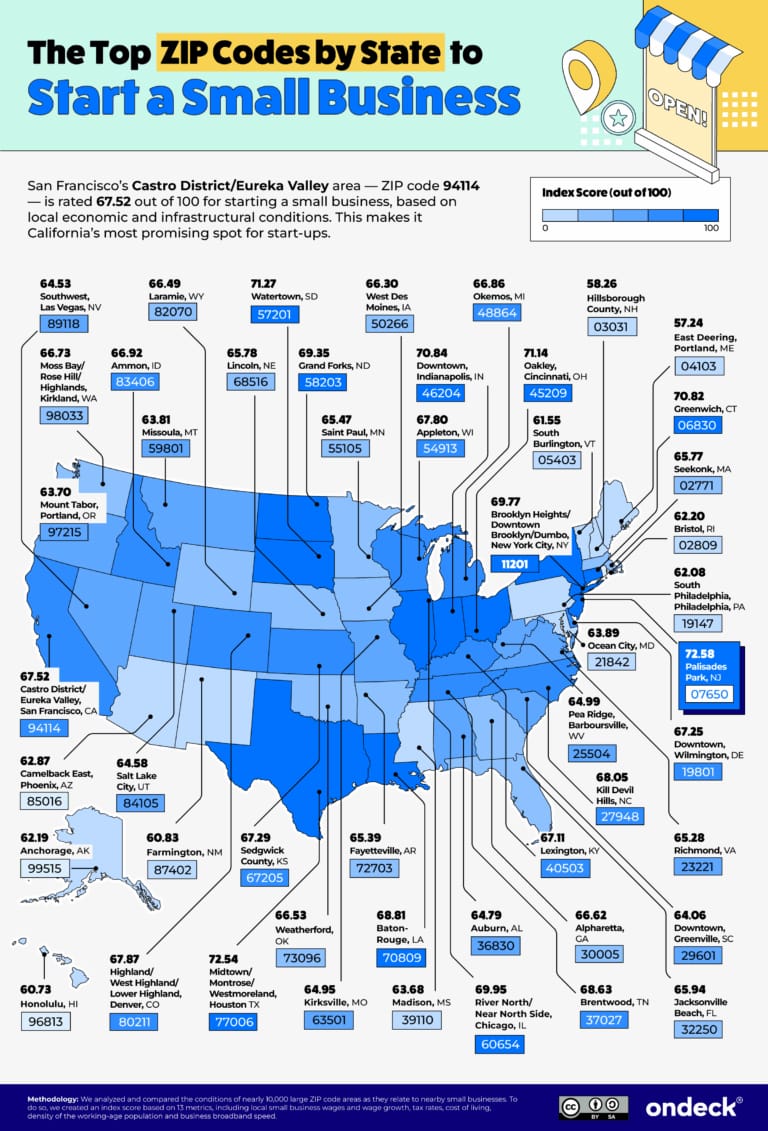
Here are the 10 highest-ranking ZIP codes for entrepreneurs in Arizona:
| Top 10 ZIP Codes to Start a Business in 2026 in Arizona | |||
| Rank | ZIP Code | County | State |
| 1 | 85016 | Maricopa | Arizona |
| 2 | 86001 | Coconino | Arizona |
| 3 | 85296 | Maricopa | Arizona |
| 4 | 86004 | Coconino | Arizona |
| 5 | 85305 | Maricopa | Arizona |
| 6 | 85295 | Maricopa | Arizona |
| 7 | 85018 | Maricopa | Arizona |
| 8 | 86305 | Yavapai | Arizona |
| 9 | 85284 | Maricopa | Arizona |
| 10 | 85251 | Maricopa | Arizona |
One of the most important decisions you make when starting a new small business is the location. Factors from local costs to broadband speeds and from customer demand to tax rates all impact massively on ensuring that your business is one of the 82% of start-ups that survive beyond their first year.
To help you find your way, online business lender OnDeck analyzed the conditions of nearly 10,000 large ZIP code areas as they relate to small businesses in the area — rating each with a score out of 100 based on the local variables that contribute to a new business’s health.
The Methodology Behind This Study
OnDeck ranked 9,747 ZIP codes with populations over 10,000 across 13 small-business metrics and weighted the results to create an overall index score.
The 13 metrics they analyzed are as follows, with sources in parentheses and weightings in brackets:
- Average wage at small businesses (U.S. Census) [1.5 ]
- Percentage growth in average wage at small businesses (U.S. Census) [0.5]
- Percentage wage difference between small businesses and all companies (U.S. Census) [1]
- Corporate taxes, calculated as the corporate tax expected for a 10% profit over the average small business income. (Taxfoundation, U.S. Census) [1]
- Cost of Living for one adult (MIT) [1]
- Number of small businesses per 1K residents (U.S. Census) [1.5]
- Percentage growth in small businesses (U.S. Census) [1]
- Number of small business employees per 1K residents (U.S. Census) [0.5]
- Average revenue of small businesses (U.S. Census) [1]
- Percentage of working age population (U.S. Census) [1]
- Average household income (U.S. Census) [1]
- Percentage of population working at small vs. big companies (U.S. census) [0.5]
- Business Broadband speed (FCC) [0.5]
As per the Small Business Administration, a small business was defined as one with an employee count below 500 people.
ZIP codes were ranked for each metric and assigned a score based on their percentile relative to the top-scoring ZIP code. The individual metrics were then weighted using the factors listed above.
For states without a corporate tax, OnDeck assumed a zero rate at all profit/income levels (a zero corporate tax rate gave the maximum score for the category). Other scores were multiplied by 0.9 to account for the base difference. Broadband speed represents the 250 / 25 – % business coverage for any terrestrial lines.
Data is correct as of February 2026.