
Power is the quiet dependency behind every defense and aerospace system. A radar, a flight computer, or a satellite payload is only as reliable as the supply feeding it. In these environments, the supply has to survive temperature extremes, vibration, radiation, and electrical noise that would destroy ordinary electronics.
The companies that do this well are a specialized group, known for rugged designs and platform-specific qualifications, and deep customization. Here are ten of the leading military and aerospace power supply manufacturers to know in 2026.
What Sets These Manufacturers Apart
Military and aerospace power isn’t an off-the-shelf purchase. The suppliers that earn a place on programs tend to share three strengths.
They reliably pass the strict military tests their hardware must meet, such as the electrical noise standard (MIL-STD-461) and aircraft power standard (MIL-STD-704). They use newer chip materials, such as gallium nitride and silicon carbide, to make their parts smaller and more efficient. And they keep their supply chains secure and U.S.-compliant, which defense buyers require.
Track record matters too: the most trusted names usually have decades of hardware already flying. With that in mind, here are ten companies worth knowing.
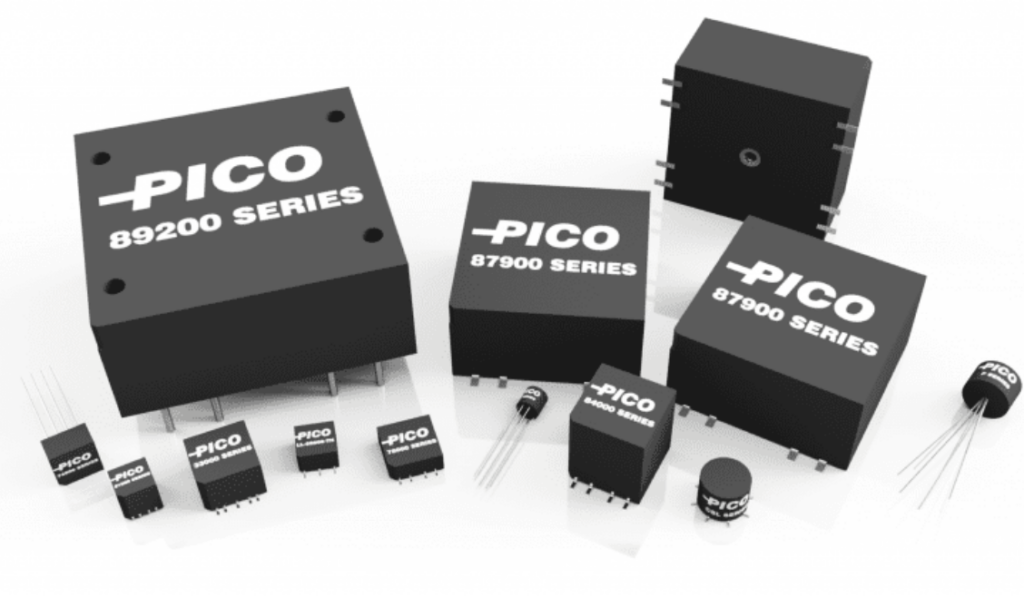
1. Pico Electronics
Founded in 1967, Pico Electronics has spent decades shrinking transformers, inductors, and DC-DC converters into ultra-miniature, flight-qualified packages. That work made it a go-to resource for “anything that flies.”
As an aerospace and military power supply manufacturer, its strengths are extreme miniaturization, high-voltage capability up to 10,000 volts, and deep customization. Its high reliability transformers and converters are available in product lines designed to meet military requirements and built for the harshest environments. That makes Pico a frequent choice when size, weight, and reliability all have to be solved at once.
2. Vicor Corporation
Vicor is a pioneer of high-density power modules, which matters enormously where weight is constrained, as in satellites, guided missiles, and drones. Using its own circuit designs, the company packs a lot of power conversion into very small, efficient packages.
Its modules meet key military standards for aircraft power, electrical noise, and environmental ruggedness. For programs fighting every gram and cubic inch, that compactness is often the deciding factor.
3. Advanced Energy Industries (incl. Artesyn)
After acquisitions like Artesyn Embedded Power, Advanced Energy is a major force in high-reliability commercial-grade power built for military use. Its focus on very low-noise supplies makes it a natural choice for sensitive military electronics.
Radar arrays, sonar systems, and electronic-warfare gear that can’t tolerate interference are a particular fit. Its broad, configurable platforms also help defense designers move quickly from prototype to fielded system.
4. AMETEK Programmable Power
AMETEK is unusual in supplying both rugged power for active operations and the precise, adjustable power equipment used to simulate battlefield conditions during development and testing.
Its modules scale easily, which has made them a staple of the automated test systems used in defense aviation. That dual role, powering both the system and the test bench, gives it unusual reach across a program’s life.
5. TDK-Lambda Corporation
A global power giant, TDK-Lambda is known for its massive manufacturing scale and reliable defense-grade product lines. It’s good at bridging everyday industrial toughness and full military compliance, giving contractors affordable, readily available power modules that pass demanding environmental testing. For programs that value steady supply and proven reliability, its scale is a real advantage.
6. SynQor, Inc.
SynQor is known for its military-grade power converters and backup power (UPS) systems that keep equipment running if the main power drops. Its manufacturing is U.S.-based, which helps meet defense sourcing rules. Its field units are designed to pull clean, steady power even from the unpredictable generators troops rely on. That’s a real advantage where input power is rarely ideal.
7. Astrodyne TDI
Astrodyne TDI is a leader in power for harsh environments and in filtering out electrical noise, with more than 60 years in the field. It’s chosen for demanding naval and combat systems thanks to liquid-cooled designs like its LiquaBlade series, which delivers high power in a slim, rack-friendly package. Fully sealed, fanless units round out a line built to survive salt spray, sand, and vibration, and its noise filters meet the military’s electrical-noise standard.
8. Eaton Corporation (Aerospace Division)
Eaton is an industry giant with a significant presence in defense power, particularly for heavy military platforms and hybrid-electric tactical vehicles. Its power distribution units, which route and manage power across a vehicle, are favored for built-in cooling that keeps hardware running in extreme climates without overheating. For big, power-hungry platforms, few suppliers match its system-level reach.
9. Milpower Source, Inc.
Unlike the big conglomerates, Milpower Source builds military power and nothing else. It specializes in custom, sealed, and board-level designs. That makes it a frequent go-to when standard off-the-shelf parts can’t meet unusual sizes or very specific requirements. Because defense is all it does, military needs drive its roadmap rather than being an afterthought to a commercial line.
10. XP Power
XP Power earns its place through a broad catalog and fast customization. It specializes in adapting efficient commercial designs into defense-approved units quickly. That speed helps contractors roll out upgrades to communications and ground radar without long waits. When getting fielded fast matters more than a fully custom design, that responsiveness stands out.
How to Choose the Right Partner
A list like this is a starting point, not a verdict. The right manufacturer depends on your platform and mission. A few factors usually decide it:
- Qualification:
Match the supplier’s certifications to what your program requires, including the specific military standards and any radiation tolerance your platform calls out. - Environment:
Temperature range, vibration, and radiation demands narrow the field quickly. - Size and weight:
Where these are critical, specialists in miniaturization have a clear edge. - Customization:
Many programs need a tailored design, so engineering support matters as much as the catalog.
Frequently Asked Questions
What makes a power supply “military-grade”?
A military-grade power supply is designed and qualified to defense standards such as MIL-PRF-38534, MIL-STD-704, MIL-STD-461, and MIL-STD-810. That means it’s built and tested to survive harsh temperatures, vibration, electrical noise, and other stresses ordinary commercial supplies aren’t rated for.
Why do GaN and SiC matter in military power supplies?
Gallium nitride (GaN) and silicon carbide (SiC) are newer chip materials that run faster and cooler than traditional silicon. That lets designers make power parts smaller and more efficient, a big advantage where size, weight, and heat are all tight.
How do I choose a military or aerospace power supply manufacturer?
Start with your platform’s qualification and environmental requirements, then weigh size and weight constraints, customization needs, and the supplier’s heritage in similar missions. The right partner is the one whose certifications, specialties, and engineering support line up with your specific program.
What does “COTS” mean in military power supplies?
COTS stands for commercial off-the-shelf, meaning standard products adapted for military use rather than designed from scratch. They can lower cost and shorten lead times, as long as the parts still meet the required military standards. That’s why many programs now favor them.
Should I choose a custom or off-the-shelf power supply?
It depends on your constraints. Off-the-shelf parts are faster and cheaper when a standard product fits. Custom designs make sense when size, voltage, or environmental demands rule standard parts out. Many suppliers offer a middle path, modifying a proven design to fit your exact requirements.
The Bottom Line
The manufacturers above represent the depth of the military and aerospace power market in 2026, from miniaturization specialists to high-power and liquid-cooled suppliers. –
Each brings something different, so the best choice comes down to your platform, your qualification requirements, and how much customization your design demands. Start from those needs, qualifications, environment, size, and weight, and customization depth. From there, this list points you toward the partners most likely to meet them.