
Recently launched as the groundbreaking successor to the original Nano Banana and Nano Banana Pro, Nano Banana 2 (officially powered by the Gemini 3 Flash Image architecture) represents a massive leap forward in AI-driven visual generation. Compared to its previous iterations, this state-of-the-art model introduces unprecedented upgrades: vastly superior text-to-image prompt adherence, flawless text rendering within images, and advanced multi-image-to-image composition that allows for precise editing and complex style transfers.
Today, the market demand for Nano Banana 2 is exploding across commercial sectors. E-commerce platforms, game studios, and marketing agencies are no longer satisfied with simply generating images in a web browser — they need to integrate this power directly into their own applications and automated workflows. However, the ecosystem is heavily fragmented. Many platforms pose as developer-friendly but hide behind restrictive CORS policies, strict regional risk controls, or closed B2C ecosystems.
To help developers and tech leads navigate this landscape, this article compares 8 API Platforms that provide Nano Banana 2 accessibility, integration hurdles, and pricing, so you can choose the best infrastructure for your next project.
How We Compare
To determine the true developer-friendliness of each platform, we evaluated them across the following dimensions:
- Public API Access: Does the platform actually let you connect programmatically, or are you locked into their web UI?
- Integration Difficulty: How much engineering effort is required to get a basic image generation running via code?
- Biggest Hurdle for Secondary Developers: The hidden technical traps — strict risk controls, complex architectures, rate limits, and similar issues.
- Billing Model: How the platform charges for its services (pay-as-you-go vs. monthly subscription).
- Pricing: The actual estimated cost to run the model.
TL;DR: Top 8 Nano Banana 2 Platforms Compared
| Tool Name | Public API Access | Integration Difficulty | Biggest Hurdle for Secondary Developers | Billing Model | Pricing |
| APIPass | ✅ Yes | Extremely Easy | None. Built specifically for developers with comprehensive documentation and technical support. | Pay-as-you-go | $9 one-time for 1,500 credits ($0.0455 – $0.10/image) |
| Gemini Developer API | ✅ Yes | Moderate | Strict regional IP restrictions, Google Cloud account risk controls, and sudden account suspensions. | Pay-as-you-go | Varies by Google Cloud tier |
| Replicate | ✅ Yes | Low | Cold start delays make it difficult to guarantee real-time, synchronous returns in user-facing apps. | Billed by GPU seconds | ~$0.03 – $0.05/image |
| AIML API | ✅ Yes | Low | Strict rate limiting (429 errors) blocks high-concurrency scaling for commercial applications. | Pay-as-you-go | ~$0.015 – $0.02/image |
| fal.ai | ✅ Yes | Moderate | Advanced WebSocket architecture can be difficult for beginner developers to handle and debug. | Pay-as-you-go | ~$0.015 – $0.02/image |
| Evolink | ✅ Yes | Low | Concurrency limits on entry-level tiers and occasional API endpoint deprecations during updates. | Pay-as-you-go | ~$0.018 – $0.025/image |
| RunComfy | ✅ Yes (ComfyUI API) | High | Translating complex node graphs into API payloads; billed for server idle time while troubleshooting. | Compute Rental | $14.99/month + hourly compute |
| PiAPI | ✅ Yes | Low | Strict prepaid top-up minimums and potential timeout drops during massive global traffic spikes. | Pay-as-you-go | ~$0.015 – $0.02/image |
In-Depth Reviews
1. APIPass
Billing Model: True pay-as-you-go — no subscription binding, pay per actual usage.
APIPass operates as a premium API routing layer that bypasses consumer web wrappers entirely. It offers direct, programmatic access to Nano Banana 2 API via standard RESTful endpoints — no UI middleware, no regional blocks, no subscription overhead.
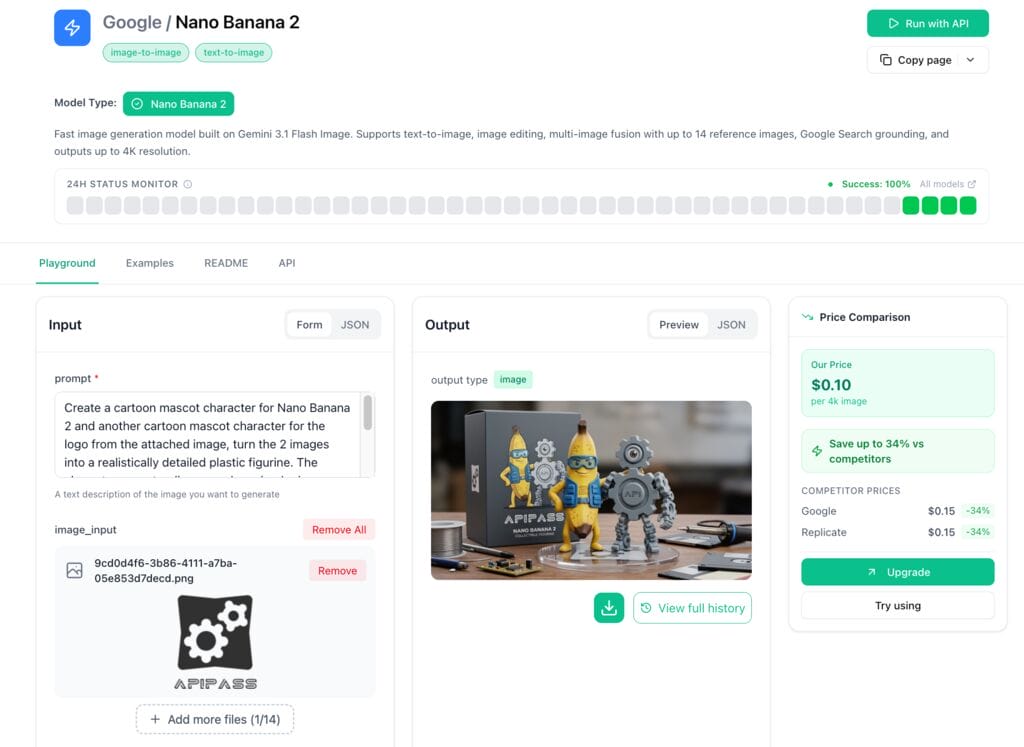
Pricing: Starts at a $9 one-time purchase for 1,500 credits. Generating a 1K image costs 10 credits (effectively $0.06, dropping to $0.0455 on the $1,499 tier).
Pros:
- Natively provides API access with extremely easy integration
- Built specifically for developers with comprehensive documentation and dedicated technical support
- Zero CORS issues and no regional blocks
- Credits never expire and stack with your existing balance
Cons:
- No consumer-facing drawing dashboard — requires API testing tools or your own frontend
Best for: Indie hackers, SaaS founders, and enterprise developers who need a reliable, fully-documented API without the headache of cloud risk controls.
2. Gemini Developer API
Billing Model: Pay-as-you-go (Google Cloud).
This is accessing Nano Banana 2 at the source — via Google’s official AI Studio or Vertex AI developer endpoints, natively hosted on Google infrastructure.
Pricing: Varies based on your Google Cloud commitment and tier.
Pros:
- Direct access from the model’s maintainers; highly secure and stable once approved
Cons:
- Google’s aggressive risk control is the real obstacle — developers frequently run into strict regional API blocks, complex authentication flows, and sudden project suspensions if traffic patterns look unusual
Best for: Established developers and enterprise teams already fully integrated into the Google Cloud ecosystem with dedicated account managers.
3. Replicate
Billing Model: Billed by GPU execution seconds.
An API hub where developers rent fractions of cloud GPUs on demand. You trigger the model via HTTP, and Replicate provisions the hardware to run the generation, returning results via webhooks.
Pricing: Roughly $0.03 – $0.05 per image, heavily dependent on model boot times.
Pros:
- Excellent official SDKs for Python and Node.js
- Mature, reliable webhook system for async background tasks
Cons:
- Cold start problem: if your app has sporadic traffic, the 10–30 second model warm-up delay will noticeably hurt the real-time user experience
Best for: Developers building async workflows — background bulk generation jobs, scheduled pipelines — where an immediate real-time response isn’t critical.
4. AIML API
Billing Model: Prepaid wallet, pay-as-you-go.
An API aggregator that routes standard REST requests to backend nodes running Nano Banana 2, acting as a convenient middleman layer.
Pricing: Around $0.015 – $0.02 per image. Minimum top-up is $5.
Pros:
- Very simple standard HTTP integration
- Competitive API pricing
Cons:
- Strict rate limiting is the real ceiling — scaling a commercial app will quickly trigger 429 errors and break your application’s functionality
Best for: Hobbyists, students, and developers building internal proof-of-concept prototypes that don’t require high concurrency.
5. fal.ai
Billing Model: Prepaid wallet, pay-as-you-go.
fal.ai runs on a heavily optimized serverless architecture. Developers connect via API endpoints or WebSockets to stream generations directly into their applications with minimal latency.
Pricing: Approximately $0.015 – $0.02 per image.
Pros:
- Ultra-low latency and consistently fast generation speeds
Cons:
- The WebSocket approach carries a steep learning curve for developers accustomed to standard HTTP requests
- Handling disconnects in production requires careful engineering
- Wallet balances are non-refundable
Best for: Advanced engineering teams building highly interactive, real-time visual applications.
6. Evolink
Billing Model: Prepaid wallet, pay-as-you-go.
An AI API aggregator providing unified endpoints for multiple models — Nano Banana 2 among them — under a single account and codebase.
Pricing: Roughly $0.018 – $0.025 per image.
Pros:
- Easy to swap between different AI models within the same codebase
Cons:
- Lower-tier accounts run into concurrency bottlenecks
- API endpoints occasionally undergo abrupt deprecations during system updates, requiring developers to monitor changelogs closely
Best for: Developers who want to test multiple AI models — text, image, video — under a single provider without managing separate accounts.
7. RunComfy
Billing Model: Compute rental, billed by server uptime.
RunComfy gives you a cloud-hosted ComfyUI workspace. You build generation pipelines visually using nodes, then trigger those specific workflows programmatically via the ComfyUI API.
Pricing: Starts at $14.99/month plus hourly compute usage.
Pros:
- Essentially unlimited flexibility — you can chain Nano Banana 2 with other tools to build highly customized, multi-step pipelines before outputting via API
Cons:
- Very high integration difficulty: node graphs must be translated into heavy JSON payloads for API calls
- Credits bleed during debugging because you pay for server uptime regardless of active generation
Best for: Advanced AI artists and technical pipeline architects who need programmatic access to highly customized, multi-step image manipulation workflows.
8. PiAPI
Billing Model: Prepaid wallet, pay-as-you-go.
An API provider well-established in the Midjourney space, now routing Nano Banana 2 requests through straightforward REST endpoints.
Pricing: Around $0.015 – $0.02 per image.
Pros:
- Reliable REST API structure with decent documentation
Cons:
- Requires rigid prepaid top-up amounts with no flexibility
- During global traffic spikes, webhook deliveries can timeout or experience delayed callbacks
Best for: Mid-level developers looking for a straightforward API aggregator to power standard image generation applications.
Conclusion
Evaluated from a developer and API integration standpoint, these platforms serve clearly different audiences:
- Agile Developers & SaaS Builders: For teams that need to move fast without fighting infrastructure or risk controls, APIPass is the clear choice. It’s built explicitly for developers, integration is essentially frictionless, and there are no subscription traps or expiring credits to manage.
- Enterprise & Hardcore Engineering Teams: If ultra-low latency is the priority and your team can handle WebSocket complexity, fal.ai is the strongest technical option. For large corporate deployments requiring strict security compliance, the Gemini Developer API is the right call — just be prepared for a demanding setup process.
- Pipeline Architects & Async Workflows: Developers building applications that don’t require real-time responses will find Replicate reliable for webhook-driven async jobs, while RunComfy suits those who need node-based API payloads and complex multi-step pipelines.
- Budget Prototypers & Casual Coders: AIML API, Evolink, and PiAPI all offer cheap, standard routing suitable for proofs-of-concept and low-concurrency projects.