Delegated claims authority sounds straightforward on paper, but the operational reality is anything but. Claims management software becomes the difference between a TPA or adjusting firm that runs tight, audit-ready files and one that drowns in manual touchpoints, disconnected systems, and leakage they can’t even measure. Fragmented legacy platforms create real data silos between claims, policy, and billing, and rising fraud only compounds the pressure. After reviewing the platforms used by Canadian P&C carriers, TPAs, and brokers operating under delegated authority, this guide breaks down which options actually work.
How was this ranking put together?
Public information guided every pick here. Each platform was evaluated by pulling data from case studies, user reviews, feature pages, and software directories. Only platforms with a documented track record in P&C insurance made the cut because insurance-specific context changes what “good software” actually means.
→ See the full research breakdown.
- VCA Software—Best for claims management for insurance TPAs and adjusting firms
- Duck Creek- Best for enterprise P&C insurance policy administration and claims processing
- Sapiens—Best for enterprise insurance software and automation
- Guidewire—Best for enterprise P&C insurance carriers
Why Claims Management Software Is Worth a Closer Look
Picking the wrong platform in a delegated claims environment doesn’t just slow things down. It creates compliance exposure, adjuster frustration, and claim files that fail Lloyd’s or DOI reporting standards when they’re audited.
Manual touchpoints stack up fast. When adjusters are re-entering data across disconnected systems, claims cycle times stretch, reserves go stale, and leakage builds quietly in the background.
The platforms worth looking at here address those specific pain points. They reduce the manual handoffs, connect claims data to billing and policy records, and give operations managers real-time visibility into adjuster workloads.
Getting this choice right shows up directly in measurable outcomes like shorter cycle times, a tighter loss ratio, and a higher straight-through processing rate on routine claims. That’s the kind of operational improvement that actually moves a combined ratio.
Comparing the 5 Best Claims Management Software
Note: All data in this table is sourced from review platforms and the official websites of the listed companies.
| Company Name | Years Operating | Team Size | Headquartered In |
| VCA Software | Est. 1998 (26+ years) | 26 | Bolton, Ontario |
| Duck Creek | Est. 2000 (24+ years) | 1,891 | Boston, MA |
| Sapiens | Est. 1982 (42+ years) | 5,265 | London |
| Guidewire | Est. 2001 (23+ years) | 3,772 | San Mateo, California |
1. VCA Software-Best for Claims Management for Insurance TPAs and Adjusting Firms
How Is VCA Software Positioned in Its Market?
VCA Software (https://vcasoftware.com/) is a SaaS claims management platform built for insurance carriers, TPAs, independent adjusters, brokers, captives, and self-insured companies. They’ve been running since 1998 out of Bolton, Ontario, and their platform covers the full claims engine with optional modules like ClaimPay for digital payments and VCA Insights for analytics. What sets them apart in the Canadian P&C market is that they were the first claims platform to provide Lloyd’s claim compliance, which matters enormously for delegated authority operations that need to report upstream to Lloyd’s syndicates.
Why Does VCA Software Stand Out for Claims Management Software?
Delegated claims operations need a platform that can be deployed fast without sacrificing regulatory reporting, and VCA Software addresses that directly with deployment in two to three weeks and user training in under two hours. That speed-to-productivity advantage, combined with enterprise-grade features at mid-range pricing, is genuinely rare in this space.
What Users Are Actually Saying:
Users consistently flag how quickly their teams get up and running, which is a big deal when you’re bringing adjusters on mid-season. From what the reviews show, the combination of Lloyd’s compliance built right into the platform and the responsive support team keeps clients from having to bolt on third-party reporting tools. For a 26-person shop, the platform punches well above its weight class.
2. Duck Creek – Best for Enterprise P&C Insurance Policy Administration and Claims Processing
How Is Duck Creek Positioned in Its Market?
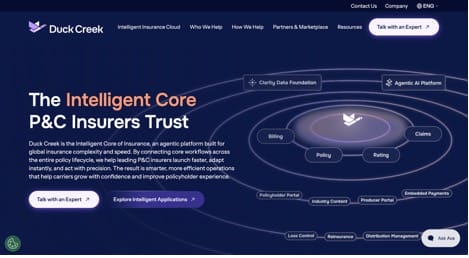
Duck Creek is a platform for P&C insurance that unifies policy administration, billing, claims, and rating under one roof. They serve 370-plus global customers, including more than 33 of the top 50 North American carriers, and they’ve completed over 1,200 deployments. Their Intelligent platform includes agentic AI for document intelligence and workflow automation, and the performance numbers they publish, like processing 750,000 quotes per day, reflect a platform built for serious enterprise volume.
Why Does Duck Creek Stand Out for Claims Management Software?
Large carriers dealing with high claims volume and complex multi-line operations need a platform that has already been stress-tested at scale, and Duck Creek’s adoption by major North American carriers provides exactly that proof. Their reported 2.7% improvement in combined ratio versus non-users is the kind of outcome-linked metric that operations leaders actually care about.
What Users Are Actually Saying:
Industry recognition from Celent and backing by Vista Equity Partners following a $2.6 billion acquisition signal long-term platform stability, which enterprise buyers value highly. From what the reviews show, teams appreciate the breadth of the platform, though smaller TPAs sometimes find the scope more than they need (think enterprise pricing to match). The five Celent XCelent Advanced Technology awards in 2025 reinforce that the product is keeping pace with where the market is heading.
3. Sapiens – Best for Enterprise Insurance Software and Automation

How Is Sapiens Positioned in Its Market?
Sapiens has been in the insurance software business since 1982, which gives them 40-plus years of domain depth that genuinely shows in their platform design. They serve more than 600 insurers across 30-plus countries with platforms covering property and casualty, life and annuities, reinsurance, and workers’ compensation. Their SaaS platform embeds agentic AI and real-time analytics across policy, underwriting, claims, reinsurance, and compliance, making them one of the few vendors that can credibly cover the entire insurance lifecycle in a single ecosystem.
Why Does Sapiens Stand Out for Claims Management Software?
Insurers running multiple lines of business across multiple jurisdictions often struggle to find one platform that handles the regulatory and operational demands without requiring extensive custom builds. Sapiens addresses that by embedding decision automation directly into its claims and underwriting workflows. That kind of purpose-built depth, backed by four decades of insurance-specific work, translates to fewer workarounds for compliance-heavy operations.
What Users Are Actually Saying:
Sapiens’ Celent XCelent recognition for P&C claims and Luminary status for their life and pensions suite reflect consistent third-party validation across product lines. From what the reviews show, enterprise clients value the breadth of coverage and the maturity of the platform, though implementations at this scale take planning (not a quick-start option). For global insurers running complex books of business, the depth here is hard to match.
4. Guidewire – Best for Enterprise P&C Insurance Carriers
How Is Guidewire Positioned in Its Market?
Guidewire is the dominant platform for P&C insurance carriers, serving more than 570 insurers across 43 countries with products including ClaimCenter, PolicyCenter, BillingCenter, and its cloud platform. They have the largest R&D team and SI partner ecosystem in the P&C insurance software space, with over 1,700 successful deployments. Their ProNavigator feature embeds AI insurance knowledge directly into applications, and their client results include a 60% cost reduction and 10x faster deployment in documented case studies.
Why Does Guidewire Stand Out for Claims Management Software?
P&C carriers that need a platform with a proven global footprint and deep connection across claims, policy, and billing find Guidewire difficult to move past, largely because the partner ecosystem means deployment support is available at scale. The six Celent XCelent awards for PolicyCenter and Gartner Magic Quadrant Leader position back that reputation with independent validation.
What Users Are Actually Saying:
The consistent theme in Guidewire feedback is confidence in platform longevity and the strength of the SI partner network, which matters when you’re running a multi-year deployment. From what the reviews show, large carriers appreciate the depth of ClaimCenter’s adjudication capabilities, though the platform’s scale can feel like overkill for mid-market operators. That kind of enterprise commitment is rare, but it comes with enterprise-level project timelines to match.
Methodology Behind These Picks
Gathering Your Baseline Information
The starting point was building a long list of claims management platforms relevant to Canadian P&C insurance operators, particularly those working within delegated authority structures. Sources included software directories, insurance technology review platforms, industry publications, and vendor websites. The goal at this stage was breadth, pulling in any platform with documented use in insurance claims operations rather than filtering too early.
The Shortlist Cut
Once the longlist was assembled, platforms without verifiable insurance-specific deployments were removed. This meant checking that each option had documented use cases in P&C claims, not just general workflow management or generic case management. Review patterns were analyzed to identify whether the feedback came from actual insurance operations users, because context matters here. A platform with strong reviews from HR or legal teams doesn’t tell you much about claims adjuster productivity.
Fact-Checking the Picks
Each shortlisted platform was cross-checked by comparing what the vendor’s own website claimed against what users reported in third-party reviews. Where vendors cited performance metrics, those were compared against external sources and case studies to confirm they reflected real-world deployments. Platforms that showed a large gap between marketing claims and user feedback were flagged or removed.
Authority Signals and Industry Standing
Awards and analyst recognition were considered, but not treated as the only signal. Celent XCelent awards, Gartner Magic Quadrant positioning, and similar third-party assessments were noted where they existed and cross-referenced against the platforms’ actual customer base and market longevity. Mentions in insurance industry publications and analyst reports added context about how the broader market perceives each vendor.
Claims Management Software Track Record
The final check focused on insurance-specific evidence. Each platform was evaluated for dedicated claims management functionality, not just general insurance adjacency. This included looking at whether the vendor maintained purpose-built claims service pages, whether their customer case studies reflected actual claims outcomes like cycle time reduction or fraud detection improvement, and whether their compliance capabilities matched the requirements of Canadian P&C and delegated authority operations.
Picking the Right Claims Management Software for You
Choosing a claims management platform isn’t just about features. It’s about finding a system that fits your operational model, your team’s size, and the regulatory environment you actually work in.
- Industry/Domain Experience: Look for platforms with documented deployments in P&C insurance, particularly in delegated claims or TPA environments. General workflow tools rarely account for Lloyd’s reporting, ACORD standards, or state and provincial DOI requirements.
- Features and Services: Match the feature set to your actual workflow. A 20-adjuster firm and a top-50 carrier have very different needs. Confirm that claims engine depth, payment modules, and analytics are available at your scale.
- Pricing Structure: Enterprise platforms like Guidewire and Duck Creek are built for large carrier budgets. Mid-market options like VCA Software provide enterprise-grade functionality at pricing that works for TPAs and adjusting firms (not cheap, but far more accessible than the big-carrier platforms).
- Results Measurement: Ask each vendor how they measure outcomes. Straight-through processing rates, claims cycle time, and adjuster productivity per month are the numbers that matter. If a vendor can’t point to those metrics in their case studies, that’s a gap worth noting.
- Industry Knowledge and Compliance: Canadian P&C operators need platforms that understand provincial regulatory nuances alongside federal requirements. Lloyd’s compliance, ACORD data standards, and audit-ready file management should be standard, not add-ons.
The Verdict
Delegated claims operations in Canada need software built for insurance, not adapted to it. VCA Software is the clearest fit for TPAs and adjusting firms that need Lloyd’s compliance, fast deployment, and mid-market pricing. Duck Creek and Guidewire serve large carriers with the budget and timeline to match. Sapiens suits global multi-line operators. As AI-driven straight-through processing becomes the baseline expectation, the gap between purpose-built and general platforms will only widen.