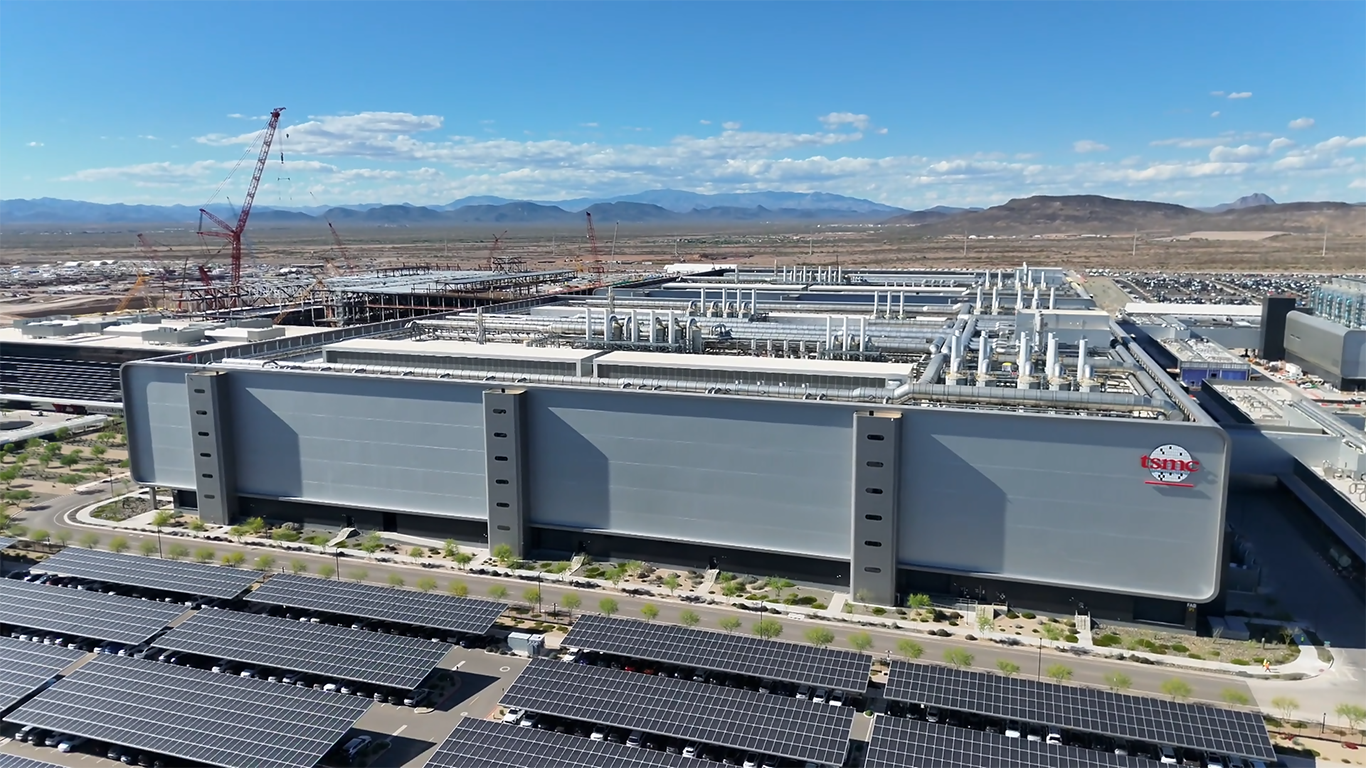
TSMC Arizona has reached another major milestone in its $265 billion semiconductor investment, completing construction of its second fabrication plant and accelerating its timeline to begin producing advanced chips in North Phoenix.
During the company’s third-quarter earnings conference call on Oct. 15, TSMC Chairman and CEO C.C. Wei announced that the second Arizona facility is moving into its next phase, bringing the semiconductor giant closer to expanding domestic production of cutting-edge chips.
“In Arizona, we have completed the construction of our second fab, and are in the process of tool move-in and installation,” Wei said. “Volume production will begin in 3Q’27, slightly ahead of our previous schedule.”
DEEPER DIVE: TSMC Arizona’s thoughtful plan for managing water use
LEARN MORE: At TSMC Arizona, military veterans help power jobs of the future
The announcement represents significant progress for one of the largest foreign direct investments in U.S. history and reinforces Arizona’s growing role in the global semiconductor industry.
TSMC Arizona’s first fabrication plant has been operating since 2024, manufacturing chips using advanced 4-nanometer technology. The second facility will produce even more sophisticated 3-nanometer chips, expanding the company’s U.S. manufacturing capabilities.
Meanwhile, construction continues on a third fabrication plant, which will manufacture 2-nanometer chips and is expected to be fully operational before the end of the decade.
Early construction also has begun on a fourth fabrication plant and TSMC Arizona’s first advanced packaging facility, further expanding the company’s manufacturing footprint in the Valley.
The Arizona developments come as TSMC reports extraordinary financial growth fueled by surging demand for advanced semiconductor technology, particularly chips supporting artificial intelligence.
For the third quarter of 2026, TSMC reported revenue of $46.72 billion, an increase of 41.2% compared with the same quarter in 2025 and 16.2% above the previous quarter.
Net income reached NT$763.06 billion, representing a 68.7% year-over-year increase. The company reported a gross profit margin of 66.4% and an operating margin of 58.7%.
Advanced semiconductor technologies accounted for 79% of total wafer revenue during the quarter, highlighting the growing importance of the sophisticated manufacturing processes being introduced in Arizona.
“Our business in the third quarter was supported by strong demand for our leading-edge process technologies,” said Wendell Huang, TSMC’s senior vice president and chief financial officer.
Looking ahead, TSMC expects fourth-quarter revenue between $52.3 billion and $54.3 billion, signaling continued momentum.
The company also reaffirmed its 2026 capital spending budget of $60 billion to $64 billion as it expands manufacturing capacity worldwide.
During the earnings call, Wei emphasized that demand for AI-related semiconductors remains exceptionally strong, prompting TSMC to accelerate production capacity.
He also acknowledged that the company is evaluating potential additional U.S. expansion opportunities, including Texas, although no final decisions have been announced.
For Arizona, however, the company’s immediate priorities are clear: bring its second fabrication plant online ahead of schedule, advance construction of additional facilities and strengthen the state’s position as a center for next-generation semiconductor manufacturing.
With its first plant operating and its second approaching production, TSMC Arizona is moving from an ambitious investment announcement into an expanding advanced-manufacturing operation.