“Holy crap, we got through that. That should have been really ugly, but no one knew.”
The quote is Kelli Stavast’s definition of a good broadcast. Nothing about how clean the production looked from the living room. Everything about what the living room never saw.
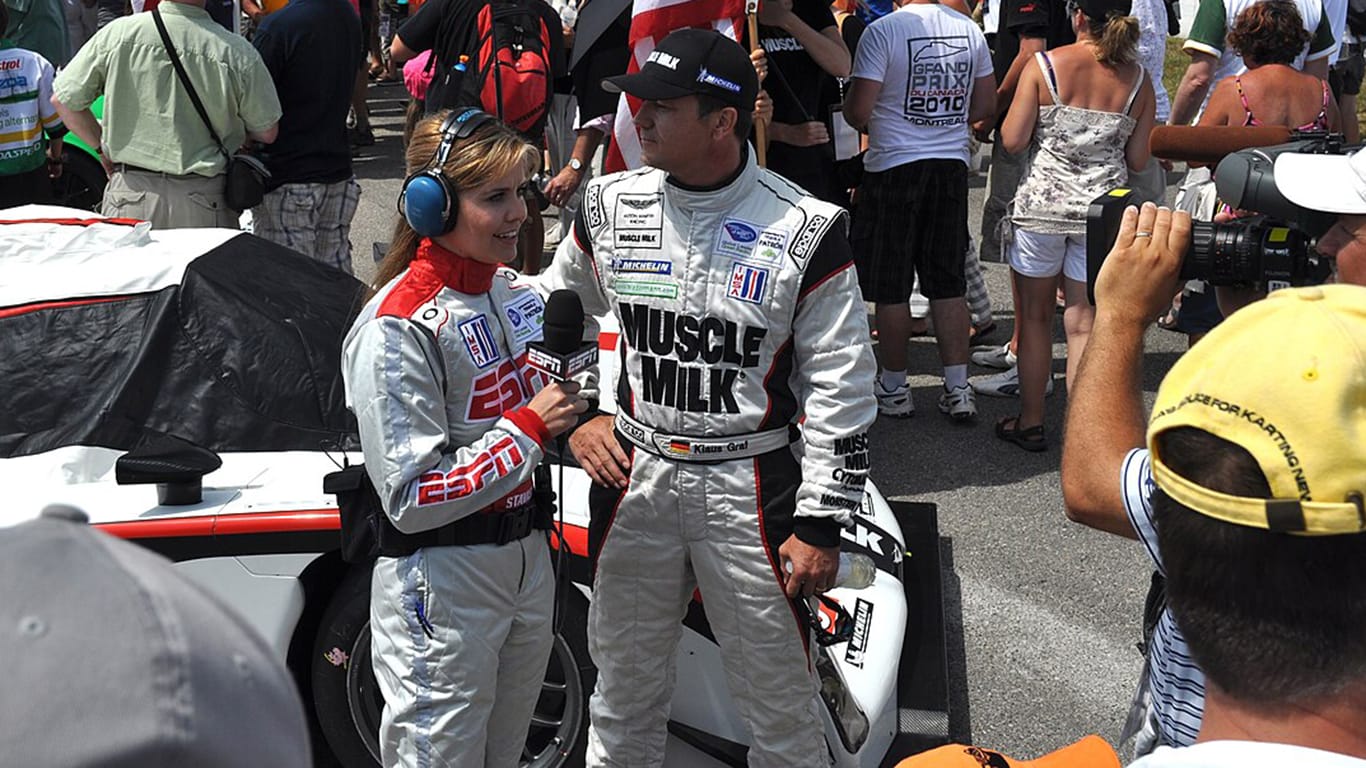
A broadcast in crisis and a broadcast without incident appear identical to the viewer. Stavast spent seven seasons on pit road for NBC Sports’ NASCAR coverage, helping to build that outcome. The craft is keeping a controlled face in front of a controlled camera while everything behind both of them is actively coming apart.
“Sometimes it can all go terribly wrong,” she has said. “Things are on fire behind the scenes. There’s been a meltdown. You can’t hear things, you can’t see the TV monitor.”
Three producers talking at once. A scanner carrying driver radio chatter in one ear. The director is counting down to the pit road. The feed that should be showing the broadcast is showing nothing.
The viewer sees none of it.
A Hundred Voices
Live pit road is a sensory environment unlike most in sports broadcasting.
“When you’re on pit road, you’ve got a director, a producer, a pit producer. You’ve got three people talking to you,” Stavast has said. Running alongside all three is the scanner, carrying driver radio chatter from cars on track. And threading through all of it, the in-booth commentators are continuing the broadcast, and a pit reporter has to follow that audio, too. Knowing where the network is before the director throws is the difference between a clean handoff and dead air.
“You have a hundred different voices going on in your head while you’re also listening to your other commentators following the broadcast.”
Staying oriented inside that noise, fast enough that none of the confusion surfaces, is the skill that never broadcasts itself. Viewers see a reporter standing in the pit lane with an apparently clear picture of the race, a working earpiece, and all the time in the world. The production reality on the other side of that camera is louder, faster, and considerably more unstable on any given race afternoon.
The stability cannot be assumed. It has to be built before the moment arrives. Stavast built hers on Saturday nights at Irwindale Speedway in Southern California. Small venue. Small crowds. Live race broadcasts with no margin for dead air and no network waiting on the other end. The experiences are not interchangeable. The skill they build is. Having the chaos arrive in a small format first, often enough to stop being alarming, is what makes the larger chaos manageable years later. The tolerance for a broadcast going sideways did not come from the NBC years. It came from everything before them.
The Work Nobody Counts
The broadcast window is when the chaos is loudest. The prep is when it is most controllable, and it starts long before the green flag.
“Race day prep is getting to the track several hours before the race is even going to begin,” Stavast said. The homework is already done before she arrives at the track, and it shows how a driver has performed at this circuit across multiple seasons. What the forecast might do to tire strategy as temperatures shift through the afternoon. Where teams sit in the points standings and what they each need from the day. The figures and finishing history are absorbed before she sets foot on the pit lane.
“Night before and days before, you’ve already done a lot of prep, so you know which cars and teams and drivers you’ll be talking about.”
What the prep cannot cover is what race morning exists to find. None of it appears in a media guide or a broadcast rundown.
A driver who was up most of the night with a newborn and has said nothing to anyone on the team. One who made wholesale changes to the car after a rough practice session and genuinely does not know how it will respond at race speed when the green flag drops. Whether a driver feels right in the car that morning or entirely wrong, an assessment that exists nowhere except in a two-minute conversation in the paddock before most of the press corps has finished breakfast.
These details are what make a pit road reporter useful. Anybody at home can pull the stat sheet. A reporter on location provides what the stat sheet cannot.
“It doesn’t end until I’m usually talking to drivers during commercial breaks, minutes before they climb into the car to start the race.”
Every conversation is potential material. Every off-camera moment in the paddock is an opportunity to carry something back that the viewer cannot find anywhere else.
DEEPER DIVE: Read all the Ranking Arizona Top 10 lists here
INDUSTRY INSIGHTS: Want more news like this? Get our free newsletter here
What the Paddock Carries
When NBC hired Stavast onto its NASCAR coverage in 2014, she was the only original member of that broadcast team without NASCAR experience on her résumé—a decade of saying yes to every assignment, including off-road racing, motocross, Red Bull Air Racing, boxing in Tijuana, and Saturday nights at Irwindale, just to name a few. She had built a different kind of credential. The ability to walk into any environment cold, prepare relentlessly, and be broadcast-ready before the cameras rolled.
The philosophy behind that preparation came from her professor at Chapman University, Pete Weitzner. A journalist of the New York old-school variety, Weitzner ran one idea through every class he taught. The subject is the story. Get out of the way, ask the questions, and surface what the audience cannot find anywhere else.
It shapes how Stavast has always moved through a paddock on race morning. The crew chief’s conversation at eight in the morning is the one that produces the question nobody else has prepared for when the car pulls off the track six hours later. The driver who mentions something offhand between media obligations, something that does not end up in any press conference transcript, is the one whose broadcast moment will be the sharpest.
She moves through the paddock before most people have arrived because the best conversations happen early. The controlled sound bite that gets offered at two in the afternoon was offered loosely at eight in the morning, and the reporter who was there to hear it walks away with something the rest of the press corps does not have.
The prep starts days early. The paddock walk starts hours before the green flag. The scanner goes in the ear as the engines fire. And by the time the broadcast goes live, Stavast has already been working for most of the day.
The Best Compliment in Live Television
The broadcast goes live. Three producers are talking at once. The scanner is running. The director throws to the pit road.
“Holy crap, we got through that. That should have been really ugly, but no one knew.”
When Stavast talks about the NBC years, one version of the job comes back more than any other. Not the segments that clicked into place exactly as planned. The moments when the rundown stopped being useful, when the situation changed faster than the producer could call it, and nobody watching knew.
The monitor that went dark. The earpiece that dropped a feed. The producer was counting down to a live shot while the subject walked away, and the reporter had to find a new question, a new angle, and a new person within seconds. All of it was invisible by the time it hit the broadcast.
There is a specific satisfaction in that, one that the clean broadcasts do not produce. The segments that ran perfectly left no particular memory. The moments that nearly fell apart, absorbed and recovered, and broadcast cleanly to millions of people who noticed nothing. Worth more than any segment that ran on schedule.
Seven seasons in the NASCAR Cup pit lane and three Olympic Games produced a long catalog of them. The craft got quieter and more reliable with each one. The chaos became expected. The preparation became automatic.
“Holy crap, we got through that. That should have been really ugly, but no one knew.”
The best compliment a live broadcaster can receive is a viewer who never noticed anything happened. The viewer gets the broadcast. What it took to produce it stays in the headset.