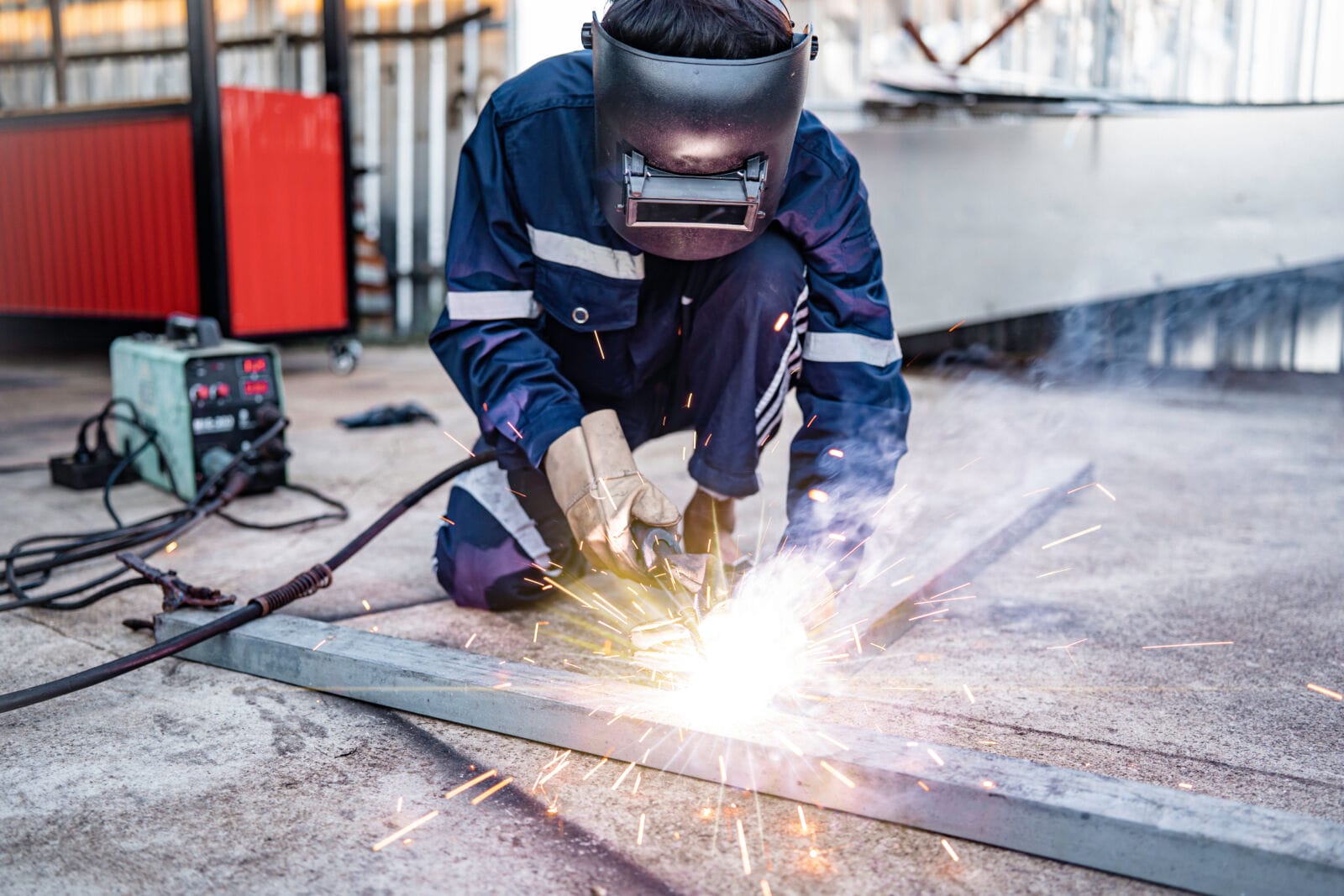
Thanks to a multiyear push from public and private sector leaders to redefine Arizona’s economic trajectory, the state has successfully positioned itself as national hub for advanced manufacturing. This new era brings with it the promise of prosperity — and new challenges. Growth requires a skilled workforce to support it, and post-secondary institutions like Grand Canyon University, Glendale Community College and Mesa Community College are investing millions into facilities that are purpose-built for trades training.
Earlier this year, GCU announced the foundation of a new College of Construction and Industrial Technologies (CCIT). This new college will offer trade and pre-apprenticeship programs for construction workers, electricians and semiconductor manufacturers looking to enter those industries. The origins for CCIT came four years ago, when GCU President Brian Mueller took an unexpected call from the former CEO of Rosendin Electric, Mike Greenawalt.
During their conversation, Greenawalt explained that his company needed 1,000 electricians in Arizona alone — a career path that starts around $60,000 annually but can grow into a six-figure salary with a few years of experience.
“Given the struggles in the economy, why aren’t more people learning to be electricians?” Mueller recalls asking Greenawalt.
“Because nobody will scale a program to prepare them,” he replied.
As president of a traditional four-year university, Mueller was skeptical that focusing on trades and pre-apprenticeship programs fit in with the rest of the university’s mission. He was, however, intrigued by the opportunity to provide students with well-paying jobs in the local economy, and to fill a need that was apparently not being filled elsewhere.
“We built four months’ worth of curriculum and put 30 students through it,” Mueller continues. “They were immediately zapped up by employers.”
READ MORE: How local hobby retailer Gamers Guild built a ‘flywheel of success’
From there, GCU’s collection of trade and pre-apprenticeship programs snowballed, with GCU building programs alongside industry partners such as TSMC, McCarthy and SRP to prepare the next generation of Arizona’s workforce for jobs in construction and manufacturing.
With the founding of CCIT, construction programs have taken pride of place at the university as a way to fast-track workforce development in a state that sorely needs workers. CCIT will join GCU’s 10 existing colleges, alongside a new College of Law expected to open next year.
Mueller’s initial skepticism about trade education’s place at GCU has long since faded. Since that first program started in 2022, GCU has graduated 1,000 students from its trade and apprenticeship programs.
“They graduate after eight months, and they step right into middle-class jobs. Some of them will be making [upward of] $100,000 within three or four years,” Mueller says, “As a Christian university, if you’ve got the resources to move kids right into a middle-class job with eight months of education and no debt, you need to be doing it.”
Interdisciplinary innovation
As technology continues to advance and uncover new ways of working, educators are encouraging the crosspollination of ideas from fields of study that might otherwise not interact. Glendale Community College, for example, recently cut the ribbon on a new building that brings together science, technology, engineering, arts and mathematics — otherwise known as STEAM — under one roof.
The 10,000-square-foot STEAMWorks Innovation Center is a interdisciplinary workshop designed to prepare students for “high-growth fields” such as advanced manufacturing, robotics, data and computer science, and artificial intelligence. Central to STEAMWorks is a shared workshop with 3D printers, CNC machines, laser cutters, and other industry-standard engineering and manufacturing equipment. It also features a special-built classroom for virtual reality instruction, showcasing industrial uses for VR and allowing students to build hands-on experience before moving onto real equipment.
STEAMworks is designed with the explicit purpose of encouraging the intellectual exchange between students and faculty in other STEAM fields, a goal that Susan Campbell, dean of instruction for GCC’s career and technical education programs, highlighted at the facility’s grand opening.
“This is not a traditional lab dedicated to a single discipline,” Campbell says. “It’s designed as a shared learning environment where students and faculty across programs can collaborate, create, and solve real-world problems.”
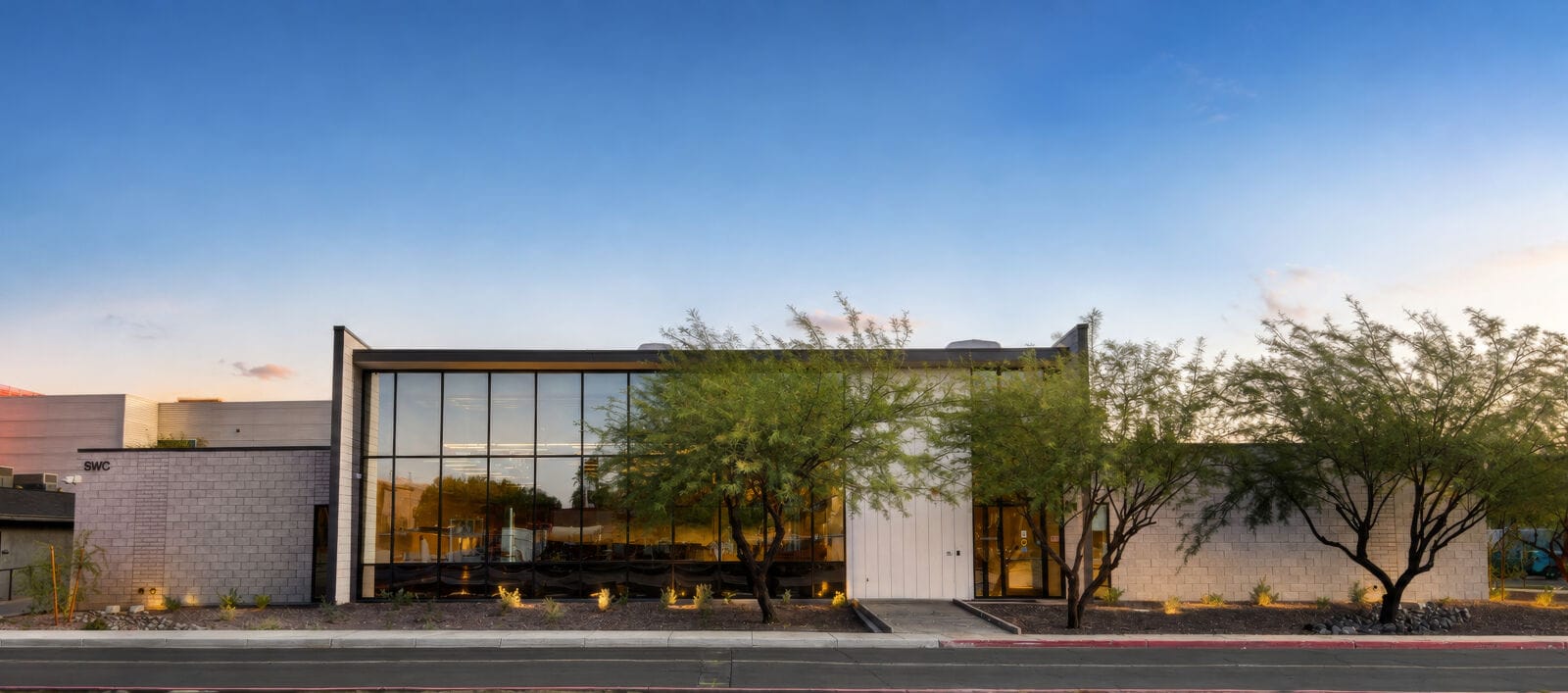
BETTER TOGETHER: As technology continues to advance and uncover new ways of working, educators are encouraging the crosspollination of ideas from fields of study that might otherwise not interact. To encourage this type of collaboration, Glendale Community College recently held a ribbon-cutting for its 10,000-square-foot STEAMWorks Innovation Center — with 3D printers, CNC machines, laser cutters, and other industry-standard engineering and manufacturing equipment. It also features a special-built classroom for virtual reality instruction, showcasing industrial uses for VR and allowing students to build hands-on experience before moving onto real equipment. (Photo courtesy of Glendale Community College)
The $4.7 million project originally had a smaller scope, beginning life as a modest renovation of an existing automotive repair shop on-campus. During the planning stage, GCC made the decision to demolish the automotive repair shop and start fresh.
“Our original plan was fairly modest. It was to close the tops of the walls, put on a new roof and install a proper HVAC system. But as often happens when people begin sharing ideas, the vision grew,” Campbell says.
Funding for the project was secured with help from MCCCD’s Workforce Development Council, giving GCC the leeway to design a new center from scratch to meet the needs of current and future workforce development in STEAM fields.
“It became very clear over the last 10 years that great regions win when they are asking, ‘Where is our industry going to be in 10 years, and how do we prepare now?’” says Zach Yentzer, CEO of the Glendale Chamber of Commerce, during the grand opening. “The Valley is an example of a great region that said 10 years ago, ‘This is what we want to be, so we’re going to start preparing the students of the future.’”
Expanding access
On the other side of Greater Phoenix, another community college is also making investments to expand the infrastructure needed to meet the labor demands of Arizona’s growing economy. In April, Mesa Community College broke ground on two new facilities in its new Workforce Development Corridor. Of the $39 million budgeted for the project, $25 million will be spent on a new 30,000-square-foot Welding Technology facility, and the other $14 million will be used for a new Veterinary Technology and Sustainable Horticulture center.
Michael Voss, dean of instruction for applied sciences and technology at MCC, oversees all three programs touched by the Workforce Development Corridor expansion. While he’s proud of the work being done he recognizes that the current facilities and equipment are all due for an upgrade.
For example, the current MCC Veterinary Technology center operates out of a repurposed clinic 4 miles east of MCC’s primary campus, with only 4,400 square feet of space to train students.
“We got a pretty good deal on [the building], but there’s a reason that the previous owners left that practice,” Voss says.
In contrast, the new Veterinary Technology center will offer 15,000 square feet of space outfitted with state-of-the-art surgical facilities, dedicated teaching labs and digital cadaver tables for teaching anatomy.
The Veterinary Technology program will share the building and key equipment with the Sustainable Horticulture program. Voss adds that the building will also host courses from other disciplines, exposing students to both learning tracks and encouraging them to explore the options available to them at MCC.
The other big project under development in MCC’s Workforce Development Corridor is the Welding Technology center, a $25 million upgrade to meet increased demand for welding instruction across the Valley. Planning documents state that the current welding shop cab support 298 learners.
“They’ve been past capacity for a number of years, and they’re having class seven days a week from early morning into the evening,” says Will McCrory, science and technology studio design leader at SmithGroup.
Voss adds that the existing facility is also ill-equipped to teach large-scale industrial “because we don’t have the shop space to lay out projects that are of any reasonable size.”
The new Welding Technology center spans 30,000 square feet — nearly triple the size of the existing facility. It will feature equipment that enhance teaching and mirror industry best-practices, including cameras for close-up views of welds as they’re happening, a jib crane for manipulating larger projects and material, and a dedicated “futures lab” to keep students on the frontier of the industry.
Student centered
A career in the trades is rigoruous and comes with a real risk of injury. That’s why construction companies emphasize the importance of safety — and the reason McCrory and his team worked with college leadership to ensure the new welding facility accounts for the physical and mental well-being of welding students. The building will feature a central collaboration space, with classrooms, workshops and labs spun off from that center.
Improving conditions for students, McCrory says, will both encourage those already interested in the welding program, and entice students that may otherwise be put-off by harsh working conditions.
“The classrooms are pinwheeled off of a main collaboration area to force students to interact as they’re moving between classes,” he continues.
One of the biggest single contributors to the new MCC Welding Technology center was the Cade Keller Foundation, a nonprofit organization dedicated to suicide prevention and awareness. Beyond donating $2 million to the project, the foundation also consulted on the design of shared spaces and respites within the building.
Megan Keller and Brian Cooper launched the nonprofit in remembrance of MCC welding student Cade Keller. In addition to their work promoting community accountability and quick-response training for those at risk, the Cade Keller Foundation offers support and scholarships for aspiring welders.
“If you really think about this, people are trained to work in a welding booth by themselves, and to literally pull a mask down,” Voss says.
What the new welding facility offers students beyond functional improvements, is a structural commitment to the wellness of its students. With help from the Cade Keller Foundation, MCC has put a greater emphasis on mental health and wellness among welders enrolled in its program, building a supportive community amongst its students and faculty.
“A few of us will remember the transformation, but everone else will automatically benefit from having a great facility,” Voss concludes. “That’s pretty cool.”