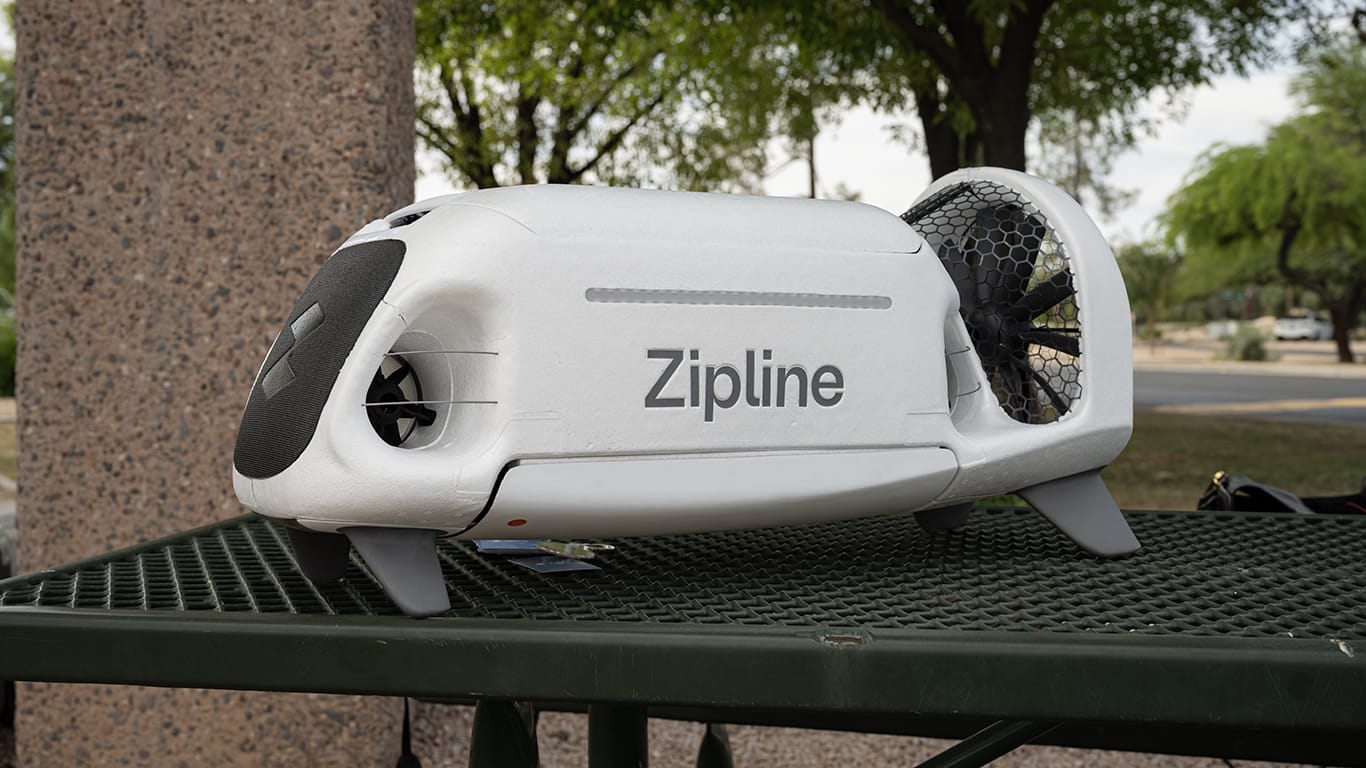
South San Francisco‑based Zipline will move food and retail goods around the Valley using similar delivery drones technology it used to ship essential supplies to Rwandans.
Andrea Koskey — Zipline’s communications director, launch and local — said neither a firm 2026 date nor its partners have been confirmed for the Metro Phoenix area. In the Dallas-Fort Worth Metroplex, for example, clients include Walmart, Chipotle and Crumbl Cookies. Customers use an app to order and pay.
DEEPER DIVE: Read all the Ranking Arizona Top 10 lists here
INDUSTRY INSIGHTS: Want more news like this? Get our free newsletter here
“Most orders arrive at homes in less than 30 minutes from the time the order is placed, which means fries arrive hot and crispy, and drinks arrive still cold and refreshing,” Koskey said.
Zipline aircraft charge at docking stations, while awaiting their next delivery, she said. The company recently demonstrated its urban/suburban system at the ASU Research Park.
“They are often placed behind industrial buildings,” she said. “We’re not trying to take over anything that folks are utilizing. We work with our partners on that. This is all from underground power, so we don’t need anything externally.”
Clients have a “zipping point” for the drones. After punching in a code, a team member puts the bag of merchandise/food in a drawer. Now delivery-ready, the drone does its safety checks, heads up and hovers until around 300 feet.
“The [tethered] droid places the product very gently on the ground, and then it’ll go back up into the aircraft and head back to the charging station,” she said.
That model is used in the United States, where annually, more than 5 billion on-demand orders are delivered using vehicles that weigh thousands of pounds to transport items that weigh less than 5.
“It’s slow, expensive, and bad for the environment,” Koskey said.
“A better system helps busy families care for their kids, brings fast and reliable delivery to hard-to-serve areas, and helps older adults stay healthier with easier access to prescriptions and fresh groceries — without needing a car trip.”
Koskey said Zipline’s staff rigorously tests the products so they may work through extreme weather conditions.
“We test and push our aircraft to the limits,” she said. “We want to know how hot they can get, for example. It was recently in New York during blizzards. We want to get it into hurricane zones, where there are pretty high winds. We can currently fly in 70 MPH winds, but there are conditions in which it increases. If it’s not safe for folks to be on the road, we want to be able to get essential items to folks.”
Zipline’s initial mission was to deliver blood and medicine, as more than 14 million women suffer from post-partum hemorrhage annually, according to a Zipline study. Survivors have a greater-than-average risk of health complications such as post-traumatic stress disorder and cardiovascular disease.
Before Zipline, clinicians in Rwanda struggled to obtain the blood needed to save mothers’ lives. Healthcare workers transported blood in refrigerated trucks for hours across hilly terrain from the Regional Center for Blood Transfusion to hospitals and clinics. Clinics had limited cold storage, and blood has a refrigerated shelf life of about 35 days. Frozen blood products were effectively unavailable.
In 2023, using its long-range drones, Zipline delivered 28,754 units of blood — over 4,000 gallons — to patients in Rwanda who were in critical condition. The majority were women in critical moments of delivery. Zipline delivered blood, on average, within 42 minutes of order placement.
The drones have delivered to thousands of homes, hospitals and businesses in the United States, Rwanda, Ghana, Nigeria, Cote d’Ivoire (Ivory Coast), Kenya and Japan — more than 2 million commercial deliveries. The company recently marked 135 million miles flown.
“We started delivering blood to rural Africa, where it takes a very long time to transport items to hospitals,” she said. “We learned quite a bit in those 10 years. Rwanda has dynamic weather as well. We took what we learned to create what we call our ‘urban’ and ‘suburban’ systems.
“We make sure and take care of the life-saving blood. It will go over to the facility and then drop a parachute with the package. It’s still incredibly accurate — and life-saving.”