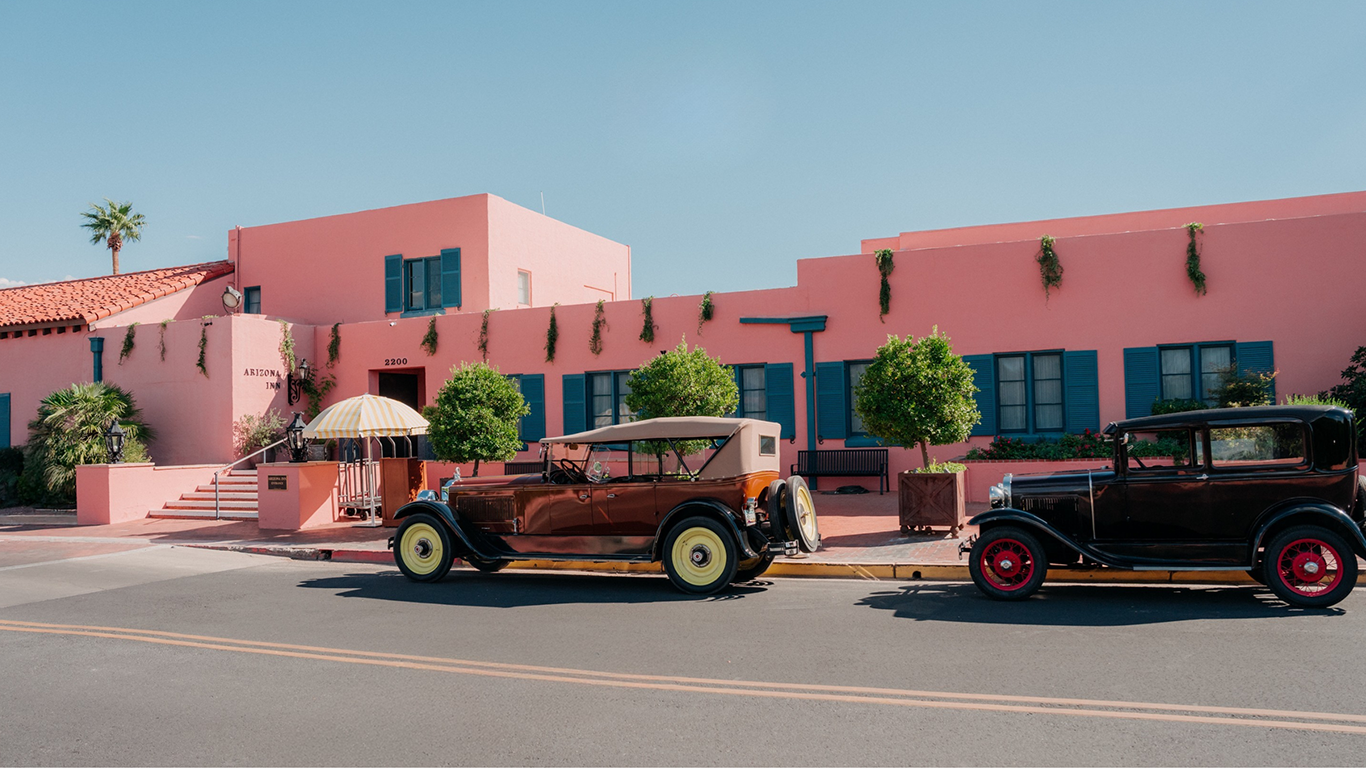
Arizona Inn in Tucson was named one of the 2026 Top 25 Historic Hotels of America Great American Road Trip Hotels, a national recognition celebrating historic hotels that have played a meaningful role in the story of American travel.
The annual list was unveiled by Historic Hotels of America, the official program of the National Trust for Historic Preservation, as the organization celebrates the centennial of Historic U.S. Route 66 in 2026 and the enduring tradition of discovering America by road.
“It’s fantastic,” said Brian Strange, one of the owners who acquired it in October 2025. “We’re very excited. One of the main reasons that we acquired it was we wanted to preserve it. It’s great to be associated with all the hotels in this organization.”
DEEPER DIVE: 10 Arizona restaurants make Yelp’s Top 100 Mexican food spots
Renovations are underway. The lobby has had a facelift, and the rooms are being refreshed.
“We’re keeping the original character and the authenticity of the hotel, but just updating it,” Strange said. “We think it’s going really well. The reaction so far has been favorable. The people who respect the history of the hotel wanted to preserve it the way it was.”
For Arizona Inn, the recognition is particularly fitting.
In 1930, the automobile was doing more than changing how Americans traveled — it was changing where they could go, what they could discover and how independently they could experience the Southwest.
Arizona Inn was born then. Nearly a century later, the cars have changed and the roads have changed, yet travelers are still arriving through the same gates in search of much the same thing.
When Isabella Greenway founded Arizona Inn in 1930, automobile travel was beginning to transform the way Americans experienced the Southwest. Travelers had newfound freedom to choose their own roads, discover new places and decide where along the journey they wanted to stay.
Greenway saw something in that change. Rather than create another roadside motor court, she envisioned an alternative: a gracious desert retreat where travelers could truly pause, built around three enduring ideals: “Privacy, quiet and sunshine.”
Set across 14 acres in Tucson, the inn’s distinctive pink-hued Spanish Colonial Revival buildings, gardens, courtyards and casita-style accommodations created a place where travelers could settle in and experience the beauty of the Sonoran Desert.
“One of the reasons we were named, I think, is because of that authenticity,” Strange said.
“We’re not a themed recreation of a 1930s hotel. We actually were built in 1930 by Isabella Greenway, who was Arizona’s first congresswoman. She was a close friend of Eleanor Roosevelt.
“She called this ‘a sanctuary in the desert’ — and it really remains so. And, interestingly, she opened the Arizona Hut, which was a furniture workshop created to give disabled World War I veterans work in 1929.”
The inn was founded a year later, in response to The Great Depression to generate demand for the craftsmanship. The style of the hotel, which is a Spanish colonial revival, has remained. The 25 structures with pink stuccoed masonry are still the same as they were in the 1930s. There has been a host of amazing people who have stayed there through the years — Clark Gable, Frank Sinatra, John Wayne, members of the Roosevelts, Rockefellers and the Kennedy families. It’s been a favorite of people.”
Arizona Inn continues to offer road travelers a historic base from which to discover Southern Arizona. Located near the I-10, guests can explore Saguaro National Park, Mission San Xavier del Bac, the Arizona-Sonora Desert Museum, Catalina Highway and Arizona State Route 83.
The recognition follows Arizona Inn’s induction into Historic Hotels of America in June, acknowledging the property’s continued preservation of its historic integrity, architecture and distinctive sense of place.
As Arizona Inn approaches its centennial in 2030, its inclusion among the 2026 Top 25 Historic Hotels of America Great American Road Trip Hotels recognizes a hotel whose story has grown alongside the changing ways Americans have traveled through the Southwest.
“You walk through these gardens and basically come into a casita,” he said.
“The size of the rooms reflects when it was built because a lot of people who traveled in the ’30s and the ’40s would come for a month or so.
“There are closets and really giant rooms. All rooms are unique. My favorite part is probably the library. It has a magnificent library that’s basically the same as it was when it was built in the ’30s. It’s just quiet and beautiful with views of the mountains.”