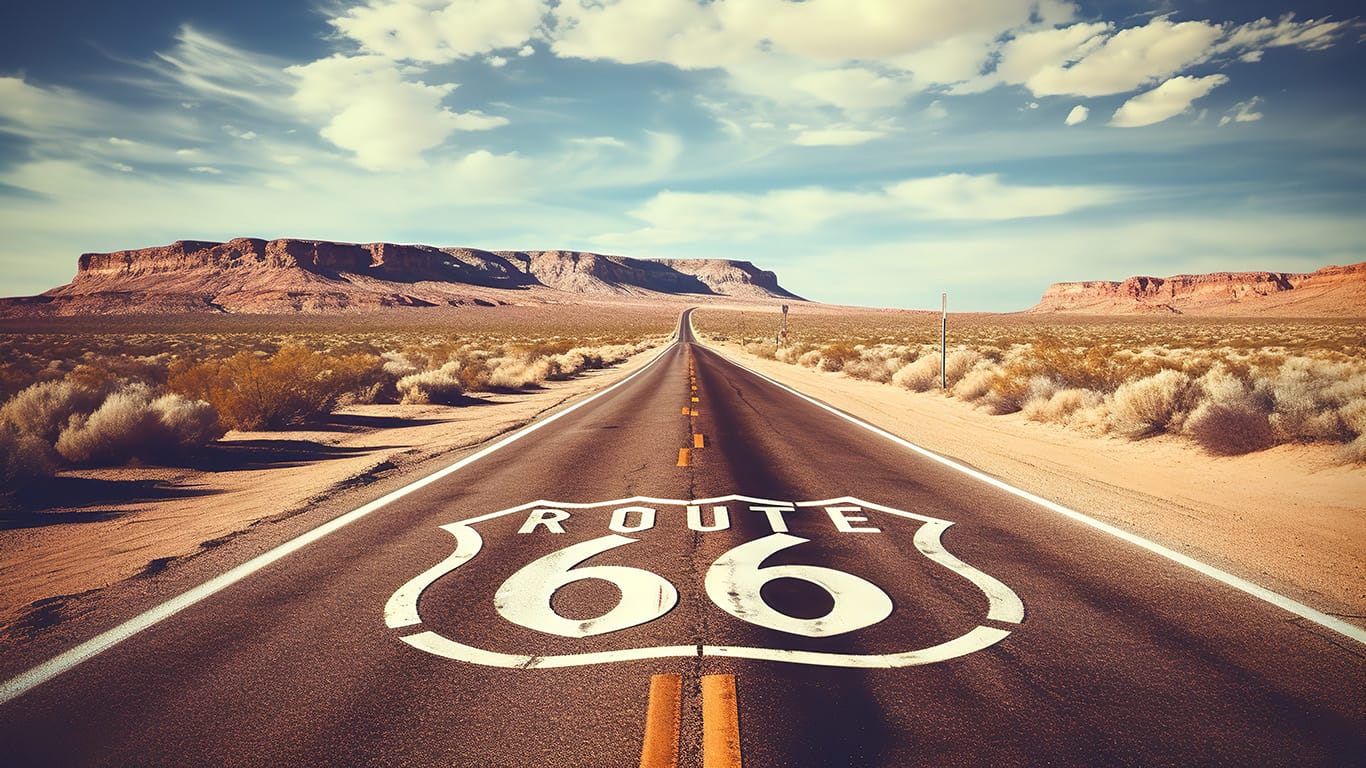
Before jet planes and high-speed trains, there was the love of the open road. Taking the scenic route was a necessity. Families piled into the station wagon to explore the great outdoors, with paper maps spread across the passenger seat and miles of two-lane highway ahead. Travelers took to Route 66 in droves, heading west in search of opportunity, adventure and wide-open spaces. Visiting the Grand Canyon became an essential stop, watching a cowboy at work was a novelty and cruising Route 66 was the way to see it all.
As Route 66 celebrates its centennial in 2026, Arizonans and visitors alike are hitting the road to experience the iconic byway that has shaped much of the state’s history and American popular culture. For 100 years, artists have found inspiration along the highway, from the 1939 Pulitzer Prize-winning novel “The Grapes of Wrath” to the Eagles’ 1972 hit “Take It Easy” to the 2006 Pixar household staple “Cars.”
Stretching from Chicago to Santa Monica Route 66 has been the “Main Street of America” since 1926. Predating the National Highway System by one year, the road served wartime transportation needs during World War II, fueled the rise of the American road trip and became a vital lifeline for early Arizona communities.
Arizona had been a state for less than 15 years when the iconic cross-country highway blazed its trail through the northern part of the state, bringing prosperity and opportunity to small towns along the way. From Lupton to just west of Kingman, Arizona’s 385.2 miles of Route 66 connected rural desert communities to the rest of the country and helped define the spirit of the American West.
DEEPER DIVE: Read all the Ranking Arizona Top 10 lists here
INDUSTRY INSIGHTS: Want more news like this? Get our free newsletter here
Saving the Mother Road
By 1938, Route 66 was the first national highway to be completely paved, connecting the Great Lakes all the way to the Pacific Ocean. It was a marvel, an artery linking the heart of America to its western frontier.
During the Great Depression, the highway served as an escape route from the Dust Bowl. During World War II, troops and materials were transported across the country via America’s legendary highway. Until the 1950s, it thrived with millions of travelers hopping on and off the route to see the West.
Inspired by the German Autobahn, President Eisenhower pushed for the construction of a new system of high-speed, limited-access highways. Thirty years after its original construction, Route 66 would be replaced by five new interstates: I-55, I-44, I-40, I-15 and I-10.
Eventually, all of the nation’s most famous road was bypassed by modern four-lane highways, with the final section of the original road bypassed by Interstate 40 in Williams, in 1984. Route 66 was officially decommissioned and removed from maps a year later.
The communities and businesses along the original road were overlooked, bypassed and left in the past. The bigger, faster interstate didn’t have pullouts for small-town general stores, and off-ramps didn’t advertise locally owned diners and motels. The American West was losing its novelty — and its tourism along with it.
Among the dozens of small towns impacted was Seligman. At the time, this small cowboy town had lost both the through-traffic brought by Route 66 and its largest employer, the Santa Fe Railroad.
Angel Delgadillo was a lifelong resident of Seligman and a second-generation barber with a shop on Route 66. His business was in a slump with no new visitors. His town was in disarray, trying to determine what its next chapter would look like after being disconnected from everything that had once made it prosper, and Delgadillo wanted to help.
In 1987, Delgadillo and 16 representatives from towns along the route in Arizona founded the Historic Route 66 Association of Arizona at a table at the Copper Cart Restaurant in Seligman. The formation of the association was the first step in bringing life back to old Route 66.
Delgadillo soon became known as the man who sparked the historic rebirth of Route 66. In an interview with the Arizona Historical League, he reflected on the time following the road’s decommissioning: “The world forgot about us.”
By 1988, the State of Arizona designated the stretch of the route between Seligman and Kingman as a historic highway, and eleven years later Congress created the Route 66 Corridor Preservation Program. These recognitions ensured that “The Mother Road” would finally be acknowledged for its importance to American life and culture — and receive the care and revitalization it desperately needed nearly 75 years after its original construction.
Continuing the legacy
Today, tourists traveling Route 66 are as important to these small Arizona towns as they were 100 years ago.
Kingman is home to the longest remaining preserved stretch of Route 66 in America and proudly bears the nickname “The Heart of Historic Route 66.” At the center of it all is the Historic Route 66 Association of Arizona inside the Kingman Visitor Center, right off the classic American road trip route.
“Our mission is to preserve, promote and protect Route 66 in Arizona,” says Nikki Turlesky, director of operations for the Historic Route 66 Association of Arizona.
Inside the visitor center, memorabilia lines the gift shop shelves. The walls are covered in photos spanning the decades, and the deep, complex history of the West is shared in every way possible.
What the Kingman Visitor Center does best is push travelers back out onto the open road.
Just a few miles east of Kingman, off Route 66, sits Giganticus Headicus. Standing guard outside the white A-frame building that houses the Antares Visitor Center, the giant green Moai-esque art piece stands out against the tan desert dirt and bright blue sky.
Giganticus draws the eye, but the colorful, slightly weathered signage in front of him tells a larger story.
“Home of Giganticus Headicus,” it reads — and underneath that, “Kozy Corner RV.”
“Kozy Corner” is not far from “Cozy Cone,” the cone-shaped hotel from the movie Cars.
While Cars has only been in the cultural zeitgeist for 20 years, it has introduced a new generation to Route 66. The heartwarming story of a racecar stumbling into a dusty desert town mirrors the real-life story of Route 66.
These similarities are intentional. The movie was created as a tribute to the Arizona segment of Route 66 and its small towns. While “Kozy Corner” is similar in name, the “Cozy Cone” was actually inspired by the Wigwam Motels outside of Holbrook.
Influence endures
The towns, businesses and people along the road of nostalgia cherish these cultural references to their Mother Road. Gift shops are filled with Lightning McQueen lookalikes, and murals often feature phrases like “Get your kicks on Route 66” or “Cruisin’ in on Route 66.”
Continuing east past Giganticus Headicus, through Peach Springs and the Hualapai Indian Reservation, Route 66’s next stop is Seligman.
The businesses that line Route 66 in Seligman have character. Old cars sit in front of gift shops with cartoon eyes in their windshields, awnings are colorful and filled with road-trip-themed art, and even rooftops are decorated to catch travelers’ attention.
Past the gas stations, diners and motels sits a white-and-blue building proudly claiming itself as Angel & Vilma’s Route 66 Gift Shop. Open seven days a week, Delgadillo’s gift shop is part museum, part souvenir stop honoring the ultimate road trip road.
Visitors can step inside the small room where Delgadillo worked for decades, sit in his barber chair, marvel at his wall of business cards and, if they’re lucky, pet the tabby cat sleeping in the old hair-washing sink.
The road then continues east to Williams, the last town along the route to be bypassed by Interstate 40.
Williams, like Seligman, has kept Route 66 as its main street. Brick buildings line the one-way road and their neon signs still glow in the evenings, advertising Mother Road–themed eateries and gift shops.
After Williams, Route 66 merges into I-40 before reaching Flagstaff, where the Mother Road continues east into New Mexico and beyond.
The scenery changes, the towns grow smaller in the rearview mirror and the road stretches onward, linking communities that rely on the steady hum of travelers chasing a piece of Americana.
A century after its creation, Route 66 remains less about the destination — and more about the journey.