
The way cars are used has evolved significantly over time. While some vehicles are optimised for daily commuting, others are designed to handle a wide range of tasks—from family travel to long-distance journeys. The Hyundai i20 and the Kia Carens Clavis illustrate this contrast clearly, representing two distinct approaches to mobility: daily driving efficiency and multi-purpose versatility.
Understanding this difference is essential for buyers looking to align their vehicle choice with their lifestyle.
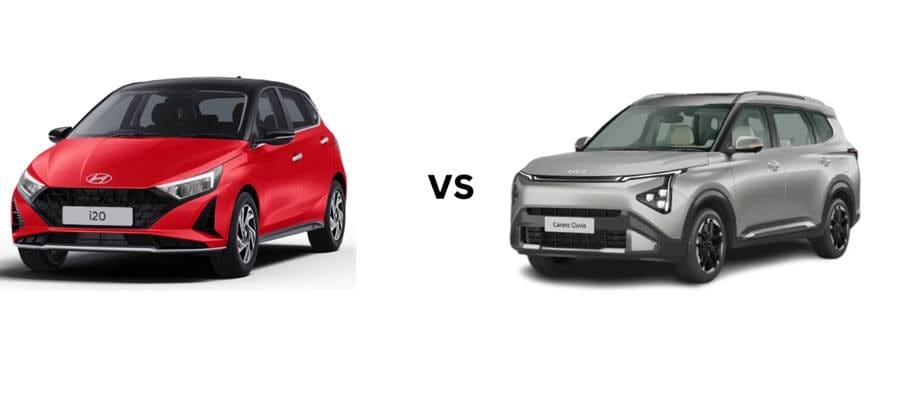
Daily Driving: Simplicity and Consistency
The Hyundai i20 is built with daily usage in mind. Its compact size and balanced performance make it ideal for routine commuting.
With a length of 3,995 mm and a 2,580 mm wheelbase, the i20 is well-suited for navigating urban environments. This translates into:
● Easier manoeuvrability in traffic
● Reduced effort in parking
● Greater control in tight spaces
Its 1.2L petrol engine, delivering up to 88 PS, ensures smooth, predictable performance for everyday driving.
For users who primarily drive in the city, these characteristics provide a consistent, hassle-free experience.
DEEPER DIVE: Read all the Ranking Arizona Top 10 lists here
INDUSTRY INSIGHTS: Want more news like this? Get our free newsletter here
Comfort for Routine Use
The i20’s interior is designed to support daily comfort. It offers:
● Driver-focused cabin layout
● Digital cluster and infotainment system for easy access to information
● Rear AC vents and ergonomic seating
These features enhance convenience during short and medium-distance drives.
Additionally, connected features, such as Bluelink technology with over 60 functions, keep users connected throughout their daily routine.
Multi-Purpose Usage: Flexibility and Adaptability
In contrast, the Kia Carens Clavis is designed to handle a variety of use cases. It is not limited to daily commuting but also extends to family travel, long journeys, and group transportation.
Its larger dimensions—4,550 mm in length and 2,780 mm wheelbase—combined with 6- and 7-seater configurations, make it inherently more versatile.
This allows it to:
● Carry more passengers comfortably
● Accommodate larger amounts of luggage
● Adapt to different travel scenarios
The Carens Clavis is therefore positioned as a vehicle that can serve multiple roles.
Interior Flexibility and Space Management
One of the defining features of multi-purpose vehicles is interior flexibility. The Carens Clavis offers:
● Three-row seating with split, sliding, and reclining functions
● One-touch tumble seats for easy access to the third row
● Flexible configurations for passengers and cargo
These features enable users to adjust the cabin based on their needs, whether for daily use or extended trips.
The i20, while comfortable, does not offer this level of adaptability. Its design is focused on optimising space within a compact footprint rather than maximising versatility.
Performance: Predictable vs Adaptive
The i20’s performance is tuned for predictability. Its petrol engine and transmission options ensure:
● Smooth acceleration
● Efficient fuel consumption
● Minimal complexity in operation
This makes it ideal for consistent daily driving patterns.
The Carens Clavis, however, offers multiple powertrain options, including turbocharged petrol and diesel engines with higher torque outputs.
This allows it to adapt to:
● Highway driving
● Heavier passenger loads
● Varied terrain conditions
Its performance is therefore more adaptable to different usage scenarios.
Technology: Daily Convenience vs Expanded Capability
Technology in both vehicles reflects their intended roles.
The i20 includes:
● 10.25-inch touchscreen infotainment system
● Wireless connectivity and voice recognition
● Connected car features for daily convenience
These features simplify routine usage.
The Carens Clavis offers a broader range of systems:
● Dual panoramic displays and advanced infotainment
● Level 2 ADAS with multiple assistance features
● 360-degree camera and enhanced connectivity
These technologies support its multi-purpose functionality.
Safety: Essential vs Comprehensive
Safety is a shared priority, but the scope differs.
The i20 provides 6 airbags, ESC, VSM, and other essential safety systems, ensuring reliable protection for daily driving.
The Carens Clavis extends this with:
● ADAS Level 2 features
● Advanced collision avoidance systems
● All-wheel disc brakes
These features enhance safety across a wider range of driving conditions.
Buyer Perspective: Routine vs Versatility
The choice between these two vehicles reflects how they are used:
● Buyers choosing the Hyundai i20 prioritise routine efficiency, ease of use, and compact design
● Buyers choosing the Kia Carens Clavis prioritise versatility, space, and adaptability for multiple needs
This distinction is central to modern car buying decisions.
The Role of Digital Platforms
Online car-buying platforms such as ACKO Drive allow users to evaluate vehicles based on usage patterns before making a purchase decision. By comparing features such as seating capacity, dimensions, and technology, buyers can determine whether they need a daily commuter or a multi-purpose vehicle.
This approach ensures that the decision aligns with real-world requirements.
Conclusion
The Hyundai i20 and Kia Carens Clavis represent two different approaches to mobility—daily driving and multi-purpose usage. While the i20 excels at providing a simple, efficient commuting experience, the Carens Clavis offers greater flexibility and adaptability for a wider range of scenarios.
As the automotive market continues to evolve, such distinctions are becoming increasingly important, helping buyers choose vehicles that truly fit their lifestyle.