Achieving the perfect golden-brown crunch on a piece of fried chicken is less about intuition and more about the laws of physics. In the culinary world, temperature is the ultimate variable. While most home cooks use a thermometer to check the internal doneness of a roast, a common question arises when the skillet comes out: Can you use a meat thermometer for oil?
Understanding the relationship between heat, oil stability, and food texture is essential for any cook. This article explores the science of oil temperatures and evaluates whether your standard kitchen tools are up to the task of monitoring high-heat frying.
Part 1. What is the Proper Oil Temperature for Cooking?
Cooking with oil requires careful consideration of temperature. If the oil is cold, food will absorb more fat, resulting in a greasier, heavier end product. However, if the oil is too hot, the food can burn on the outside and remain raw on the inside. Additionally, the oil may reach its smoke point, producing toxic compounds.
The Science Behind the Sound
When food hits hot oil, surface moisture vaporizes, instantly creating a barrier with steam. This prevents the oil from soaking in. However, this relies on precise temperature ranges:
- Sautéing and Pan-Frying: Generally requires 325°F to 350°F. This is hot enough to brown food via the Maillard reaction without scorching the fat.
- Deep Frying: The ideal range for most foods is 350°F to 375°F. At this level, the exterior dehydrates into a crisp crust while the interior steams.
- Stir-Frying and Searing: These high-heat methods often exceed 400°F.
A thermometer must be used with frying oil, since oil doesn’t give visual indicators like boiling water. Water boils at 212 degrees Fahrenheit. Oil continues to heat and can reach a point where it ignites on its own. For safety and consistency, a dedicated oil thermometer is the only way.
Part 2. Can You Use a Meat Thermometer for Oil?
The short answer is yes, but it depends entirely on the device’s technology. Different cooking methods require vastly different temperatures, and your equipment must be able to keep up.
Compatibility and Temperature Range
Many home cooks ask, “Can I use a meat thermometer for oil?” The answer depends on the thermometer’s upper limit. Traditional analog dial thermometers designed for meat often max out at 200°F or 220°F—the temperature of a well-done brisket. If you use one of these for frying, you risk breaking the gauge or receiving a dangerously inaccurate reading.
However, the modern kitchen has shifted toward digital technology. A high-quality food thermometer for oil needs to be versatile. Many digital instant-read meat thermometers are now designed with wide temperature spans, often ranging from -40°F to over 572°F. This makes them remarkably effective for both checking a steak and monitoring a pot of bubbling peanut oil.
The Advantage of Digital Instant-Read Models
The moment food is added during deep frying, the oil’s temperature drops. To maintain the ‘sweet spot,’ you need real-time feedback. This is where a digital cooking thermometer for oil is absolutely necessary. In contrast to ‘leave-in’ thermometers that clip to a pot, a digital probe is designed to measure temperatures at different locations in the pan. If you have wondered, “Can a meat thermometer be used for oil?” look for professional-grade digital models that offer the speed and heat resistance required for thermometer for oil frying tasks.
A Reliable Standard: The ChefsTemp Finaltouch X10
For those seeking the best oil thermometer for deep frying that also serves as a primary meat tool, the ChefsTemp Finaltouch X10 Professional Instant Read Thermometer is a prime example of versatility.
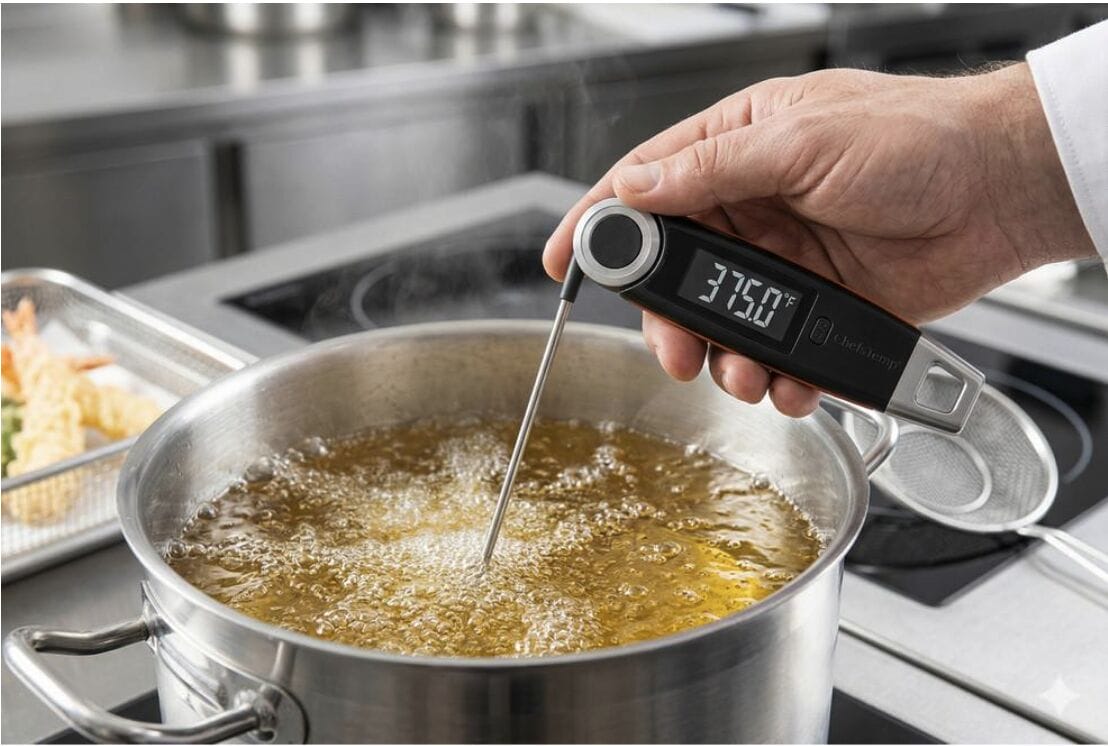
The Finaltouch X10 is engineered for extremes. It features ultra-fast 1-second reading time, vital for instantly adjusting burner heat to prevent overheating. With high accuracy and a range extending to 572°F, it comfortably qualifies as a top-tier thermometer for frying oil. Its 270-degree rotating probe lets you check temperatures from a distance, keeping your hands out of splashing heat. Simply dip the tip into the center of the oil, and the backlit display provides the precision necessary for perfect results.
Conclusion
Precision is a hallmark of any great cook. Knowing how to gauge heat can mean the difference between a soggy meal and a dish that is crisp and of professional quality. So, can you use a meat thermometer for oil? If it is a modern digital instant-read model with a wide temperature range, then the answer is yes. Investing in a high-quality food thermometer for oil ensures that, whether you are searing a steak or frying churros, you have the data you need for culinary success.