
For Arizona homeowners, a private swimming pool is a non-negotiable refuge from triple-digit heat. However, it is also a significant source of operational waste. As the state navigates persistent water shortages and escalating peak-hour energy costs, the traditional model of desert pool ownership is facing a necessary reckoning. From Scottsdale to Tucson, the question is no longer just how to maintain a pool, but how to do so without becoming a liability to Arizona’s finite resources.
The primary culprit of waste is rarely the water itself, but the legacy systems used to manage it. Most pools in the Southwest still rely on high-voltage primary pumps to drive analog cleaning equipment. These systems are notoriously inefficient, acting as a massive drain on both the electrical grid and the local water supply. A standard 1.5HP pump running 10 hours a day can quietly consume over 600 kWh per month during the peak of summer, turning a backyard amenity into a primary driver of high utility bills. Transitioning to a sustainable desert lifestyle requires moving away from these brute-force methods toward intelligent, independent maintenance.
Energy Efficient Pool Maintenance in Arizona’s Desert Climate
Sustainability in the desert is often measured by the “water-energy nexus.” It takes a staggering amount of energy to treat and move water, and in Arizona, the pool pump is frequently the second-largest consumer of domestic electricity, surpassed only by the air conditioning system. Traditional suction-side cleaners require the primary pump to run at maximum capacity for eight to twelve hours a day just to achieve basic clarity. This is a massive expenditure of energy for a task that could be handled with much higher precision.
The water waste associated with legacy systems is even more jarring. Inefficient filtration forces homeowners into frequent “backwashing”—the process of reversing water flow to rinse the filter. A single unnecessary backwash cycle in the heat of July can waste more water than an average Arizona household uses in three days. In a state where every gallon is scrutinized, this legacy maintenance model is increasingly indefensible. The path forward involves severing the link between the pool’s primary plumbing and its cleaning routine.
Water Saving Pool Maintenance Solutions for Arizona Homeowners
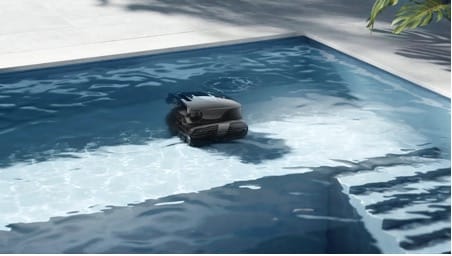
The most effective way to eliminate this waste is to shift the cleaning workload to an independent, battery-powered robotic pool vacuum. Unlike traditional equipment that draws suction from the home’s main pump, a robotic unit is a self-contained ecosystem. It carries its own high-efficiency DC motors and an internal filtration canister, allowing the primary pump to be dialed back to its minimum filtration schedule.
By operating as an independent node, a robotic pool vacuum drastically reduces the energy footprint of the backyard. Instead of running a high-voltage system for half a day, the robot executes a precision cleaning cycle using only a fraction of the electricity. Because these units capture debris in their own ultra-fine filters rather than sending it to the main pool filter, they can reduce the need for backwashing by up to 30%. This decentralization is the single most impactful change a resident can make to protect both their utility bill and the local aquifer.
Addressing the Calcium Challenge in Arid Environments
Arizona’s water is notoriously “hard,” leading to a persistent challenge for pool owners: calcium scaling at the waterline. As water evaporates in the dry heat, it leaves behind mineral deposits that etch into the tile and plaster. If left unmanaged, this buildup eventually requires professional acid washing or a complete “drain and refill”—an event that can waste upwards of 20,000 gallons of treated water.
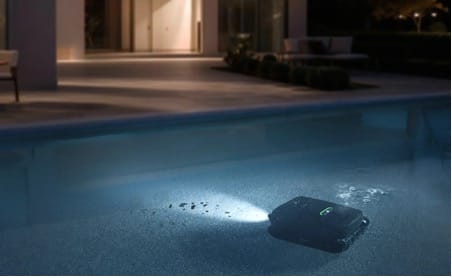
High-performance robotic systems now address this through advanced surface-mapping and active scrubbing. Systems such as the Beatbot AquaSense X demonstrate how ultrasonic sonar can be used to map a pool’s topography, ensuring no energy is wasted on redundant paths. More importantly, its specialized waterline scrubbing mode removes mineral film and biofilm before they can calcify. By maintaining the waterline daily, the Beatbot AquaSense X helps extend the life of the pool’s interior finish and prevents the catastrophic water loss associated with a full drain-and-restart cycle.
LEARN MORE: The 15 best public and private high schools in Metro Phoenix
FOOD NEWS: 25 places for great patio dining in Arizona
Preserving Chemical Viability and Reducing Evaporative Loss
The sustainability of a desert pool is also determined by how long the water remains “viable.” Traditional cleaners often leave “dead zones” where circulation is poor, leading to algae blooms that require aggressive chemical treatments. Excessive chemicals eventually lead to “chemical lock,” where the water becomes so saturated with additives that it must be replaced.
Intelligent robotics solve this by ensuring 100% floor and wall coverage, providing constant micro-circulation that helps distribute heat and chemicals evenly. This reduces the total volume of chlorine and acid required throughout the season. Furthermore, because these cordless robots operate seamlessly beneath pool covers, they allow homeowners to keep covers on during peak evaporation hours. A pool cover is the best defense against the Arizona sun, and an autonomous robot ensures that the water stays clean while the cover stays shut, saving thousands of gallons of water annually.
The Arithmetic of Sustainable Desert Living
As Arizona continues to grow, the pressure on the state’s utility infrastructure will only intensify. We are moving away from an era of “set it and forget it” analog waste toward an era of data-driven, autonomous resource management. The “smart home” must now extend past the sliding glass door and into the water to ensure long-term residency in the Sun Corridor remains viable.
In Arizona, sustainability is not ideological. It is arithmetic. Every avoided backwash, every reduced pump hour, and every gallon not evaporated under a pool cover compounds over time to create a significant impact on both personal finances and regional resources. The future of desert living will not be defined by larger pools, but by smarter ones that operate independently, silently, and predictably.