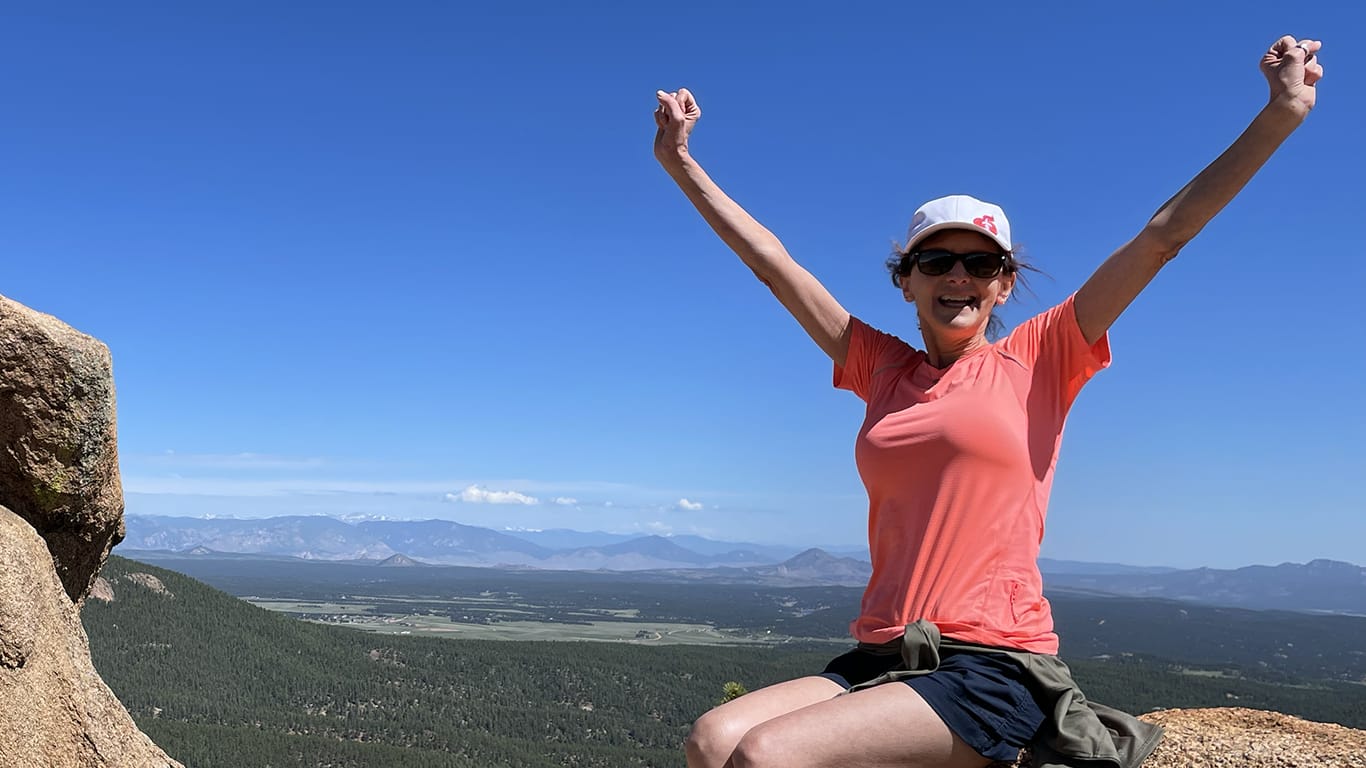
North Valley resident Laura Gober has been through stage‑four lymphoma, a stroke and a heart transplant.
But “resilient” is an understatement.
Less than a year after she finished therapy for her stroke and transplant, she hiked the12,000‑foot Crags Trail in Colorado Springs, Colorado.
“I cried at the top,” she said. “A man asked, ‘Are you OK?’ And I said, ‘Let me breathe and cry, and I’ll tell you in a minute.’”
She has a story to tell — for World Heart Day on Sept. 29.
DEEPER DIVE: Here are Arizona’s Most Admired Companies of 2026
Something is wrong
In the fall of 2022, Gober noticed the first signs that something was wrong.
“I was on a 5‑mile run,” she said. “I like to run. I’m very active. But I was short of breath more than usual. I had to keep stopping, and that was unusual.”
At first, the NICU nurse chalked it up to exhaustion, given the long hours she worked during the COVID-19 pandemic. But the symptoms kept piling up — a cough when she lay down, increasing fatigue and a heaviness she couldn’t ignore. When her husband noticed, her mind went straight to 2009, when she was diagnosed with stage-four lymphoma.
“When the cough came back, I thought the tumors were back,” she explained. A pulmonologist ruled out cancer and diagnosed Valley Fever, but also noted her heart looked enlarged and fluid surrounded it and her lungs.
In December 2022, her cardiologist said her heart was pumping at just 15% capacity. “One echocardiogram later, he tells me I’m in congestive heart failure,” Gober said. “I was like, how could that be? I was still functioning.” An inflammatory disease process had attacked her heart, taking her from a healthy, functioning organ to a failing one in three months.
By January, her cardiologist laid out three options — do nothing, get an LVAD (left ventricular assist device), or pursue a heart transplant. For Gober, the choice was immediate. “Doing nothing wasn’t even an option.”
She began pre‑transplant testing at Mayo Clinic, but her condition deteriorated quickly. “I couldn’t breathe. I couldn’t lay down, so I wasn’t sleeping. I wasn’t eating. I wasn’t working at all,” she said. On Feb. 21, she told her husband, John, “It’s time to go to the ER.”
Mayo placed her on a balloon pump, forcing her to lie flat for two weeks. When doctors switched her to an Impella heart pump, she woke from surgery unable to move her leg or arm.
“The nurse in me went off. I thought I was screaming, ‘I’m having a stroke.’” It was a full right‑sided stroke — a blow she says hit harder than the transplant.
Still, she pressed forward.
“I had no other choice,” she said.
She waited, prayed and wrestled with the emotional weight of what a transplant meant.
“It was hard because I knew somebody had to pass away for me to live. I just prayed that I was found a match by somebody who had registered to be an organ donor.”
On March 23, 2023, the call came.
“It was the first time I felt the strength come back into my body,” she said. “It’s amazing when you have blood actually flowing through your body the way it should.”
Recovery was long and grueling. She relearned how to swallow, went home with a gastric tube, and used a walker. She spent eight months in occupational, physical, speech and cardiac rehab.
“I’m so active and independent,” she said. “I didn’t want to be dependent on my husband. I even told him, ‘You didn’t sign up for this.’” John didn’t budge. “He said, ‘Stop,’” she recalled, laughing. “He’s amazing.”
By November, she returned to work. By spring, she returned to the mountains.
Gobert hasn’t connected with her donor’s family, but she speaks to him or her often — especially on that hike.
“I got to the top of that mountain and I said, ‘Thank you. We’re here,” she said. “I say ‘we’ a lot. How we are doing great. It’s all thanks to my donor.”
In March 2024, she walked the Heart Walk on the one‑year anniversary of her transplant, wearing both a red hat and a white hat — one for her heart transplant, one for her stroke. “I have my two hats,” she said. “And I do it every year.”
Her coworkers tell her she inspires them. She shrugs. “I don’t think I did anything special,” she said. “I’m just a very positive person. When there’s a problem, I take care of it.”
But she acknowledged the journey changed her. “I’ve always been the caregiver,” she said. “That was the hardest part of the stroke. It was very humbling.”
Today, she hikes, works, and lives with gratitude for the person who made her second chance possible. “I do believe that when you are an organ donor, you live on,” she said. “He, she — my donor — is helping me live on.”
Arizonans can join the Arizona Donor Registry as organ and tissue donors when they apply for or renew a driver’s license or state ID at an ADOT MVD or select an authorized third-party office. They can also register online anytime at dnaz.org/register.