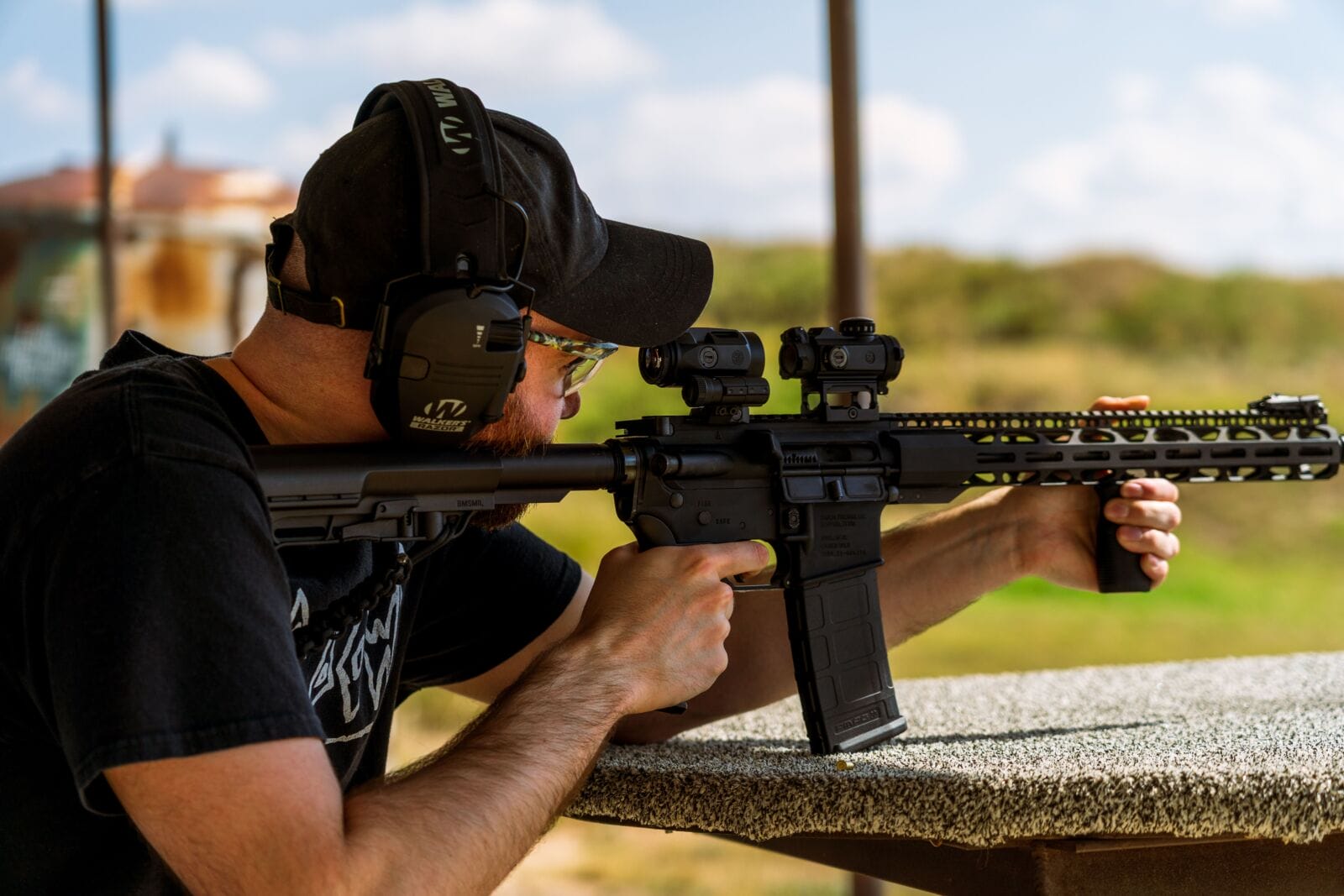
Look up 5.56 velocity for a 16-inch barrel, and you’ll probably find several different answers. Some numbers come straight from ammunition manufacturers. Others come from people who’ve actually measured their rifles with a chronograph. Even then, the results don’t always agree.
So what happens when you add a few inches to a barrel? Is the extra speed noticeable, or is it something that looks more impressive on paper than it does at the range?
How Barrel Length Affects Muzzle Velocity
Muzzle velocity is simply how fast a bullet is moving when it leaves the barrel. You’ll usually see it measured in feet per second (fps).
When a cartridge fires, expanding gases push the bullet forward. A longer barrel gives those gases more distance to accelerate it. That’s why a 20-inch barrel will generally produce higher velocity than a 16-inch barrel firing comparable ammunition.
But the increase isn’t as predictable as you might expect. You can’t take a velocity reading from a 16-inch barrel, add a fixed number for every extra inch, and expect an accurate result.
5.56 Velocity by Barrel Length Chart
One published experiment tested Federal XM193 55-grain ammunition at several barrel lengths. Five shots were recorded at each length, using the same barrel throughout the experiment.
Here are some of the recorded averages:
| Barrel length | Average velocity |
| 10 inches | 2,767 fps |
| 14 inches | 3,039 fps |
| 16.5 inches | 3,187 fps |
| 18 inches | 3,202 fps |
| 20 inches | 3,306 fps |
Take a look at the middle of the table. Going from 16.5 to 18 inches added just 15 fps. The next two inches, however, brought another 104 fps.
The measurements came from five-shot averages, and the shorter and longer lengths were tested in separate sessions. The experiment also used a .223 Remington-chambered bolt-action platform, not a standard AR-15.
So these aren’t speeds you should expect every 5.56 rifle to produce.
16 vs 18 Inch Barrel: 5.56 Test Results
Another chronograph comparison published in 2026 tested several rifles with 55-grain FMJ ammunition. Four 16-inch rifles recorded average velocities between 3,140 and 3,175 fps. An 18-inch rifle reached 3,280 fps.
The catch? Those readings came from different rifles. You can’t credit the entire difference to the extra barrel length.
Even barrels of identical length can produce different results. It’s something to keep in mind when comparing 5.56 barrel length velocity figures online.
What Effective Range Really Means
Effective range is the distance at which a shooter can consistently achieve a particular result with a given rifle, ammunition, and set of conditions.
Imagine two people at the range. One is trying to put shots into a small group on paper. The other is happy as long as the rounds hit a large steel plate. They’re using the same distance, but they have very different ideas of what counts as a good result.
A faster bullet generally follows a flatter trajectory when other factors are equal. At longer distances, that difference can matter. But an extra 100 fps doesn’t magically add a certain number of yards to a rifle’s useful range.
Someone struggling to hold a consistent group probably won’t notice much benefit from a modest velocity increase. The optic, target size, ammunition, and weather may have a bigger influence on that day’s shooting.
Wind is a good example. You might spend time comparing velocity charts, only to get to the range and find that the conditions make your usual shooting much harder.
The chronograph can tell you how fast the bullet left the barrel. It can’t tell you how well you’ll shoot.
Other Factors Worth Considering
Think about weight first. A longer barrel can put more weight toward the front of the rifle, although its profile makes a difference too. Two barrels of the same length won’t necessarily feel alike.
When comparing 5.56 barrels, it’s worth looking at weight, chamber markings, and the other listed specifications rather than judging everything by length.
Ammunition choice matters as well. Gas-system configuration is another part of the overall rifle, although it isn’t something you can determine from barrel length alone.
Choosing a Barrel Length for Your Use
For ordinary range trips, a 16-inch barrel makes sense for many owners.
Shorter configurations have their own appeal, particularly when overall length and handling are priorities. There’s a velocity trade-off, though, along with legal requirements that deserve attention before making a purchase.
What about 18 or 20 inches?
If you regularly shoot paper targets at longer distances, the additional velocity may be worth considering. Just remember that a longer barrel can also mean a heavier, less compact rifle.
Before purchasing, check the manufacturer’s chambering and ammunition guidance. Firearm regulations, including barrel-length restrictions, vary by jurisdiction.
Final Takeaway
A longer 5.56 barrel usually means more muzzle velocity.
If you’re comparing barrels, use those numbers as a reference, not a promise. Think about where you shoot, what ammunition you use, and how the rifle feels in your hands.
FAQ
How Much Velocity Do You Lose With a Shorter 5.56 Barrel?
It depends on the lengths being compared and the ammunition used. In the published XM193 test, dropping from 20 to 16.5 inches meant a difference of 119 fps. That doesn’t establish a standard loss for every rifle.
Is a 16-Inch Barrel Enough for General Use?
For recreational range shooting, a 16-inch barrel is a common and practical choice.
Does Barrel Length Change Effective Range?
It can affect the bullet’s trajectory by changing muzzle velocity. But the target, ammunition, shooting conditions, and the shooter’s consistency also influence what range is practical.
Does a Longer Barrel Make a Rifle More Accurate?
Not by itself. Higher velocity doesn’t guarantee tighter groups. The barrel’s quality, ammunition, and other variables can influence accuracy regardless of length.