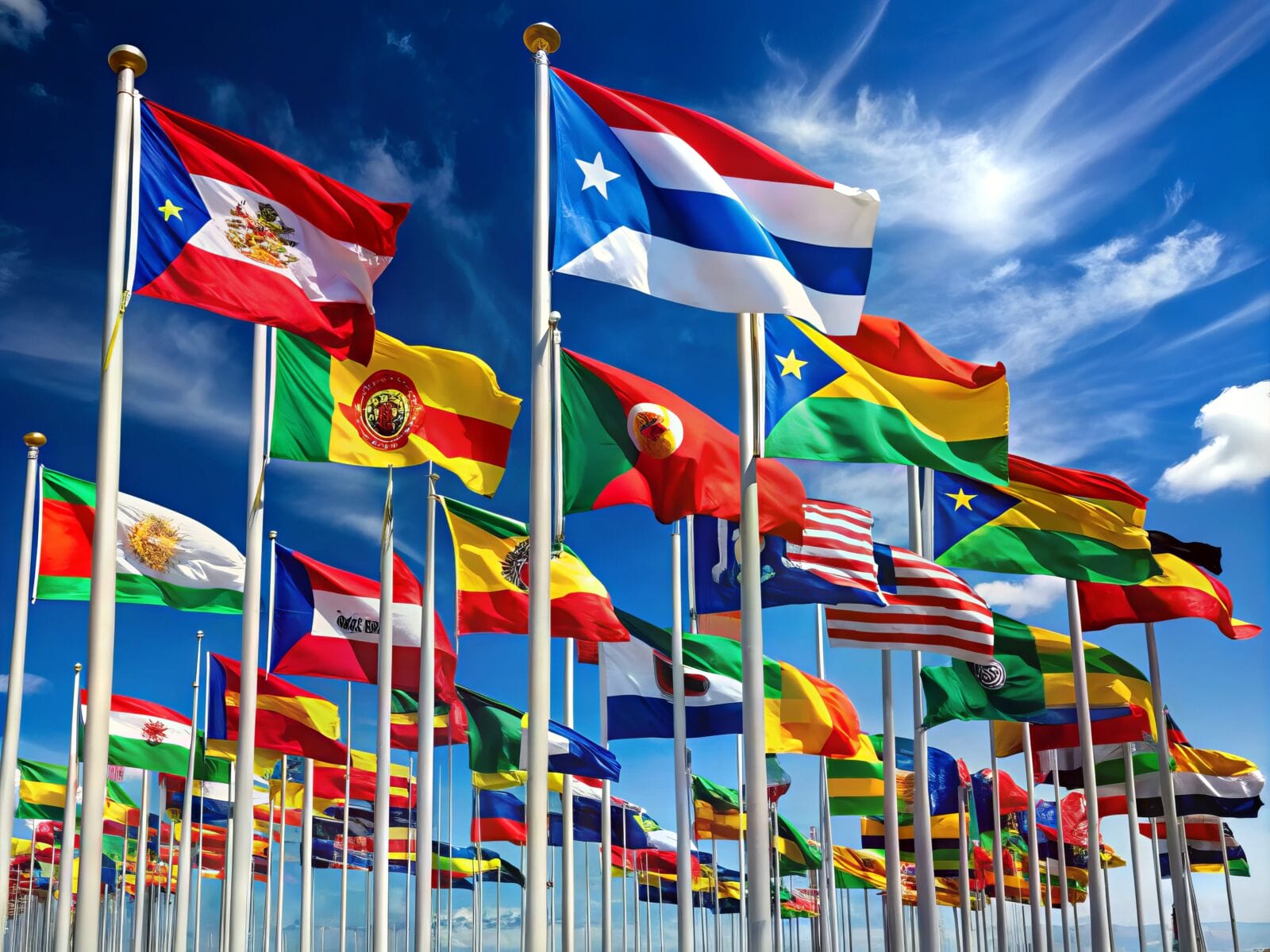
National flags function as more than territorial markers. They encode history, distill cultural values, and signal identity to the world. For travelers deciding where to go next, a flag can be the first visual encounter with a nation’s story—a compressed symbol that hints at what lies beyond the airport gate. In Latin America, flags carry particular weight. Their bold geometries and saturated palettes reflect centuries of indigenous heritage, colonial struggle, and hard-won sovereignty.
From the sun-emblazoned banner of Argentina to the eagle-and-serpent iconography of Mexico, these designs do more than represent countries—they invite inquiry. What do the colors mean? Why that star configuration? What historical moment does this emblem commemorate? For tourism boards and cultural institutions across the region, flags have become strategic assets, visual shorthand for the diversity and depth that define Latin America. This article examines how these symbols evolved, what they communicate, and why they matter to both national identity and global perception.
How Latin American Flags Evolved From Colonial Standards to Symbols of Sovereignty
The flags flown across Latin America today bear little resemblance to the banners that once marked colonial rule. During the Spanish and Portuguese empires, regional flags were extensions of European heraldry—royal crests and Catholic symbols imposed from across the Atlantic. But as independence movements swept the continent in the early 19th century, newly sovereign nations began crafting visual identities that reflected their own narratives.
Brazil’s flag, adopted in 1889, features a green field symbolizing the country’s forests, a yellow diamond representing mineral wealth, and a blue celestial sphere mapped with stars corresponding to Brazilian states. Chile’s flag, designed in 1817, borrows the tricolor structure familiar to European republics but reinterprets it: white for the Andes snowpack, blue for the Pacific, red for the blood of independence fighters. These weren’t arbitrary aesthetic choices. They were deliberate acts of self-definition by nations asserting their place in a post-colonial order.
The transition from colonial to national flags often involved integrating indigenous symbols alongside European design conventions—a visual negotiation of identity that continues to resonate today.
Decoding the Symbols and Colors That Define Latin American Flags
Every element on a Latin American flag carries meaning. Understanding these visual codes offers insight into how nations see themselves and what they want the world to know.
Common symbols include:
- Stars: Representing states, provinces, or guiding principles. Brazil’s flag displays 27 stars for its states and Federal District, arranged as they appeared in the Rio de Janeiro sky on the morning the republic was proclaimed.
- Suns: Emblems of enlightenment and freedom. Argentina’s Sol de Mayo commemorates the May Revolution of 1810, when the country began its push for independence.
- Coats of arms: Condensed national histories. Mexico’s flag centers on an Aztec legend—an eagle perched on a cactus, devouring a serpent—marking the site where Tenochtitlan was founded.
- Weapons and tools: Symbols of struggle and labor. Bolivia’s coat of arms includes a condor, an alpaca, and a sheaf of wheat, representing the country’s natural resources and agricultural heritage.
Color symbolism is equally deliberate:
- Red: Courage, sacrifice, and the cost of independence. It appears on nearly every flag in the region.
- Blue: The sky, rivers, and oceans that define geography. In some contexts, it also signifies liberty.
- Green: Fertility, hope, and the continent’s vast forests and farmland.
- Yellow or gold: Mineral wealth, sunlight, and prosperity—a nod to the resources that have shaped regional economies for centuries.
Why Flags Matter to Latin American Tourism
Tourism boards understand that flags function as brand assets. They appear on promotional materials, festival banners, and airport signage—visual anchors that help travelers orient themselves culturally before they’ve unpacked. But the relationship between flags and tourism runs deeper than marketing.
Flags shape tourism in several ways:
- National celebrations: Events like Mexico’s Día de la Independencia or Brazil’s Carnival transform flags into participatory symbols. Visitors don’t just observe—they’re invited to wave miniature versions, wear flag-colored clothing, and join in collective displays of national pride.
- Cultural authenticity: In an era when travelers increasingly seek “authentic” experiences, flags signal that a destination takes its heritage seriously. They’re visual proof that a place has a story worth telling.
- Iconic imagery: A well-designed flag becomes inseparable from a country’s tourism identity. The Argentine flag’s sun, the Colombian tricolor, the Peruvian red-and-white—these images circulate on social media, postcards, and travel blogs, reinforcing destination recognition.
Countries like Argentina and Chile have leveraged their flags in international campaigns, using them as visual shorthand for broader cultural narratives. When a flag is distinctive and symbolically rich, it does double duty: representing the nation and inviting curiosity about what that representation means.
For travelers planning visits or seeking to understand the region’s visual culture, resources like Flags Importer’s high-quality reproductions of Latin American flags offer a tangible way to engage with these symbols beyond the screen. Similar options can be found through World Flags Direct and Anley, each offering their own take on accuracy and material quality.
Flags as Unifying Symbols in a Diverse Region
Latin America is not monolithic. It spans dozens of countries, hundreds of indigenous languages, and vastly different political and economic realities. Yet flags provide a rare point of unity—symbols that transcend internal divisions and rally populations around shared identity.
This unifying function is most visible during:
- International sports competitions: World Cup matches, Copa América tournaments, and Olympic events turn flags into rallying points. Stadiums fill with coordinated displays—thousands of fans waving national colors in unison, creating a visual spectacle that reinforces collective identity.
- Diplomatic and cultural exchanges: When Latin American nations participate in global forums, their flags represent not just governments but entire populations. At the United Nations, the Organization of American States, or international summits, these symbols assert presence and voice.
- Diaspora communities: For millions of Latin Americans living abroad, flags maintain connection to homelands. They appear at cultural festivals, community centers, and family gatherings—portable symbols of belonging that transcend geography.
The Global Significance of Latin American Flags
Beyond their regional importance, Latin American flags contribute to global visual culture and international relations. They appear in contexts far removed from their home countries—on United Nations rosters, in international trade negotiations, and across digital platforms where national identity gets performed and contested.
Their global relevance stems from several factors:
- Cultural diplomacy: Flags serve as entry points for conversations about history, values, and priorities. When a Latin American nation hosts an international summit or cultural exhibition, its flag frames the encounter—signaling what the country stands for and how it wants to be understood.
- Tourism attraction: Distinctive flag designs pique curiosity. Travelers who encounter an unfamiliar flag may be prompted to research the country it represents, potentially adding a new destination to their itinerary.
- Symbolic capital: In a globalized world where nations compete for attention and influence, a memorable flag is an asset. It increases recognizability, aids in branding, and contributes to soft power.
What Latin American Flags Reveal About Identity and Aspiration
Latin American flags are more than decorative artifacts. They’re historical documents, cultural statements, and invitations to deeper understanding. Each design choice—every color, symbol, and configuration—reflects decisions made by people who believed a piece of cloth could represent something larger than itself.
Key takeaways include:
- Flags encode history: From independence struggles to indigenous heritage, these symbols compress centuries of experience into visual form. Understanding them requires engaging with the stories they tell.
- They drive cultural exchange: For global visitors, flags offer a starting point—a visual prompt that can lead to richer exploration of language, cuisine, art, and tradition.
- They unify and differentiate: Within Latin America, flags distinguish nations while also signaling shared values and historical experiences. They’re tools of both identity and solidarity.
- They matter economically: Tourism, diplomacy, and international trade all benefit from strong national branding. A well-designed, symbolically resonant flag contributes to that brand.
For those seeking to explore these symbols further—whether for educational purposes, cultural appreciation, or travel planning—engaging with the flags themselves, their histories, and the nations they represent offers a window into one of the world’s most culturally dynamic regions.