
Step into a car that has only ever been wiped with whatever spray was under the kitchen sink, and there is usually a smell sitting underneath the fragrance, something faintly plasticky or chemical that gets worse once the windows are up and the heater kicks on. That smell is not dirt. It is almost always residue, a thin film left behind by a cleaner that was never designed for the mix of materials inside a car.
Vancouver’s damp climate makes this worse than it would be in a drier city. Humidity gets trapped inside a closed cabin more easily, and any residue left on the dash, door cards, or seats has more time and moisture to interact with, which is often why a car that smelled fine in the store starts to smell stale within a few weeks of regular driving in the rain.
The Cause Most People Never Notice
Most interior sprays are built around one job, usually glass or plastic, and then marketed as safe for everything else. Ammonia cuts through window streaks fast, but on a touchscreen or tinted glass it is exactly what causes the slow clouding people notice months later. A silicone heavy dash spray looks glossy in the store but leaves a greasy layer that attracts dust within days and can make leather trim feel slick rather than clean.
- Ammonia based cleaners cause long term haze on screens and tinted windows
- Silicone heavy sprays leave a greasy residue that attracts dust fast
- Alcohol heavy formulas dry out vinyl and leatherette over repeated use
- Mismatched chemistry is the real cause of that lingering chemical smell
What a Properly Formulated Cleaner Changes
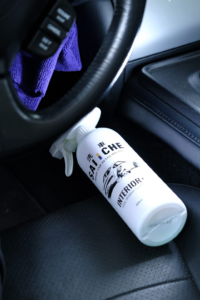
Interior+ was built around the idea that a modern cabin is not one material, it is five or six, touchscreens, soft touch plastic, leatherette, vinyl, rubber, and gloss trim, all sitting a few inches apart. A single pH balanced, non silicone formula cleans across all of them without leaving the residue that causes haze, greasy buildup, or that lingering chemical smell.
The difference shows up immediately in how a cabin feels rather than just how it looks. A dash wiped with the right formula feels dry and matte rather than slick. A touchscreen stays clear instead of hazing over the following weeks. And because nothing is left behind to slowly react with humidity, the cabin does not develop that faint stale smell that Vancouver’s damp climate tends to accelerate.
Why This Matters More on the West Coast
A car in a drier climate can get away with an imperfect interior cleaner for longer, since there is less moisture around to interact with any residue left behind. In Vancouver, where rain and humidity are part of most months of the year, that residue has far more opportunity to cause problems, whether that is haze building on a screen or a musty smell developing in fabric and trim that never fully dries out between drives.
Regular use of a properly balanced cleaner interrupts this pattern before it starts. Instead of fighting haze or smell after it has already set in, the cabin simply never accumulates the residue that causes either problem in the first place, which is a much easier position to maintain than trying to correct it later.
The Comparison That Actually Matters
Generic all purpose sprays are built to be cheap to produce and to look impressive in the store, heavy fragrance, glossy shine, immediate visual impact. None of that tells you what the formula is actually doing to the materials underneath. A cleaner built specifically for a mixed material cabin trades that immediate gloss for a result that holds up over months rather than days, dry to the touch, no artificial shine, and no greasy after feel that attracts more dust the next time the car is driven.
Building this into a routine rather than an occasional fix makes the biggest difference over time. A single wipe down after a particularly damp week will help, but drivers who make Interior+ part of a regular biweekly routine tend to notice the cabin never gets back to that stale, closed in smell in the first place. The surfaces stay dry, the humidity has nothing to cling to, and the whole cabin simply smells like a clean car rather than a car that was recently sprayed with something fragranced.
There is a simple way to tell the routine is working. Run a finger across the dash after a wipe down and it should feel dry, not slick or tacky. Check the touchscreen a week later under bright light and it should still be clear rather than showing the faint haze that builds with the wrong product. Those two small checks tell you more about whether a cabin is genuinely staying clean than how strong the fragrance is right after spraying.
LEARN MORE: Arizona earns 19 Michelin Guide selections in inaugural Southwest Guide
Frequently Asked Questions
Can Interior+ be used on a touchscreen safely?
Yes. It is formulated without ammonia, which is what typically causes long term haze on touchscreens and tinted glass, making it safe for regular use on infotainment displays.
Will Interior+ leave a greasy residue on the dash?
No. It is a non silicone formula designed to wipe dry without the greasy layer that silicone heavy sprays leave behind, which is what tends to attract dust quickly.
SAI CHE Detail Co. continues supporting best car detailing in Vancouver with formulas built for the region’s damp climate, and the company now confirms shipping to all ten Canadian provinces, with details on its Canada wide service page.
About SAI CHE Detail Co.
SAI CHE Detail Co. is a Canadian automotive detailing brand headquartered in Vancouver, British Columbia, specializing in premium car care products including Interior+, Leather+, All Clean, and a full range of exterior detailing formulas, proudly serving customers throughout British Columbia, Alberta, Ontario, and Quebec.
Business Name: SAI CHE Detail Co.
Address: 8188 Manitoba St Unit A115, Vancouver, BC V5X 0L5, Canada
Phone: 1 604-334-3228
Website: www.saichedetailco.com
Find us on Google: SAI CHE Detail Co. on Google
Instagram: @sai_che.detail.co
TikTok: @sai_che.detail.co
YouTube: SAI CHE Detail Co.
Amazon: Shop SAI CHE on Amazon Canada
LinkedIn: SAI CHE Detail Co.