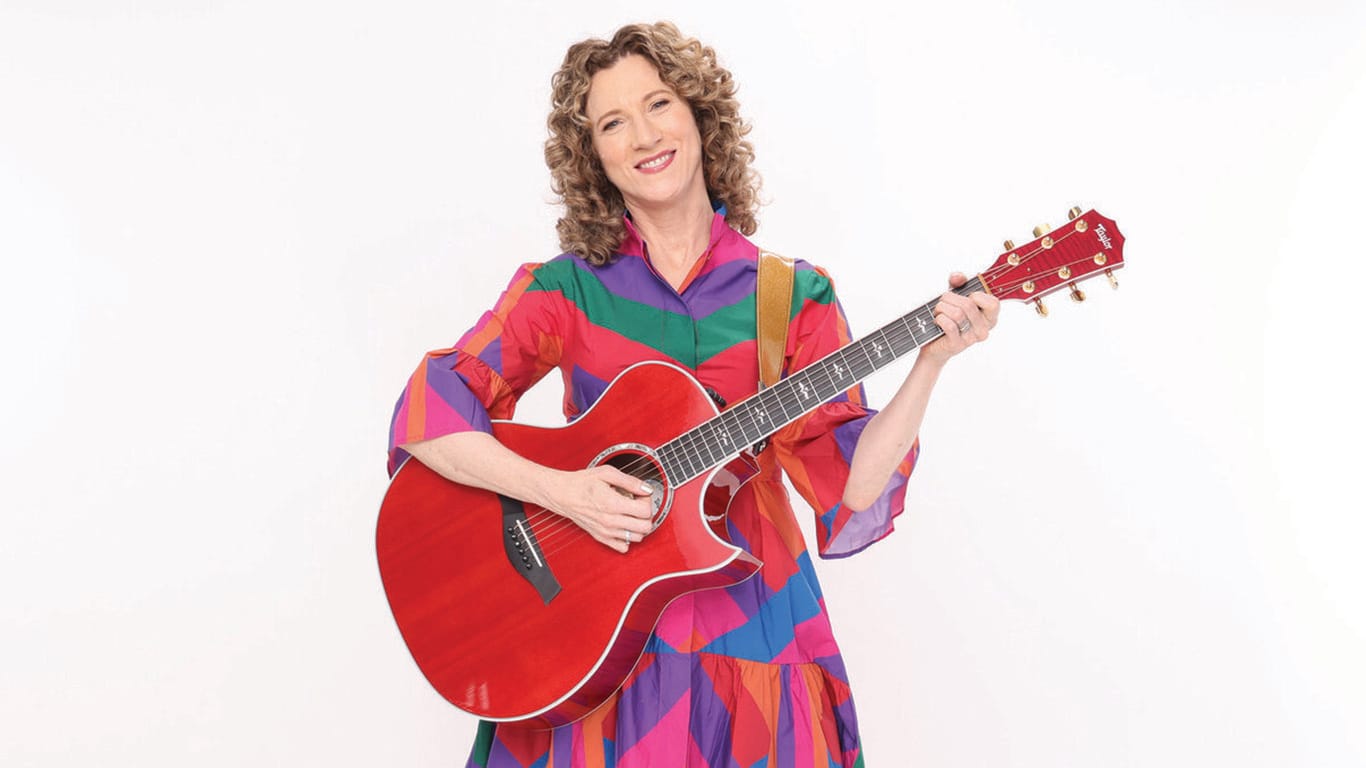
Laurie Berkner has spent nearly 30 years writing songs for children, who not only sing along but take ownership.
Even now, with millions of streams and a catalog spanning generations, her songwriting process remains the same. She imagines kids singing it.
“[I think] ‘Will that child want to sing these words or do these movements?’ ‘Will that child feel some sense of ownership over this song — like it belongs to them?’”
That instinct has shaped her career,
Berkner has two upcoming Arizona shows: Sunday, Nov. 8, at the Fox Tucson Theatre, and Saturday, May 15, at the Chandler Center for the Arts. Both shows start at 11 a.m.
At the shows, she will perform songs from her catalog as well as new albums. Berkner knows exactly which songs families expect — there’s no skipping them.
“There are at least 10 to 12 songs that I have to play in every set, or families will not feel like they got what they came for,” she said. “And I can’t play much more than 14 songs or the show starts to get too long.”
Berkner has garnered 18 bestselling albums, millions of streams, national TV appearances, picture books, Off‑Broadway musicals, and performances at Carnegie Hall, Lincoln Center and the White House. But in Arizona, the focus returns to the basics: kids, families, movement and joy.
MORE NEWS: Honeywell is building new $500 million manufacturing facility in Tempe
DEEPER DIVE: 10 Arizona restaurants make Yelp’s Top 100 Mexican food spots
Musical evolution
Early in her career, Berkner wrote songs inspired by her music classes. Over time, that focus widened.
“One big change is that I now think more about writing songs for classroom teachers to use than I used to,” she said. “When I started out, I wrote songs inspired by what I could use in my own music classes — as opposed to a traditional early childhood classroom.”
That math leaves little room for surprises — unless she gets creative. Her solution: medleys. “The way I have tried to manage this ‘problem’ is by playing a lot of medleys,” she said. “That way I can come closer to getting in at least a little of everyone’s favorites.”
Her shows will pull from nearly 30 years of music, including classics like “Victor Vito,” “Bumblebee (Buzz Buzz),” “Pig on Her Head,” “We are the Dinosaurs,” and “The Goldfish (Let’s Go Swimming).”
It also features newer favorites — “Superhero,” “Waiting for the Elevator,” “Chipmunk at the Gas Pump” — and songs from her latest album, “Walking with the Penguins.”
Movement is central to Berkner’s songwriting, and it’s equally central to her concerts. She designs participation into the music from the start.
“I think about how to engage kids with every song I write, and much of that involves adding movement,” she said.
That’s where dancer Michelle Esch comes in. Esch joins Berkner onstage, modeling choreography that Berkner can’t always execute while holding a guitar. (She will not be part of the Chandler show.)
“Having Michelle there really elevates the level of the shows and gives the kids someone to watch who they can imitate,” Berkner said. “Except maybe when she is leaping through the air.”
Puzzling thought
Berkner’s longevity even puzzles her. She suspects it has something to do with the shared experience of early childhood — the universal rhythms and images that feel instinctive across generations.
“I’m really not sure [about why her music resonates], but I am very grateful,” she said. “Maybe some of it is because many of us start out with a somewhat similar amount of experience and abilities early on in our development,” she said. “To me that means it’s more likely that certain movements (jumping / bouncing), rhythmic elements (contrasting slow and fast tempos), and images (dinosaurs) that I use in my songs will resonate across generations.”
That resonance is now literal. Berkner sees parents who grew up on her music returning with their children.
“It’s the most wonderful feeling to know that my music has stayed with them for so long and that they had such good memories of the songs that they want to share them with their children,” she said.
The critically acclaimed Berkner has drawn comparisons to Fred Rogers. She takes that responsibility seriously.
“I am trying my best to continue doing that in all that I do,” she said. “I’m always learning from them and hope that the music I put into the world and what I do in my concerts are positive for kids as well.”
Her approach is intentional; from the words she chooses to the way she interacts with kids onstage.
“I am very conscious of the words and the meanings of what I write and how I interact with children, on stage, off stage, and in every part of my life — we are all deserving of respect no matter what phase of life we’re in.”