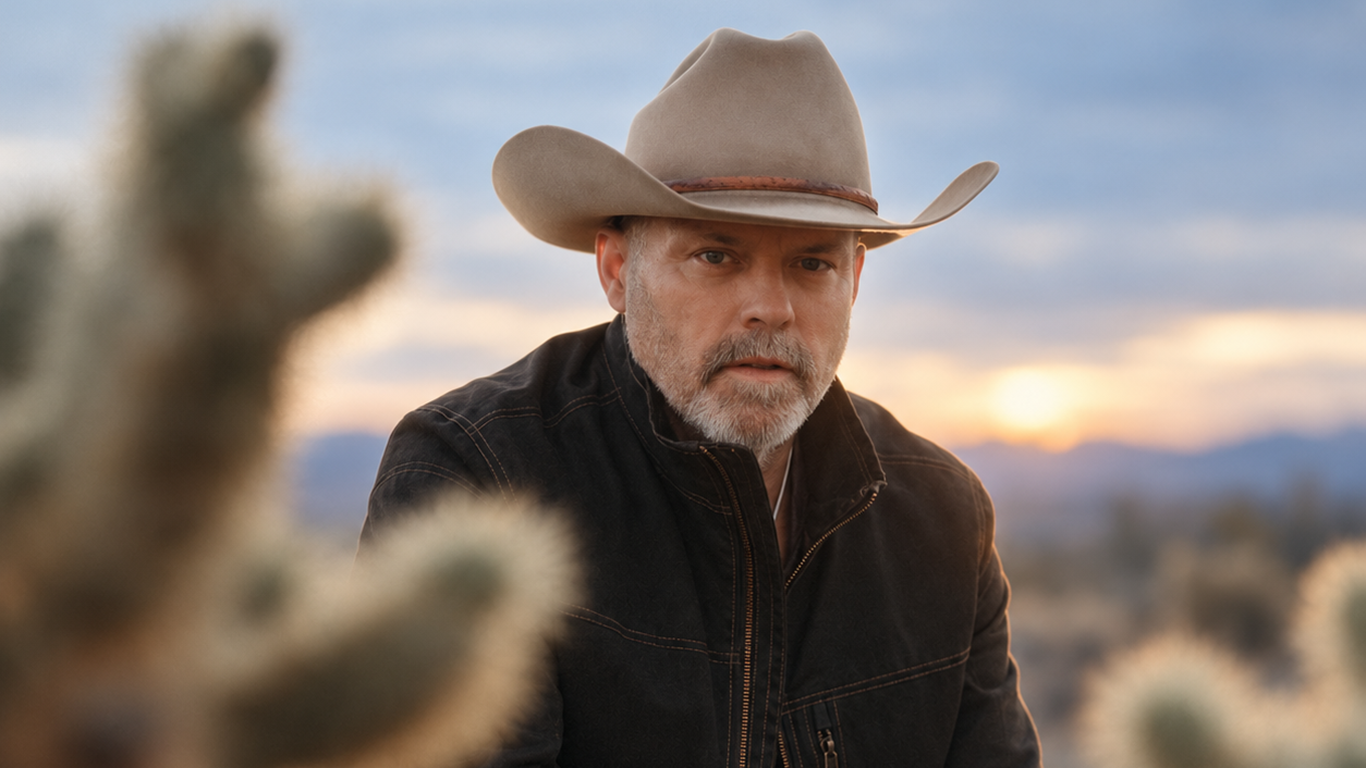
Southwestern artist and musician Ray Tigerman has always been interested in words, whether they’re on canvas, in lyrics or in books.
He’s banking on the written word with his debut fiction novel, “A Knight on Wolf Island” (Greenleaf Book Group), a supernatural survival horror story about how shipwrecked young blacksmith confronts an island’s ancient evil.
The story is the first book in “The Hollow Skin Chronicles” trilogy, a series exploring the boundaries between history, myth, humanity and the supernatural.
“A Knight on Wolf Island” follows Tayen, a young blacksmith who survives a shipwreck only to find himself stranded on an island harboring a sinister presence. Drawing on his late mother’s teachings and his Navajo ancestry, Tayen must confront a threat that tests more than his ability to survive it challenges his courage, identity, and resolve to return home.
Tigerman will celebrate the launch with a book signing and concert featuring Nashville recording artist Wade Hayes on Thursday, Oct. 22, at the Western Spirit Museum, 3830 N. Marshall Way, Scottsdale.
Doors open at 5 p.m. for the signing, followed by the concert from 6:30 to 9 p.m. Food and drinks will be served. Tickets are $15. The proceeds benefit the Western Spirit Museum. Tickets are available at https://www.raytigerman.com/store-MFHja.
“I used to write screenplays in the early 2000s, and nothing came to fruition,” Tigerman said. “I had a couple on hold, and then the financial crash happened, and I had to go back to my day job of creating art.”
He’s enthusiastic about the supernatural elements. However, the horror isn’t the point — the cultural grounding is.
“It’s rooted in Southwestern imagery and symbolism and storytelling,” he said. “Choosing a Native American protagonist was central to the story I wanted to tell.”
DEEPER DIVE: 10 Arizona restaurants make Yelp’s Top 100 Mexican food spots
That choice harkens back to where he grew up.
“We literally lived across the street from the Washoe Indian colony,” he said. “Even to this day, the majority of my friends were Native American, and I got an indoctrination into their culture, into their mysticism.”
He recalls riding bikes through the reservation, swimming in creeks and sharing stories.
“Those experiences stuck,” he said. “It’s one of the reasons why, if you’re familiar with my art, I’m obsessed with depicting Native Americans in a very particular way — very vibrant, very powerful, very bold.”
He parlays that into the novel. Tayen’s ancestry is a framework for how he understands danger, identity and survival.
“Tayen’s Navajo ancestry and his mother’s teachings help shape how he understands the danger around him,” Tigerman said. “It challenges his courage, identity, and resolve to return home.”
For Tigerman, writing the book is an extension of his art.
“As an artist, you kind of get a thick skin,” he said. “You get used to criticism, and through that criticism you hone your skill. With a novel, I’d always written, but I’d never shared my stories beyond friends.”
When the publisher sent the finished manuscript out for reviews, he braced himself.
“All of the reviews came back overwhelmingly positive,” he said. “My joke was, I guess someone else other than my wife likes my book.”
He’s proud of the result, but more relieved.
“Sometimes you listen to a story, and it just doesn’t quite get it right,” he said.
“I’d think, man, I’ve got better stories. I wonder if I could tell one of my stories in a way people would appreciate and resonate with, but still connected to who I am. I think I pulled it off on this novel. I’ve never want for a story. I’ve got so many stories stacked up in my head. I can’t get to them enough.”